

Most organizations do not intentionally create complex IT environments. Complexity builds gradually and often unnoticed, for example through a new system to support a project, an acquisition that brings in another system , or even a quick fix that becomes permanent.
Over time, the application landscape grows faster than governance can keep up. Teams rely on overlapping tools, legacy systems remain in place longer than planned, and decision-makers lose visibility into what is actually running in the organization.
Application rationalization is how companies regain control.
The entire approach emphasizes that we do not remove systems without any prior analysis. It is important to understand the application portfolio and to be able to identify redundancy and risk. Based on this, we can make informed decisions — specifically about what to keep, what to modernize, what to consolidate, or what to retire, or decommission.
If rationalization is carried out correctly and precisely, operational costs decrease, agility improves, and the foundation for digital transformation is established.
This guide outlines a practical, field-tested approach.
What Is Application Rationalization?
Application rationalization is the structured process by which an organization first evaluates its existing application portfolio and then decides on the future role.
Typical outcomes include:
- Retaining business-critical systems
- Consolidating duplicate functionality
- Replacing outdated platforms
- Retiring unused or redundant applications
- Modernizing systems that still provide value
The goal is to achieve clarity.
Organizations that consciously manage their application portfolio can:
- Reduce IT costs
- Improve security and compliance
- Accelerate modernization
- Simplify governance
- Support faster business decisions
Without rationalization, complexity continuously increases.
Why IT Complexity Becomes a Problem
In many enterprises, the application portfolio evolves organically rather than strategically.
Common drivers include:
- Mergers and acquisitions
Each acquisition introduces new systems, vendors, and integrations and often create overlap. - Shadow IT
Departments adopt tools independently to solve immediate problems. - Legacy system dependency
Older platforms remain in place because they still work—or because replacing them seems risky. - Technology sprawl
Cloud services make it easy to deploy new applications quickly leading to too much IT.
Individually, these decisions make sense, but combined they create fragmentation.
Typical symptoms include:
- Multiple systems performing the same function
- Unclear ownership of applications
- Lack of transparency in licensing costs
- Unsupported or end-of-life technologies
- Integration complexity
- Slow change delivery
At this point, rationalization becomes necessary.
When Should You Start Application Rationalization?
Many organizations wait too long.
They begin rationalization only after:
- Costs increase unexpectedly
- A security or compliance issue emerges
- A major transformation initiative starts
- A merger or divestiture occurs
In practice, the best time to start is as early as possible—when complexity is still manageable.
Typical triggers include:
- Rapid growth
- Digital transformation programs
- Cloud migration initiatives
- Technology modernization efforts
- Governance or compliance requirements
- Budget optimization projects
If leadership cannot answer basic questions about the application landscape, it is a sign that rationalization is already overdue.
For example:
- How many applications do we run?
- Which systems are business-critical?
- Which technologies are nearing end of life?
- Which applications are actively used vs. rarely used?
If these answers require manual investigation, visibility and transparency is missing.
The Core Principles of Effective Application Rationalization
Successful rationalization is not a one-time cleanup exercise. It is an ongoing capability.
The organizations that do this well will typically follow a few consistent principles.
1) Start With Visibility, Not Decisions
You cannot rationalize what you cannot see.
The first step is always to build a reliable inventory of applications, including:
- Application name and short name
- Purpose of the application
- Business owner
- Technical owner
- Technology stack
- Usage level
- Cost
- Risk status
- Lifecycle stage
Without this foundation, decisions are based on assumptions rather than real data.
2) Use Consistent Evaluation Criteria
Every application should be assessed using the same framework.
Typical evaluation dimensions include:
- Business value
- Technical health
- Operational efficiency
- Security and compliance risk
- Strategic alignment
Consistency is what makes rationalization scalable.
3) Focus on Business Impact
The goal is not to reduce the number of applications.
The goal is to improve operational effectiveness and efficiency.
Some applications should stay.
Some should evolve.
Some should be phased out.
The difference depends on the business value they generate.
4) Make Rationalization Continuous
Application portfolios change constantly.
New systems are introduced
Old systems are retired
Business priorities shift
Rationalization should be part of governance, not something done only during emergencies.
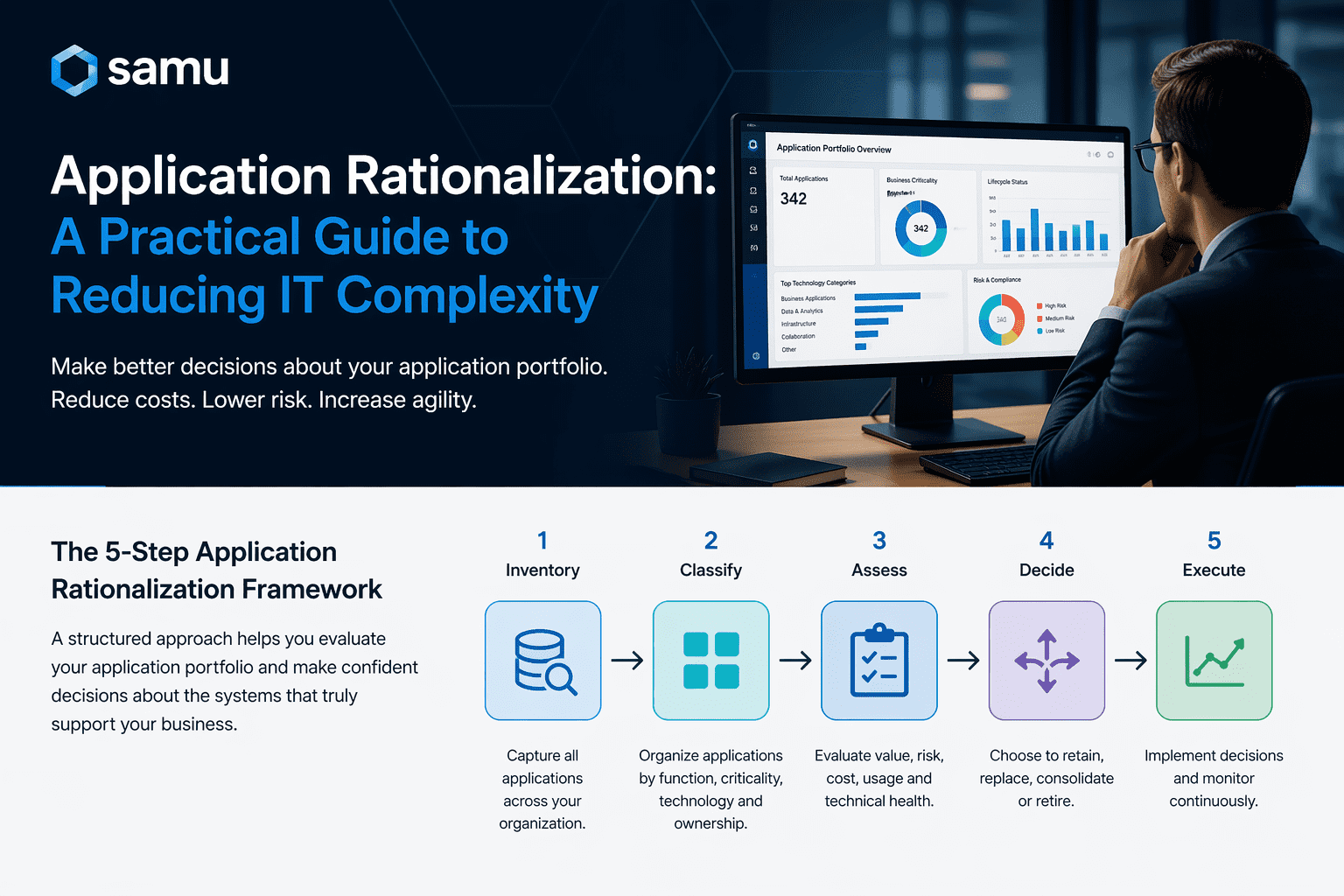
The Practical 5-Step Application Rationalization Framework
This framework reflects how most successful organizations approach rationalization in practice.
Step 1 — Build the Application Inventory
Start by identifying all applications across the organization.
Sources typically include:
- CMDB systems
- Procurement records
- License management tools
- Cloud platforms
- Departmental inventories
- Architecture repositories
Expect to find gaps. Most organizations discover previously unknown applications during this phase.
That is normal.
The objective is completeness, not perfection.
Step 2 — Classify Applications
Once the inventory is created, applications will need to be structured and classified.
Typical classification categories include:
- Business function
- Criticality
- Lifecycle stage
- Hosting model
- Technology platform
- Ownership
This step transforms the list into a portfolio.
And this is when analysis will become possible.
Step 3 — Assess Value and Risk
Each application should be evaluated using clear, repeatable criteria.
Typical questions include:
- Does this application support a critical business capability?
- Is the technology still supported?
- Is usage declining?
- Is the maintenance effort increasing?
- Does a duplicate solution exist internally?
This assessment identifies:
- Redundant systems
- High-risk technologies
- Low-value applications
- Modernization candidates
It also creates alignment between IT and business stakeholders.
Step 4 — Define Rationalization Actions
At this stage, decisions become concrete.
Most organizations use four standard actions:
- Retain
Keep the application as-is. - Replace
Move to a new system. - Consolidate
Merge multiple applications into one. - Retire
Remove the application completely.
These actions form the rationalization roadmap.
Step 5 — Execute and Monitor
Execution is where many rationalization initiatives stall.
Common reasons include:
- Unclear ownership
- Missing governance
- Lack of visibility into dependencies
- Insufficient communication
Successful organizations treat rationalization as a managed program, not as a technical task.
Key success factors include:
- Clear accountability
- Transparent decision-making
- Progress tracking
- Regular portfolio reviews
Rationalization is not finished when applications are removed.
It is finished when governance prevents future and unnecessary complexity from returning.
The Most Common Mistakes in Application Rationalization
Even well-intentioned initiatives can fail if the approach is too narrow.
Here are the patterns that are most common.
Treating Rationalization as a Cost-Cutting Exercise
Cost reduction is a benefit, but not the purpose.
If rationalization focuses only on savings, critical capabilities may be removed unintentionally.
The real objective is operational clarity and efficiency.
Ignoring Business Stakeholders
Application decisions cannot be made by IT alone.
Business owners understand:
- Process dependencies
- Operational risks
- User impact
Their involvement is essential.
Using Incomplete Data
Decisions based on partial information create risks.
For example: Retiring a system without understanding integration dependencies can disrupt operations.
Reliable data is the foundation for safe and effective rationalization.
Running Rationalization as a One-Time Project
Complexity returns quickly if governance processes are not implemented.
Rationalization must become part of ongoing portfolio management.
The Business Impact of Application Rationalization
Organizations that implement structured rationalization typically see measurable results.
Common outcomes include:
- Reduced software licensing costs
- Lower infrastructure spending
- Improved system reliability
- Simplified integrations
- Faster delivery of new capabilities
- Better compliance posture
But the most important benefit is often overlooked.
Decision speed.
When leaders understand the application landscape, they can act faster—and with great confidence.
How Enterprise Architecture Supports Rationalization
Enterprise architecture provides the structure required to manage application portfolios effectively.
It connects:
- Applications
- Technologies
- Business capabilities
- Business processes
- Risks
- Costs
- Strategic Initiatives
This visibility allows organizations to:
- Identify redundancy
- Track lifecycle status
- Understand dependencies
- Prioritize modernization
- Align technology with strategy
Without the enterprise architecture data, rationalization becomes guesswork.
With enterprise architecture data, it becomes governance.
Conclusion
Application rationalization is not about reducing systems.
It is about reducing uncertainty.
Organizations that understand their application landscape can:
- Control costs
- Manage risk
- Accelerate transformation
- Support growth
And most importantly, they can make decisions based on facts rather than assumptions.
Complexity is inevitable.
Unmanaged complexity can be catastrophic.
How often should application rationalization be performed?
Application rationalization should not be treated as a periodic cleanup activity. The most effective organizations integrate rationalization into their ongoing governance processes. This typically means reviewing the application portfolio continuously, with formal reassessment cycles every 6 to 12 months. Major events such as mergers, cloud migrations, or regulatory changes should trigger additional reviews.
What is the difference between application rationalization and application modernization?
Application rationalization focuses on evaluating the entire portfolio and deciding the future role of each system. Modernization is one possible outcome of that process. For example, a legacy application may be modernized if it still delivers strong business value, while another system may be retired or replaced if its functionality is redundant.
Who should be responsible for application rationalization?
Responsibility should be shared across IT and business leadership. Enterprise architects typically coordinate the process, but business owners provide critical context about operational dependencies and priorities. Successful rationalization programs have clear governance structures and defined accountability rather than relying on informal decision-making.
How long does a typical application rationalization initiative take?

Oliver holds a degree in Economics from the University of California, Berkeley, and was raised in the United States. With over 25 years of extensive experience in sales, business development, and account management, he has specialized in managing enterprise accounts within the Information and Communications Technology (ICT) sector.
For more than eight years, Oliver has been a key contributor at Atoll, where he has played a pivotal role in expanding SAMU’s customer base. Currently, he is focused on growing SAMU’s international presence, with a strategic emphasis on the North American market.
Outside of his professional life, Oliver is a dedicated family man, proud father to a son and daughter. He is passionate about sports, avidly following all major US sports leagues, and actively competes in golf and basketball. His competitive spirit and team-oriented mindset extend beyond the office, reflecting his dynamic approach both professionally and personally.