1. SAMU EA tool provides a unique mix of flexibility on a user-friendly platform.
As a result, it is loved not only by the IT department but also by all participants involved in the transformation activities.
The discussion around Enterprise Architecture – EA – and the supporting software in 2026 is no longer just about diagramming capabilities or framework compliance. In 2026, enterprise architecture management has decisively moved into the center of strategic decision-making. CIOs, transformation leaders, and Enterprise Architects are expected to provide real-time visibility into application portfolios, technology risks, business capability alignment, and the impacts of transformation initiatives.
EA software has therefore evolved from a documentation platform into a decision-support system. The organizations that gain real value from EA Management are those that treat architecture as a living, continuously updated representation of the enterprise — not just as a static collection of models.
Selecting the right EA software in 2026 directly affects digital transformation speed, IT governance quality, investment prioritization, cloud strategy alignment, and risk management transparency. This is why a superficial “top tools” list is insufficient. What matters is understanding how different categories of enterprise architecture tools operate and how they align with your organizational maturity and strategic objectives.
2. What Does “Best” Mean in Enterprise Architecture Software?
The phrase “best enterprise architecture software” can be misleading if not carefully defined. There is no universally best tool; there is only a platform that best supports a specific enterprise context.
In 2026, “best” typically implies:
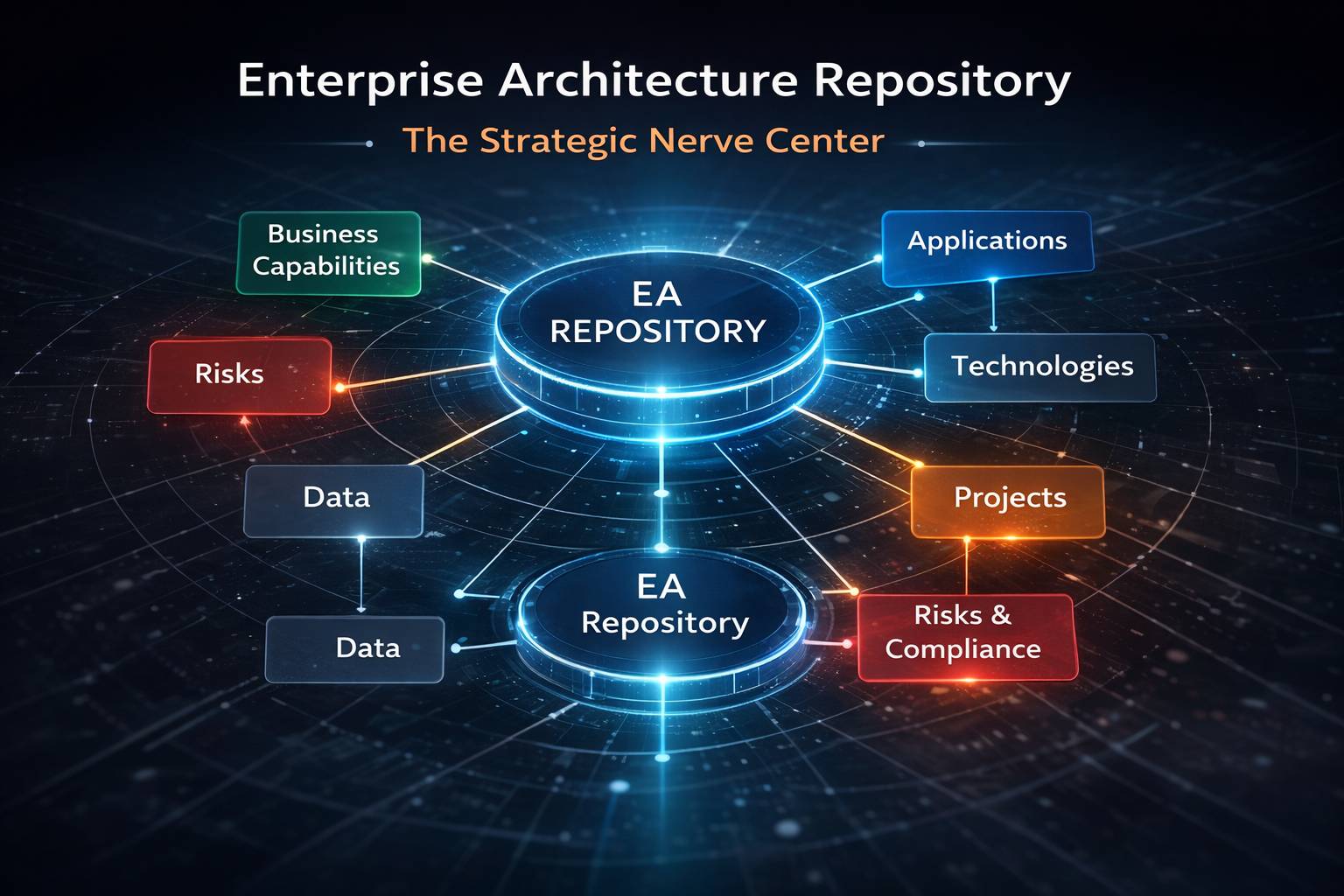
- A reliable and scalable enterprise architecture repository
- Strong application portfolio management capabilities
- Clear business capability mapping
- Technology lifecycle management visibility
- Strategic roadmapping support
- Integration with operational systems
- AI-assisted insight generation
- Governance and compliance traceability
The shift is subtle but critical. Historically, EA tools were evaluated primarily based on modeling standards support, such as TOGAF alignment or ArchiMate notation capabilities. While modeling remains important, it is no longer sufficient. Modern EA software must function as a continuously updated source of truth for enterprise structure and change.
The best Enterprise Architecture – EA – software 2026 is therefore not defined by how beautiful diagrams are generated, but instead by how reliably it supports executive decision-making.
3. Categories of Enterprise Architecture Tools in 2026
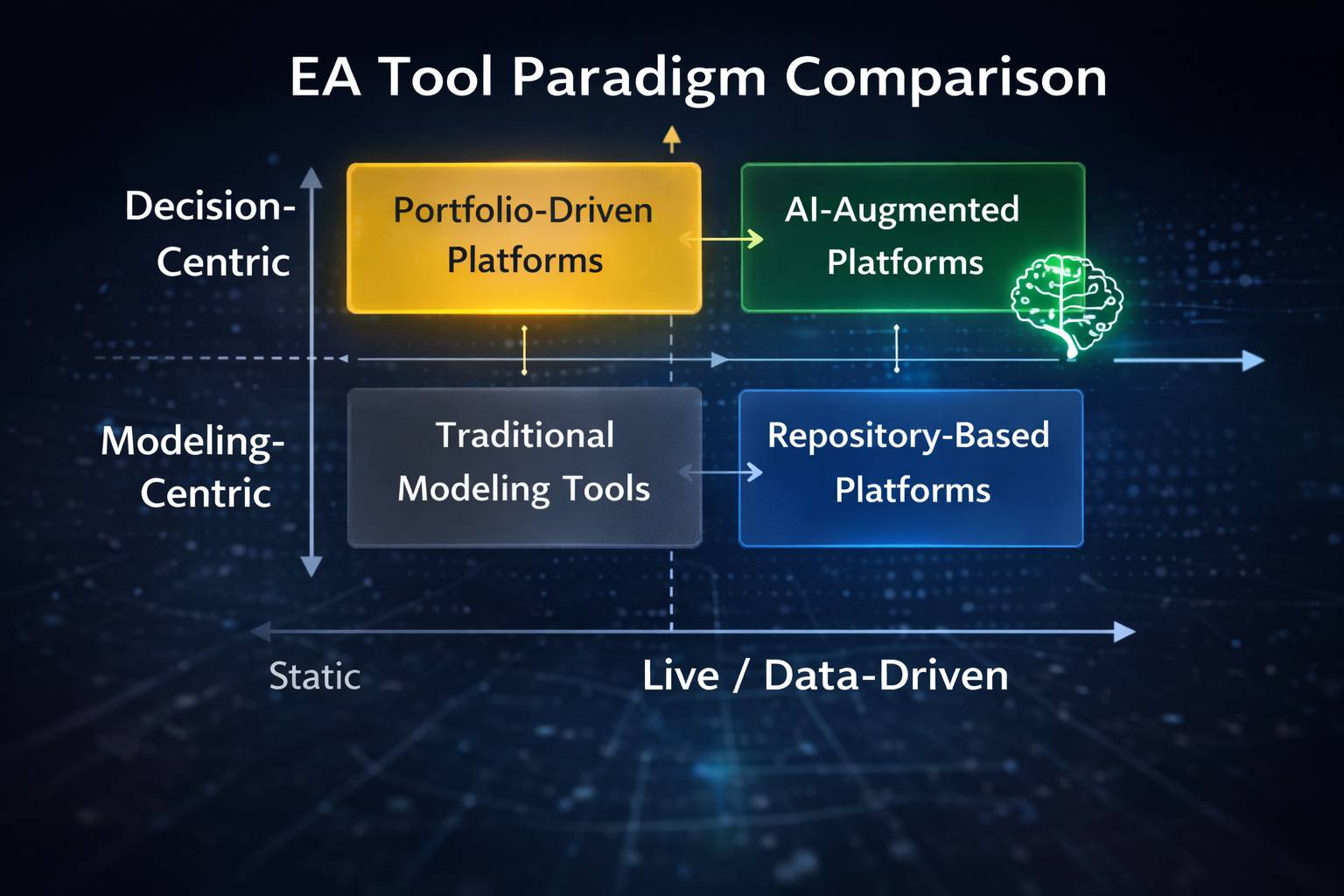
Understanding tool categories is essential for meaningful comparison. Enterprise architecture software platforms in 2026 typically fall into distinct paradigms.
3.1 Modeling-Centric EA Tools
These tools focus heavily on formal modeling standards. They are often strong in notation support and diagram precision but may rely on manual updates and architect-driven data entry. They are suitable for organizations with strong modeling culture but limited automation needs.
3.2 Repository-Based EA Platforms
Repository-first platforms emphasize structured data storage. Models are generated from underlying relationships in a central database. These tools provide stronger consistency and traceability across business, application, and technology layers.
3.3 IT Portfolio-Driven Platforms
Some EA software evolved from IT portfolio management solutions. These platforms are particularly strong in application portfolio management and cost visibility but may have limitations in strategic capability modeling.
3.4 AI-Augmented, Data-Centric Platforms
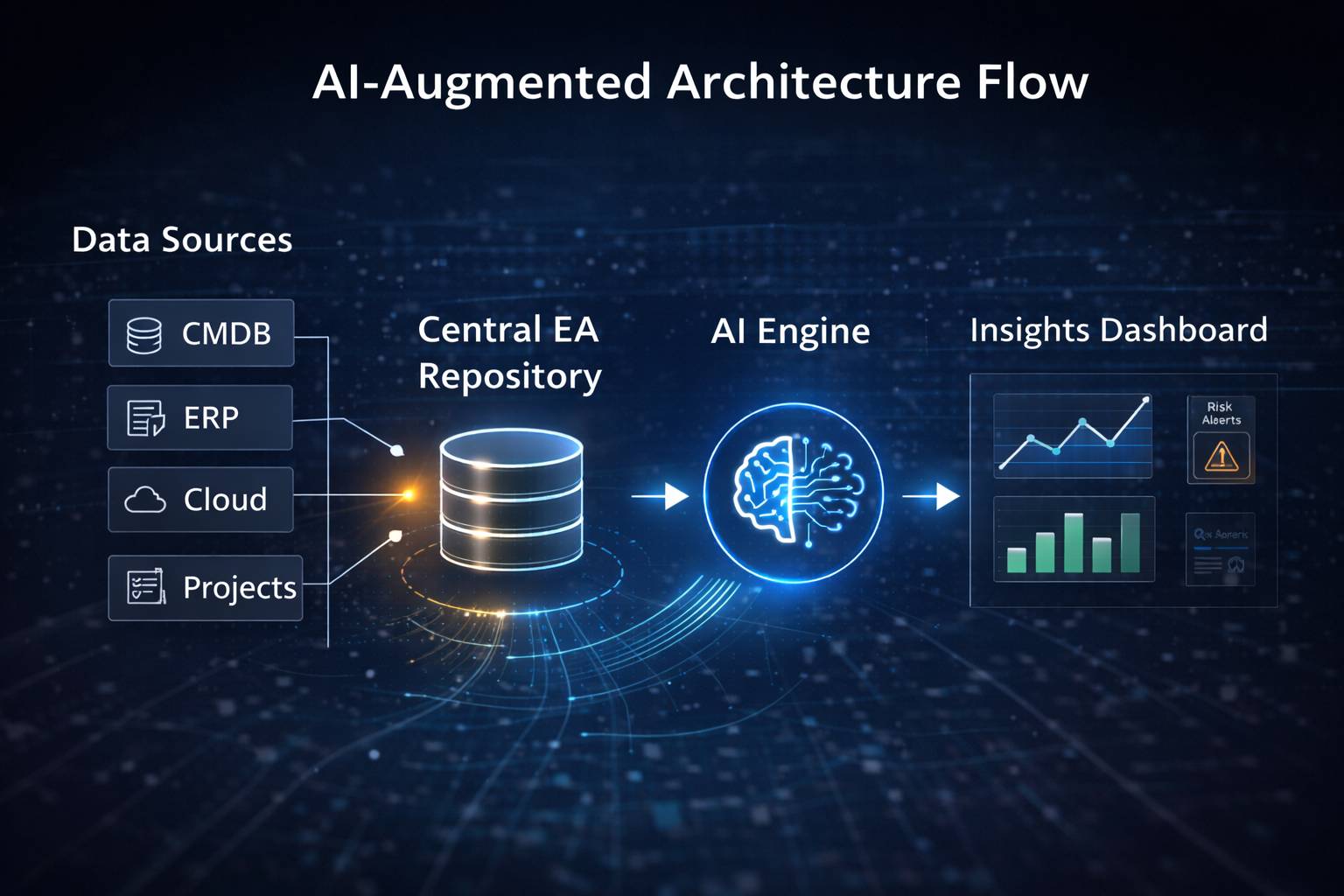
The newest category integrates automation, synchronization, and AI-based insights. These platforms aim to reduce manual maintenance effort and increase decision intelligence. They focus on maintaining a live enterprise architecture repository synchronized with operational systems.
3.5 Hybrid Governance Platforms
Some vendors position their enterprise architecture tools primarily as governance and compliance platforms, emphasizing workflow, approval processes, and risk documentation.
Each category serves different maturity levels. The best Enterprise Architecture – EA – software 2026 depends on which paradigm aligns with your strategic objectives.
4. Core Capabilities to Compare in Enterprise Architecture Software
A structured comparison should focus on capabilities rather than marketing positioning.
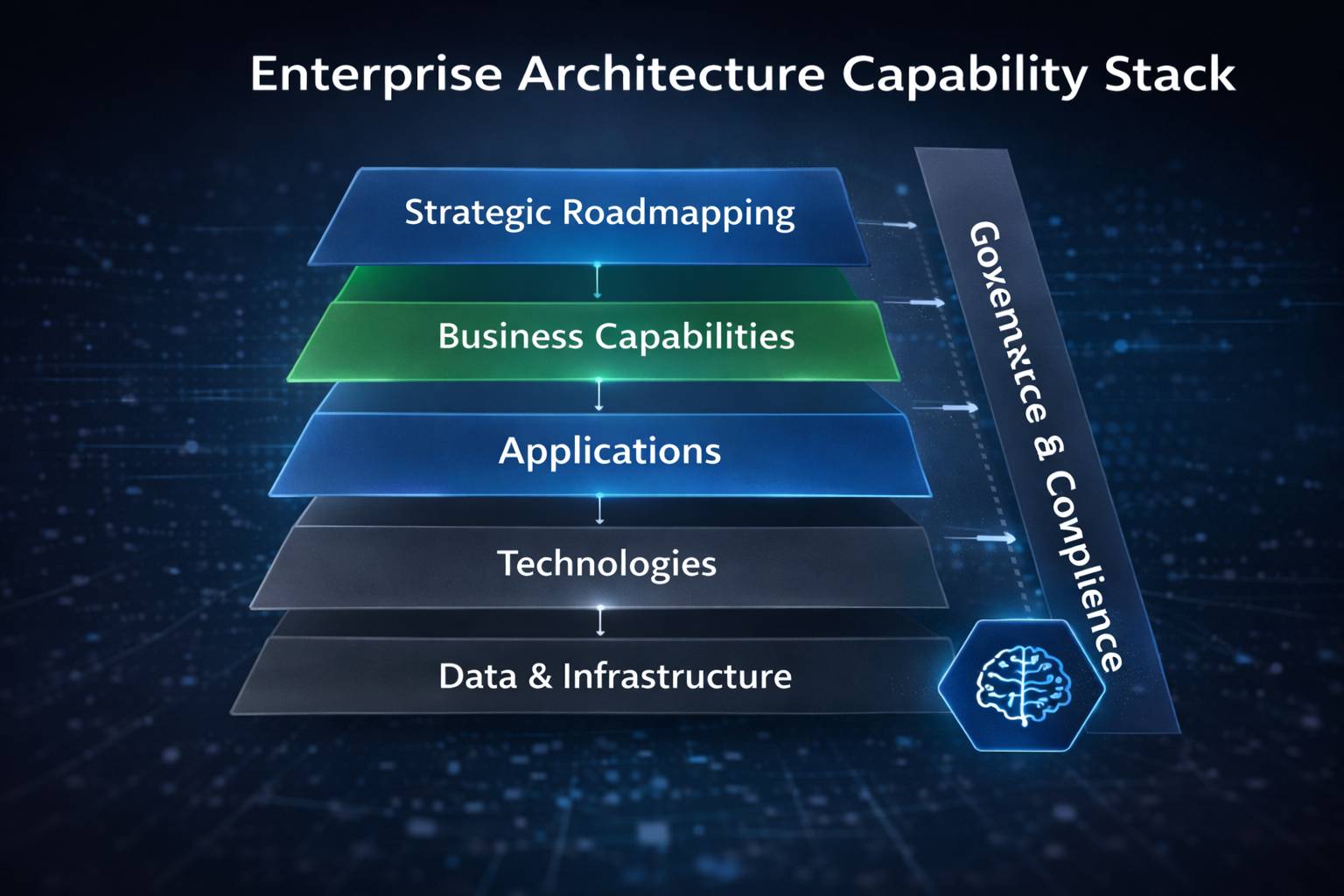
Application Portfolio Management
Modern EA software must provide a comprehensive overview of application landscapes, including ownership, lifecycle stage, risk exposure, technical debt indicators, and redundancy analysis. Application portfolio management is central to transformation planning.
Business Capability Mapping
Strong EA platforms allow business capability modeling that connects strategic objectives to applications and technologies. Without capability mapping, EA remains disconnected from generating business value.
Technology Lifecycle Management
Visibility into technology versions, end-of-life timelines, and vendor dependencies is critical in 2026. The best EA software supports proactive technology risk management.
IT Landscape Visualization
Visualization should not rely on static diagrams. Instead, it should dynamically reflect repository data, enabling consistent impact analysis and scenario evaluation.
Strategic Roadmapping
Enterprise architecture software must support transformation planning across multi-year horizons. Roadmaps should integrate project portfolios, capability evolution, and application lifecycle changes.
Governance and Compliance
EA platforms should document architecture principles, standards compliance, and risk mitigation. Workflow capabilities should enhance accountability and use of the platform.
AI-Augmented Insights
Increasingly, the best Enterprise Architecture – EA – software 2026 integrates AI-assisted pattern detection, anomaly identification, and recommendation capabilities.
5. AI and Automation in Enterprise Architecture Platforms
Artificial intelligence in enterprise architecture is not about replacing architects. It is about augmenting their ability to interpret complex data landscapes.
AI capabilities in EA software typically include:
- Automated dependency analysis
- Pattern recognition across application portfolios
- Risk clustering
- Data validation and anomaly detection
- Suggested rationalization candidates
Automation reduces manual repository maintenance, increasing trust in the EA data model. As organizations scale, manual updates become unsustainable. AI-driven synchronization and validation mechanisms therefore become critical differentiators.
6. Cloud-Native vs. Legacy EA Platforms
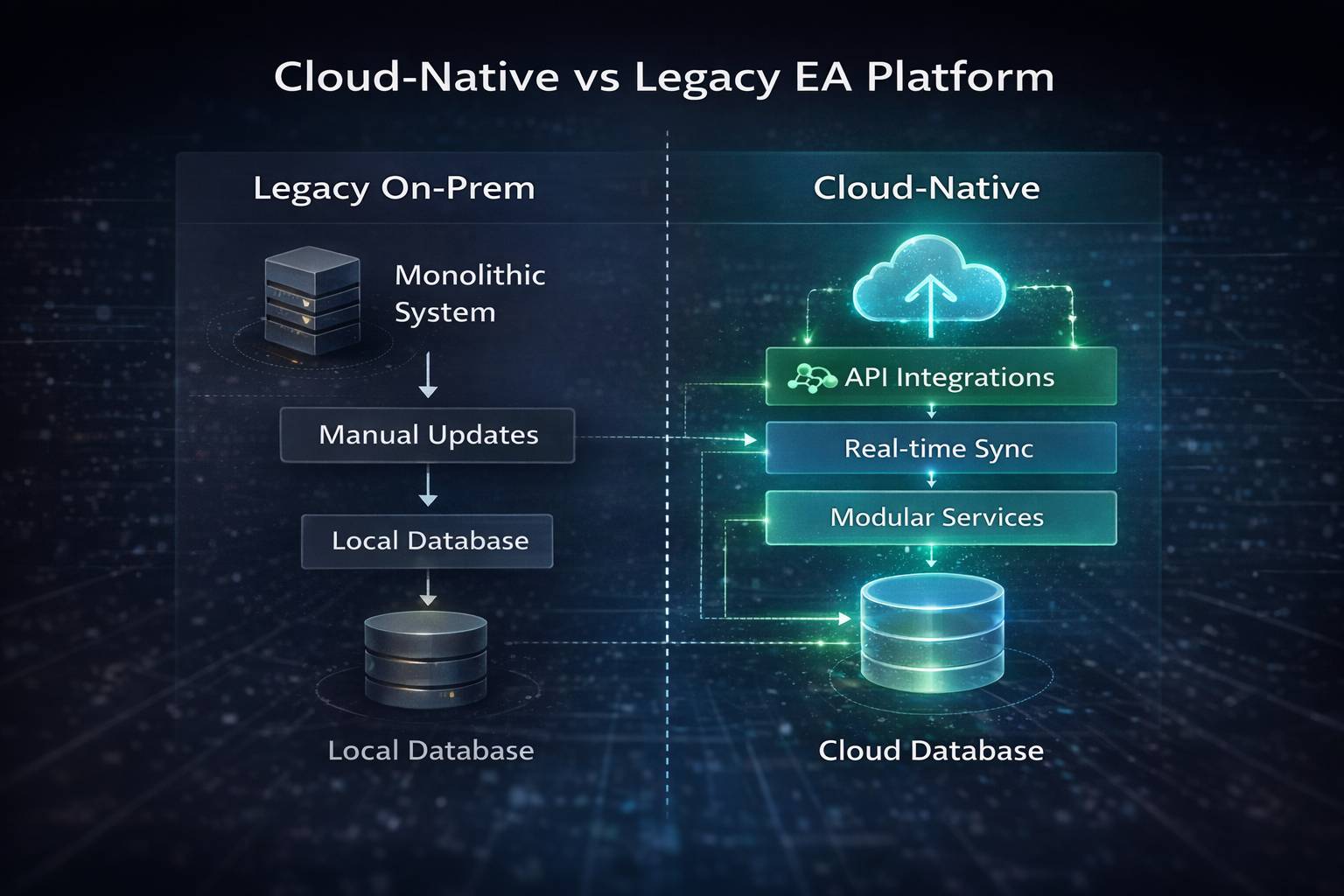
Cloud-native enterprise architecture software offers advantages in scalability, and continuous updates. Legacy on-premise tools may provide high customization but often require heavier infrastructure management.
The decision between cloud-based and on-premise EA platforms depends on:
- Data sensitivity requirements
- Regulatory constraints
- Integration complexity
- Internal IT strategy
In 2026, most enterprises favor cloud-native platforms due to agility.
7. Enterprise-Grade Evaluation Criteria
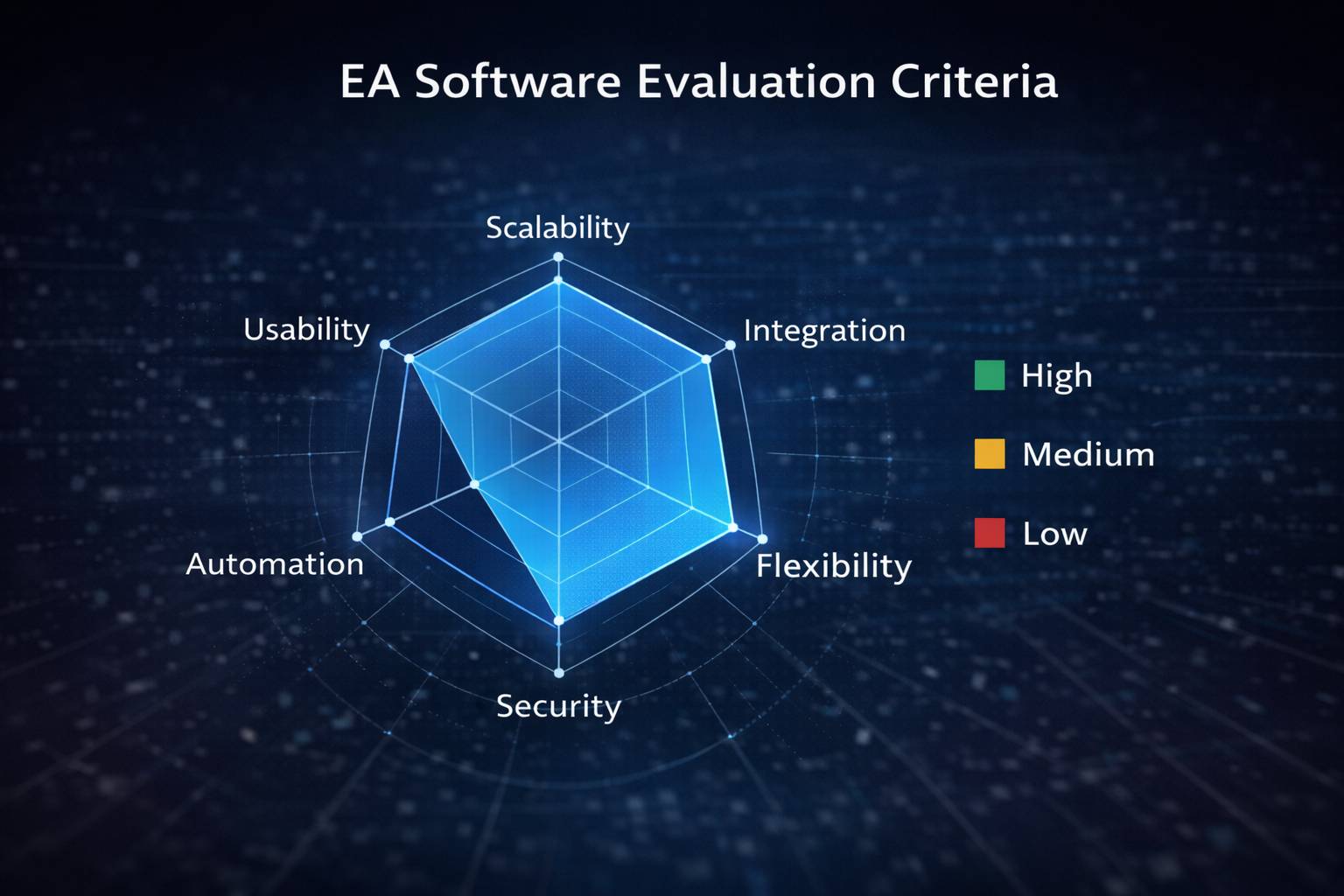
When evaluating EA software, CIOs and EA leaders should assess:
Scalability
Can the platform support tens of thousands of architecture objects without performance degradation?
Integration Ecosystem
Does it integrate with CMDB, ERP, project portfolio tools, and cloud management platforms? What connectors are available out of the box?
Data Model Flexibility
Can the meta-model be adapted and customized without heavy vendor intervention?
Security and Compliance
Does the platform meet enterprise-grade security standards?
User Experience and Adoption
Is the tool usable beyond architects, including business stakeholders?
Cost Structure
Does pricing align with long-term usage and expansion plans?
8. Common Mistakes When Comparing EA Software
Organizations often:
- Overemphasize modeling standards
- Underestimate integration complexity
- Ignore long-term maintenance efforts and costs
- Choose tools based on short demos
- Neglect stakeholder adoption considerations
These mistakes lead to underutilized EA repositories.
9. A Practical Comparison Framework for CIOs
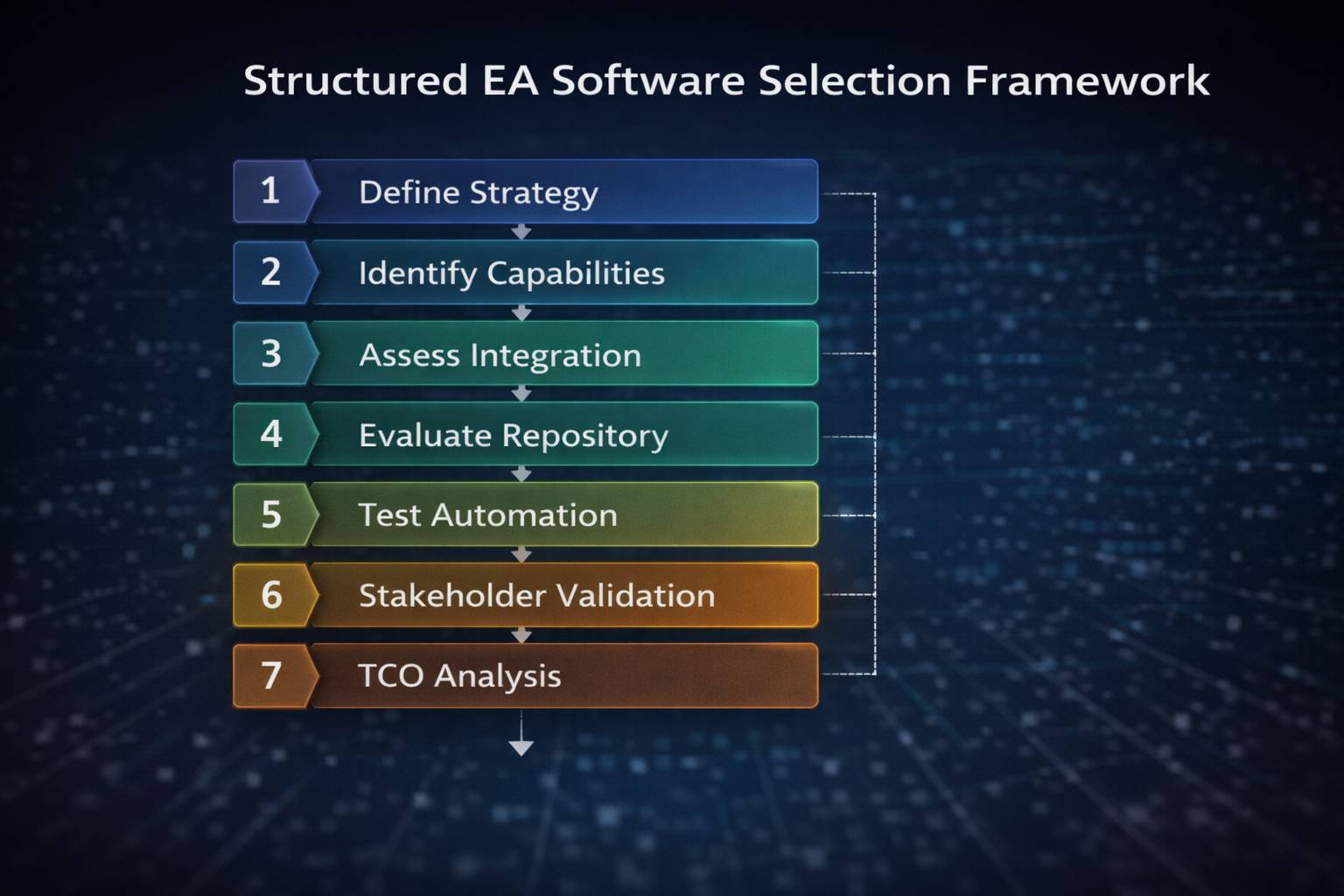
A practical evaluation framework includes:
- Define strategic objectives
- Map required capabilities
- Assess integration needs
- Evaluate repository architecture
- Test automation features
- Conduct stakeholder usability reviews
- Analyze total cost of ownership
This structured approach ensures alignment between tool selection and enterprise strategy.
10. Future Trends Beyond 2026
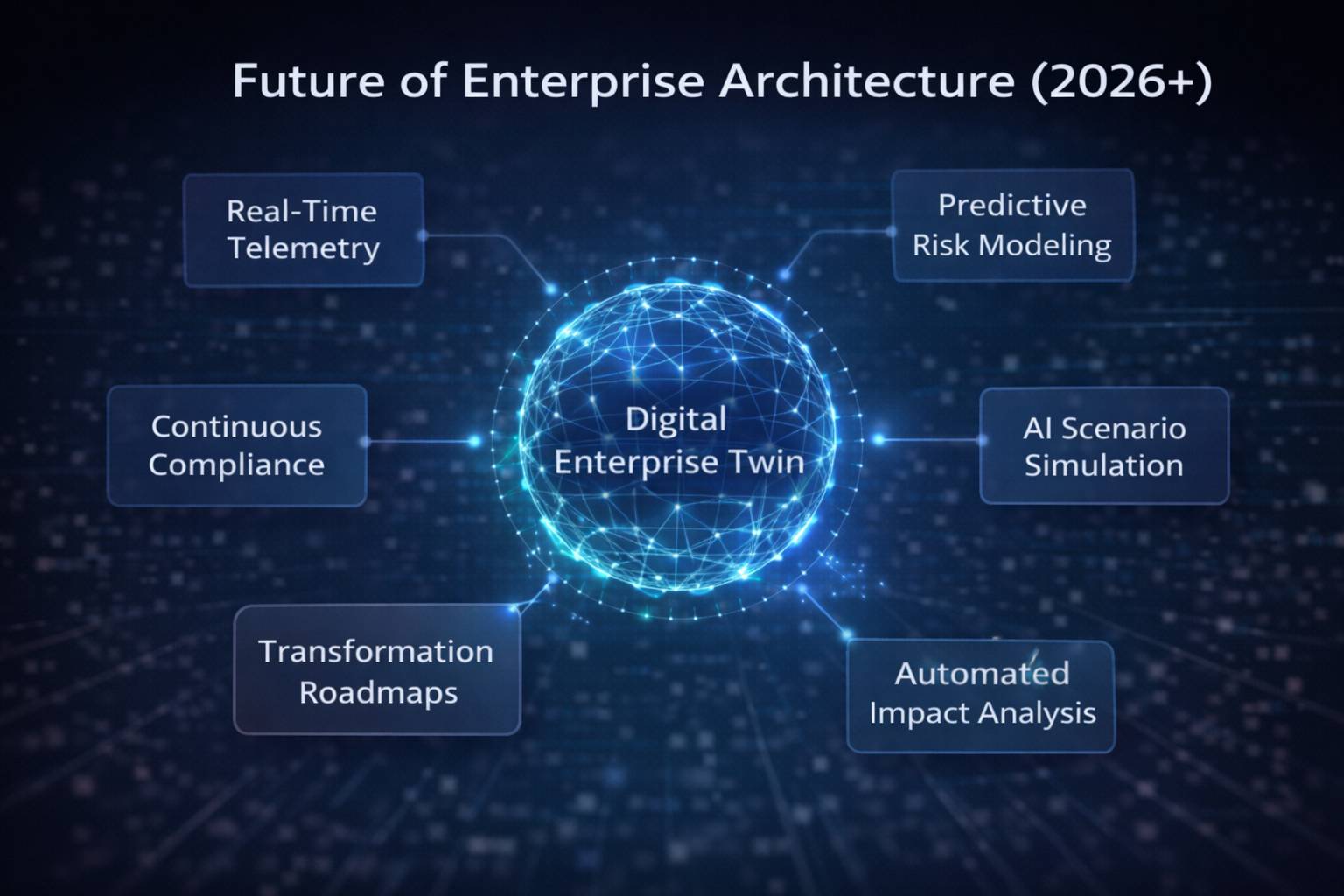
Enterprise architecture software will increasingly:
- Integrate real-time operational telemetry
- Support predictive risk modeling
- Automate compliance tracking
- Enable cross-domain transformation simulations
- Incorporate AI-driven scenario planning
Architecture is moving toward continuous intelligence rather than periodic documentation.