
Data Security and Compliance with SAMU
Due to the exponential growth of IT and digitalization, organizations across all industries are facing numerous challenges related to security and compliance, particularly in the context of Enterprise Architecture. During the past few years our customers have indicated how security and compliance related challenges are affecting their business and becoming ever more complex.
Through our discussions with our customers these are areas related to security and compliance that should be considered:
Navigating Complex Regulatory Landscapes
One of the most significant challenges is navigating the constantly evolving and complex regulatory requirements across industries and jurisdictions (GDPR, DORA, PCI, etc.). Organizations must carefully monitor, report, and manage every process to comply with government regulations, which can be particularly challenging in sectors like healthcare, financial services, and technology.
Resource Constraints and Skill Gaps
Many organizations struggle with resource constraints, especially the shortage of skilled professionals who understand the nuances of compliance. There’s often a disconnect between legal teams focused on legal aspects and IT/security teams focused on control testing, creating gaps in compliance implementation.
Keeping Up with Technological Advancements
The adoption of new technologies like AI, IoT, and 5G requires updated security standards. Organizations must ensure their Enterprise Architecture can accommodate these advancements while maintaining compliance and security.
Managing Cloud Risks
There is increasing complexity in managing risks on technology stacks that use multiple cloud service providers, where there is shared responsibility to protect data. This challenge is particularly relevant to Enterprise Architecture as it involves designing and implementing secure multi-cloud environments.
Ensuring Visibility and Control
IT and risk professionals often struggle to have clear visibility over the enterprise. This lack of visibility can lead to problems with organizational and data silos, complex systems, or duplicated information, making it difficult to maintain security and compliance across the entire architecture.
Balancing Compliance and Operational Scalability
Organizations face the challenge of mitigating risks while optimizing business performance. Enterprise Architects must design systems that are both compliant with regulations and scalable to meet business needs.
Addressing Third-Party Security Issues
Even if a firm has robust risk management, they can still be vulnerable due to weaknesses in third-party systems, such as email providers, operating systems or software vendors. This challenge requires careful consideration in Enterprise Architecture design to minimize risks from external dependencies.
Implementing Proactive Security Measures
Enterprise Architects need to integrate proactive security measures, such as threat modeling, segmentation, and encryption, to reduce vulnerabilities from the outset. This requires a deep understanding of both security principles and architectural design.
By addressing these challenges, organizations can work towards creating more secure and compliant Enterprise Architectures that are resilient in the face of evolving threats and regulatory requirements.
The above-mentioned challenges can be managed with our Enterprise Architecture tool SAMU. See below how SAMU addresses these:
SAMU EA tool overview
SAMU is an enterprise architecture management tool that empowers organizations to plan and manage their IT infrastructure and business processes effectively. With its adaptable framework, SAMU integrates diverse data sources into a live, accurate repository, instrumental in adhering to regulations like DORA and GDPR. It provides a structured approach and defines guiding principles for safeguarding sensitive information and helps in managing security risks such as Cyber-attacks, operational resiliency, data breeches, etc..
See more about SAMU EA tool here.
Are you struggling with compliance regulations (DORA, GDPR, PCI, etc.)?
Are you nervous about the security of your data and of risks that you face as an organization?
This is how SAMU can help:
Key Data Security Features
SAMU supports data security through a range of features:
- Access Control: SAMU’s sophisticated permission management system ensures that only authorized personnel can access and modify data, maintaining integrity and preventing unauthorized access.
- Data Governance Policies: In SAMU and through its flexible meta-model you can link data governance policies by mapping those policies to any object in the repository. This can include data classification, access controls, retention, and sharing.
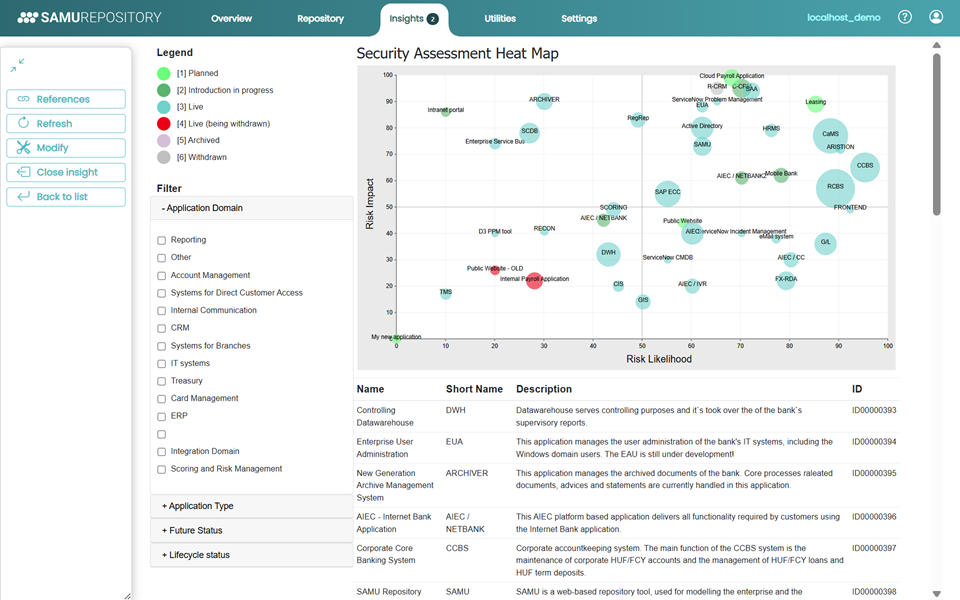
- Risk Assessment and Mitigation: In SAMU you can link objects to concepts like Capability Maturity, Operational Resilience, Technology Debt, IT Risk, Application rationalization, Cost Management, and Application Obsolescence. You can model security zones and assign architecture components to them.
- Integrating Security Measures: SAMU can support security measures and controls throughout an organization’s IT systems and infrastructure by for example creating security standards as an object type in the meta-model of the repository. This can be used to assess potential vulnerabilities, establishing security policies and procedures, and implement appropriate technologies to protect data at various levels.
- Security Related Components: As the meta-model in SAMU is completely flexible you can architect security related features and concepts. For example, firewalls, antivirus software and other security related components can be registered in the repository. Or Business Continuity and Disaster Recovery related architectures can be modelled showing how such plans would work from an enterprise architecture perspective.
- Integration: With SAMU’s robust integration capabilities (REST API, SOAP Adapter, etc.) it can be integrated to SIEM (Security Information and Event Management) Systems automatically updating and maintaining security related data.
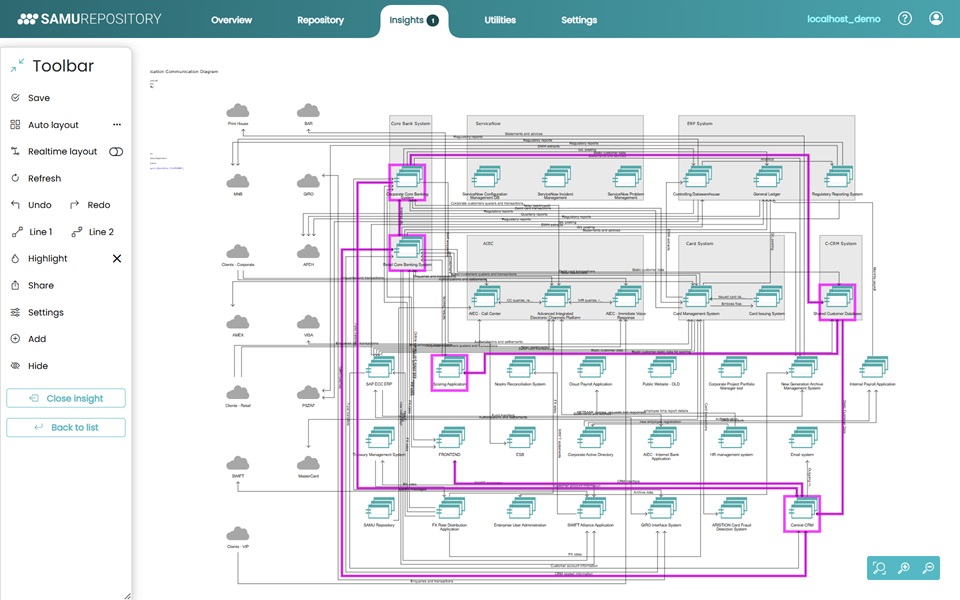
- Data Flow Mapping: In SAMU you can map data flows across various business units, systems, and processes, which is invaluable for identifying potential privacy risks and vulnerabilities. It enables organizations to track the movement of personal and sensitive data, ensuring compliance with data privacy regulations.
Compliance Considerations
SAMU aids compliance efforts by:
- Maintaining a comprehensive architecture landscape for regulatory adherence (DORA, GDPR, etc.).
- Providing audit trails and custom reports for DORA or GDPR compliance..
- Mapping data flows to identify privacy risks and vulnerabilities.
- Ensuring alignment with regulatory standards through continuous monitoring and automated auditing.
Summary
SAMU can be a helpful tool to support security and privacy considerations in architectural design, follow data governance policies, select appropriate technologies based on technology standards, and facilitate compliance with regulations.
If you would like to learn more or ask specific questions related to how SAMU can support security and compliance please contact us here..
Join our satisfied customers!
Digitally conscious businesses who trust us






Why us?
We offer a Free SAMU Trial and/or a Free Proof of Concept (We set up the trial using customer data)
SAMU is extremely flexible, the meta-model is fully flexible, custom reports can be created, sophisticated user permission rights
Our Best Practice Model based on 20+ years of experience in delivering successful EA projects
SAMU has been developed using a bottom-up approach. Product development is based on real-life customer needs.
Customer satisfaction and our approach. Each customer is unique. We strive to bring real value and to have a successful EA practice.
Powerful visualizations: Our visualizations are all data-driven generated from the live repository with multiple lifecycle views available.
Integration capabilities: Sophisticated API to automate data upload and maintain quality in the repository.
What is an enterprise architecture tool and who is it for?
An enterprise architecture tool is a platform designed to help organizations gain a clear, structured view of their entire IT landscape, including applications, systems, and business processes. Instead of working with fragmented data across multiple tools, teams can centralize everything in one place and understand how technology supports business goals.
Solutions like SAMU are built specifically for enterprises, CIOs, and IT leaders who need to make strategic decisions about their IT environment. Whether it’s optimizing legacy systems, planning digital transformation, or improving collaboration between business and IT, an enterprise architecture tool provides the visibility and control needed to move forward with confidence.
How does an enterprise architecture platform improve IT strategy and decision-making?
An enterprise architecture platform connects high-level business objectives with the underlying IT systems that support them. This makes it possible to see how changes in technology impact the organization as a whole, rather than evaluating systems in isolation.
With a well-implemented enterprise architecture platform, IT leaders can identify redundancies, reduce complexity, and prioritize investments based on real data. It becomes much easier to align IT strategy with business goals, manage risks, and ensure that every decision contributes to long-term value instead of short-term fixes.
What problems does enterprise architecture software solve for enterprises?
Enterprise architecture software addresses some of the most common challenges large organizations face: lack of transparency, duplicated systems, increasing IT costs, and difficulty managing change. In many companies, information about systems and processes is scattered, outdated, or incomplete.
By introducing a centralized enterprise architecture software solution, organizations can create a single source of truth for their IT landscape. This improves visibility, supports better governance, and enables faster, more informed decisions. It also helps reduce unnecessary complexity and ensures that technology investments are aligned with business priorities.
How does SAMU support IT landscape management and application portfolio management (APM)?
SAMU provides a comprehensive view of the IT landscape, allowing organizations to map, analyze, and continuously optimize their systems. Through advanced IT landscape management capabilities, users can understand how applications are connected, where dependencies exist, and which areas require attention.
In addition, SAMU supports application portfolio management (APM) by helping organizations evaluate the performance, cost, and business value of each application. This makes it easier to identify redundant or outdated systems, prioritize modernization efforts, and build a more efficient, future-ready IT environment.
Is SAMU suitable for large enterprises and CIO-level decision making?
Yes, SAMU is designed with enterprise-scale complexity in mind. It supports organizations that operate with large, distributed IT environments and need a reliable foundation for strategic decision-making at the highest level.
For CIOs and senior IT leaders, SAMU provides the insights required to balance innovation with stability. It enables better planning, clearer communication with stakeholders, and more effective governance across the entire IT landscape. This makes it a valuable tool not only for managing current systems, but also for guiding long-term digital transformation initiatives.
How is SAMU different from other enterprise architecture tools?
While many enterprise architecture tools focus primarily on documentation, SAMU is designed to actively support decision-making and continuous improvement. It goes beyond static diagrams and provides actionable insights that help organizations optimize their IT landscape in real time.
SAMU combines enterprise architecture, IT strategy, and application portfolio management into a single platform. This integrated approach reduces the need for multiple tools and ensures that all stakeholders work with consistent, up-to-date information. As a result, organizations can move faster, reduce complexity, and make more confident strategic decisions.
Contact us
Don't take our word for it!

Atoll Technologies Ltd. EA tool SAMU is a leader in Info-Tech Research Group /SoftwareReview 2024 Enterprise Architecture Data Quadrant Report.
„Atoll Technologies Ltd.is the dominant vendor for EA tools in the Middle East. It also has regional strength in Central and Eastern Europe, and can provide strong support to these otherwise underserved markets."

Atoll Technologies Ltd. EA tool SAMU is included in the Forrester Now Tech: Enterprise Architecture Management Suites, Q2 2022.
