
A CIO once told me something that stuck.
“We’re not afraid of technology. We’re afraid of not knowing what depends on what.”
That sentence captures the real problem many organizations face today. Not lack of systems. Not lack of tools. Not even lack of budget.
Lack of clarity.
Over the years, most IT environments grow quietly. A new application is introduced to support a project. A SaaS tool is added because it solves an urgent business need. A legacy system stays in place because replacing it would be risky. Then another integration is built. And another.
Nothing dramatic happens at first.
Until one day, a simple change becomes unexpectedly complicated.
A system upgrade takes months instead of weeks.
A migration project stalls because dependencies are unclear.
An acquisition closes, but the IT integration drags on for years.
That’s usually the moment when organizations start talking seriously about their IT landscape.
The First Sign Is Almost Always a Question
It often begins during a budgeting discussion or a transformation initiative.
Someone asks:
How many applications do we actually run?
There is usually an answer. But it’s rarely the same answer across teams.
Finance sees license costs.
IT sees infrastructure.
Business units see the tools they use every day.
But the full picture — the connections between all of them — is missing.
That gap is where risk hides.
Not because systems are failing.
Because no one is completely sure how they fit together.
Complexity Is Manageable. Uncertainty Is Not
Large organizations are used to complex environments. Thousands of systems are not unusual. Multiple cloud providers, legacy platforms, integrations, data pipelines — this is normal.
What creates friction is uncertainty.
When teams don’t understand system dependencies, even routine changes become cautious exercises. Releases slow down. Projects require more approvals. Decisions get postponed.
The cost is rarely visible in a single budget line. It shows up as time.
Projects take longer.
Troubleshooting takes longer.
Decision-making takes longer.
Eventually, the organization becomes careful instead of agile.
Where the Problem Usually Shows Up First
Not in architecture diagrams.
In business initiatives.
A company decides to modernize its customer platform.
A merger brings in hundreds of unfamiliar systems.
A cost optimization program reveals dozens of overlapping applications.
Many organizations address these challenges through structured enterprise architecture use cases.
A cloud migration uncovers dependencies no one documented years ago.
Suddenly, technology stops being an enabler and becomes an obstacle.
Not because the systems are broken.
Because the landscape is unclear.
Visibility Changes the Conversation
One of the most noticeable shifts happens when organizations finally see their IT landscape as a whole.
Discussions become simpler.
Instead of guessing, teams can point to facts.
Instead of debating assumptions, they can review dependencies.
Instead of delaying decisions, they can evaluate impact.
You start hearing different questions.
Which applications are actually critical?
Which systems can be retired safely?
Where are the biggest risks if we change this platform?
What is the real cost of keeping this technology?
These are practical questions. And they are difficult to answer without a structured view of the environment.
The Surprising Impact of Redundancy
Almost every large organization has some level of duplication in its technology stack.
Two tools doing the same job.
Multiple versions of similar systems.
Applications that are rarely used but still maintained.
Individually, these decisions are reasonable. Departments choose tools that solve immediate problems. Projects move quickly. Innovation happens.
Over time, however, the landscape becomes crowded.
One common reason is uncontrolled SaaS adoption across departments.
The issue is not just cost. It is confusion.
When several systems serve similar functions, teams struggle to decide which one to invest in. Integration becomes more complicated. Training becomes inconsistent. Support becomes fragmented.
And eventually, the organization spends energy maintaining technology instead of improving it.
Major Change Makes the Landscape Visible
Interestingly, organizations rarely focus on IT landscape management during stable periods.
They focus on it when something big happens.
A merger. – Without visibility into both environments, IT integration can quickly become slow and risky.
A restructuring.
A digital transformation program.
A large-scale cloud migration.
A security incident.
These moments expose how interconnected systems really are.
What looked like separate applications suddenly turns out to be tightly linked. What seemed like a minor change reveals unexpected dependencies. What felt like a routine migration becomes a strategic project.
At that point, visibility is no longer a convenience.
It becomes a necessity.
Enterprise Architecture Becomes Practical
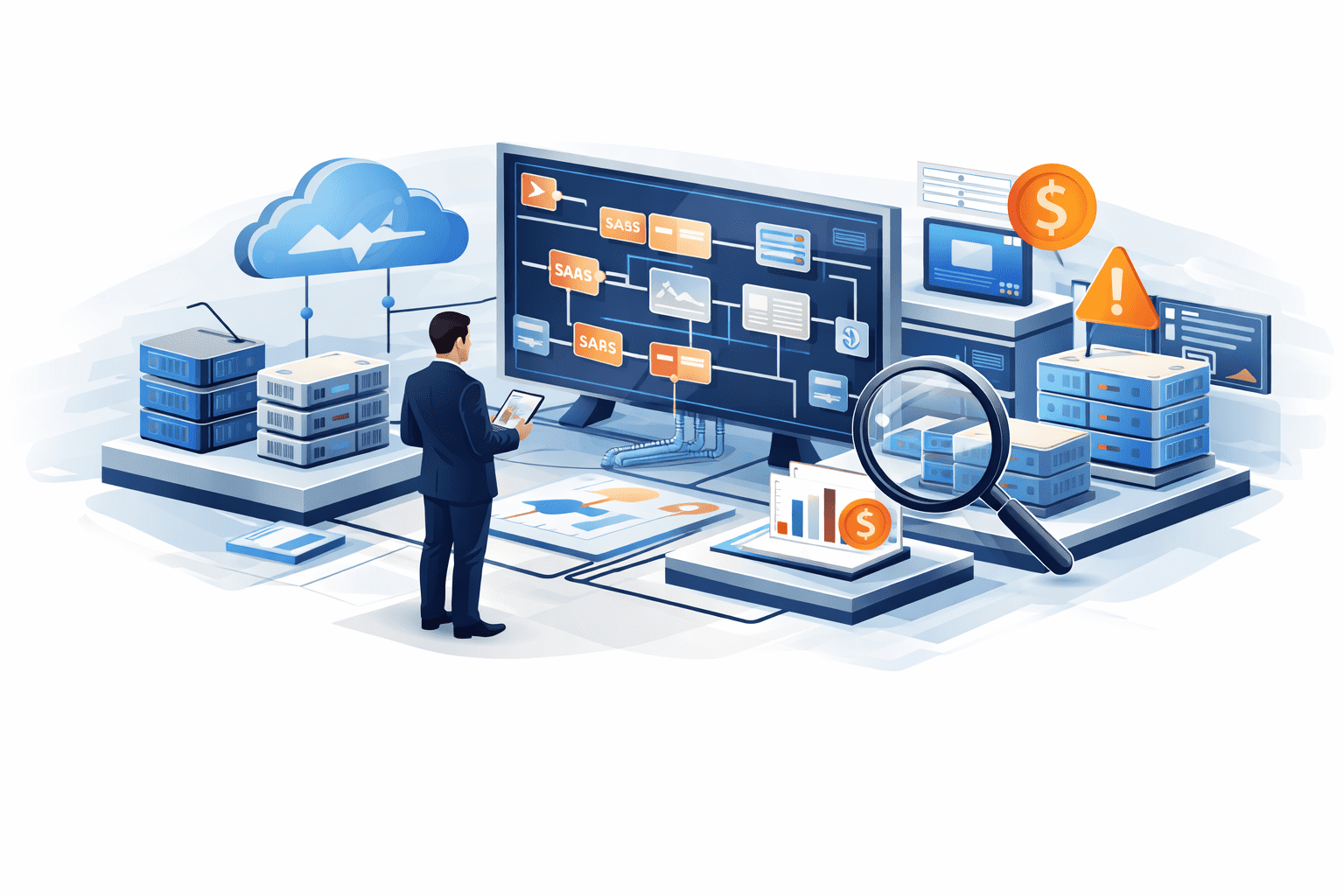
Modern enterprise architecture platforms help organizations maintain a clear and continuously updated view of their technology landscape.
There was a time when enterprise architecture was seen as documentation.
Today, it is increasingly seen as infrastructure for decision-making.
When organizations map their IT landscape in a structured way, architecture stops being theoretical. It becomes operational.
Teams use it to understand dependencies before launching projects.
Leaders use it to evaluate risks before approving investments.
Operations use it to identify systems that can be simplified or retired.
The value is not in the diagrams themselves.
It is in the confidence they create.
The Organizations That Move Faster Usually See More
Speed in IT is rarely about working harder.
It is about seeing clearly.
Organizations that understand their technology landscape tend to make decisions faster because they spend less time investigating unknowns. They can assess impact quickly, plan changes more accurately, and avoid unnecessary surprises.
They are not necessarily smaller.
They are not necessarily more advanced.
They are simply better informed.
And that difference compounds over time.
Projects finish sooner.
Costs become more predictable.
Risks become easier to manage.
Why IT Landscape Management Is Becoming a Leadership Topic
Not long ago, discussions about system dependencies or application inventories stayed within IT departments.
That is changing.
Executives now recognize that technology complexity affects business performance directly. It influences operational efficiency, financial planning, and strategic flexibility.
When leaders understand the structure of their IT environment, they can make decisions with confidence. When they don’t, even small changes feel risky.
This is why IT landscape management is moving from a technical discipline to a leadership concern.
A Simple Test
If you want to know whether an organization has control over its IT landscape, ask one question.
What happens if we change this system?
If the answer is immediate and evidence-based, the organization has visibility.
If the answer requires weeks of investigation, the landscape is still hidden.
And hidden complexity is expensive.
Final Thought
Technology will always evolve. Systems will be added, integrated, replaced, and retired. Complexity is unavoidable.
What organizations can control is whether that complexity is understood.
The companies that succeed in managing their IT landscape are not the ones with fewer systems.
They are the ones that know exactly how those systems fit together.

Oliver holds a degree in Economics from the University of California, Berkeley, and was raised in the United States. With over 25 years of extensive experience in sales, business development, and account management, he has specialized in managing enterprise accounts within the Information and Communications Technology (ICT) sector.
For more than eight years, Oliver has been a key contributor at Atoll, where he has played a pivotal role in expanding SAMU’s customer base. Currently, he is focused on growing SAMU’s international presence, with a strategic emphasis on the North American market.
Outside of his professional life, Oliver is a dedicated family man, proud father to a son and daughter. He is passionate about sports, avidly following all major US sports leagues, and actively competes in golf and basketball. His competitive spirit and team-oriented mindset extend beyond the office, reflecting his dynamic approach both professionally and personally.