
Application Rationalization Tool
Reduce Complexity, Cut Costs, and Modernize Your Application Portfolio
Most enterprises do not face challenges because they lack available applications. Instead, they struggle because they have too many of them and often do not even know what they are used for.
Over time, organizations tend to accumulate systems through mergers, departmental decisions, vendor changes, and temporary solutions that somehow become permanent. What begins as innovation often turns into fragmentation. Teams rely on overlapping tools, legacy systems remain in production long past their usefulness, and infrastructure costs continuously grow while delivering less value.
This is where focusing on application rationalization becomes essential.
Application rationalization is the structured process of evaluating, consolidating, modernizing, or retiring applications in order to improve efficiency, reduce risk, and align technology with business goals. It helps transform an uncontrolled application landscape into a manageable, transparent, and cost-effective portfolio.
SAMU enables organizations to perform application rationalization with clarity and confidence. Instead of relying on spreadsheets, vision diagrams and fragmented documentation, teams gain a unified view of applications, dependencies, costs, risks, and lifecycle status — and all in one tool.
The result is not just a smaller application portfolio but a smarter one.
What Is Application Rationalization?
Application rationalization is the process of systematically analyzing applications to determine:
- Which systems should be retained
- Which should be modernized
- Which should be replaced
- Which should be retired
The objective is not simply to reduce the number of applications but instead to optimize the application portfolio.
In many organizations, application rationalization begins only when costs become unsustainable or transformation initiatives stall or fail. However, the most successful enterprises treat application rationalization as a continuous discipline — part of their enterprise architecture governance and technology lifecycle management.
A well-executed application rationalization strategy enables organizations to:
- Reduce IT operating costs
- Eliminate redundant functionality
- Improve system reliability
- Strengthen cybersecurity posture
- Accelerate digital transformation
- Simplify architecture governance
- Improve decision-making speed and accuracy
Without rationalization, unfortunately complexity will grow faster than capability.
Why Application Rationalization Is Critical for Modern Enterprises
Enterprise IT environments evolve continuously. New applications are introduced to support business initiatives, while legacy systems remain in place to avoid disruption. Over time, this leads to application sprawl — a condition where the number of systems exceeds the organization’s ability to manage them effectively.
The consequences can be catastrophic and are measurable.
Organizations often discover:
- Multiple applications performing the same function
- Applications with no clear business ownership
- A collection of Software Solutions that are rarely used but still maintained
- Applications or Systems with hidden security vulnerabilities
- Legacy platforms that block modernization efforts
- Infrastructure costs that grow faster than the revenue they help generate
Application rationalization addresses these issues directly.
Instead of reacting to the problems and challenges that arise, organizations gain the ability to manage their application landscape proactively.
This shift from reactive maintenance to strategic governance is one of the defining characteristics of mature enterprise architecture management.
The Hidden Cost of Application Sprawl
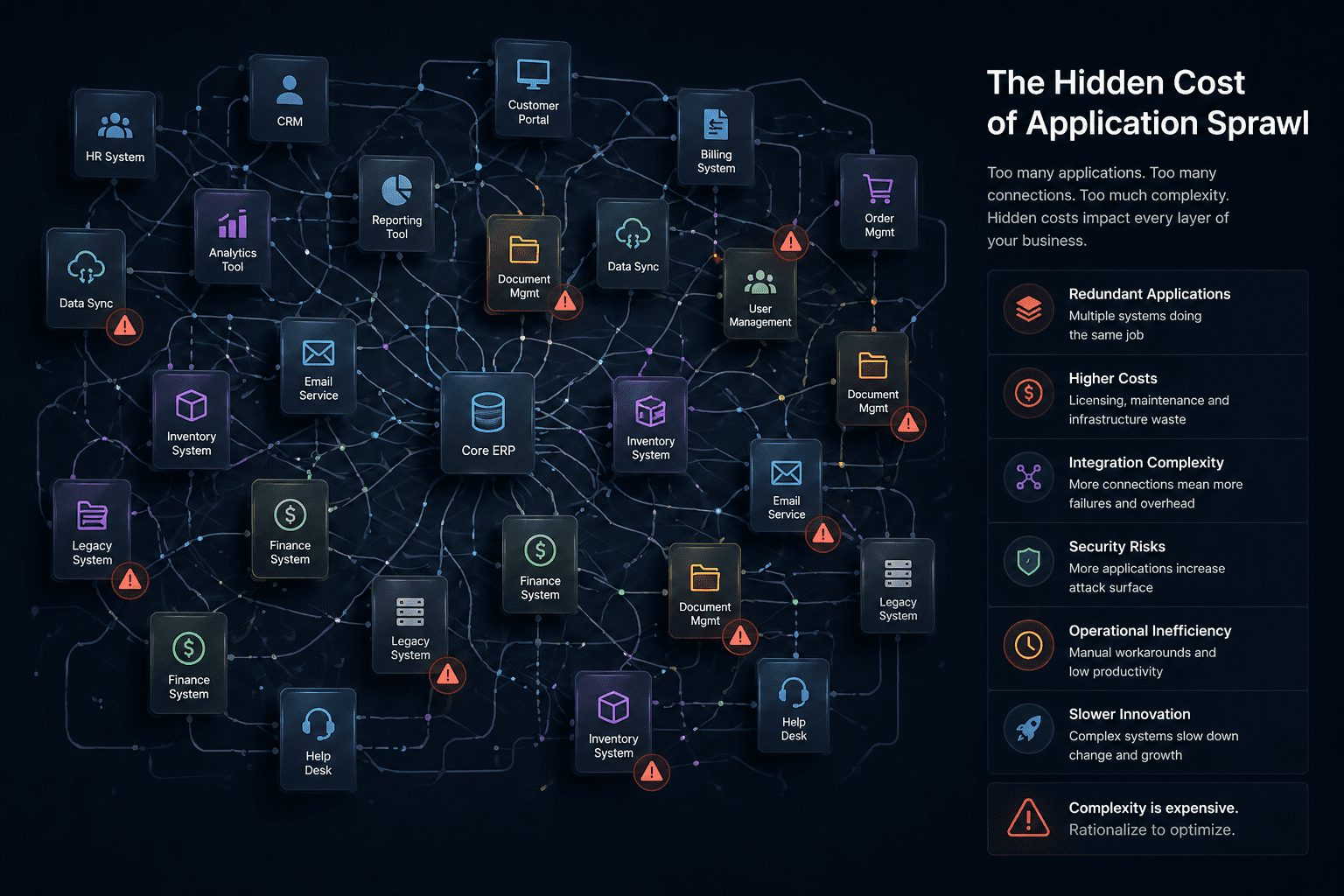
Application sprawl is rarely visible at first. It develops gradually as departments adopt new tools to solve immediate problems.
As the years go by, the organization suddenly realizes that it is operating hundreds — sometimes even thousands — of applications.
The cost is not limited to licensing fees.
The real cost also includes:
- Operational complexity
- Integration overhead
- Security exposure
- Maintenance effort
- Infrastructure consumption
- Support workload
- Training requirements
- Vendor management
These costs often accumulate silently and Application rationalization will expose them.
When organizations gain visibility into their application portfolio, they often identify opportunities to reduce costs by 20–40 percent without having to sacrifice capability.
This is why application portfolio rationalization is frequently one of the highest-impact initiatives in enterprise IT.
The Core Goals of Application Rationalization
Every organization approaches application rationalization differently, but the objectives are usually consistent.
Reduce Redundancy
Duplicate functionality is one of the most common inefficiencies in enterprise IT. Multiple departments may use different systems to perform the same task, leading to unnecessary licensing and support costs.
Rationalization identifies the overlap and consolidates the functionality into a smaller number of strategic platforms.
Improve Application Quality
Legacy applications often remain in production long after their architecture becomes outdated. These systems can introduce reliability issues, security risks, and performance limitations.
Rationalization enables organizations to replace or modernize aging systems before they become critical failures.
Align Technology with Business Strategy
Application’s primary function should be to support business outcomes. When systems persist without clear value, they consume resources without contributing to growth.
Application rationalization ensures that every application has a defined purpose and a measurable impact.
Simplify Architecture
Complexity will slow decision-making. It increases integration efforts, complicates governance, and creates operational risk.
A rationalized application landscape is easier to manage, is more secure, and better suited to evolve.
The Application Rationalization Framework
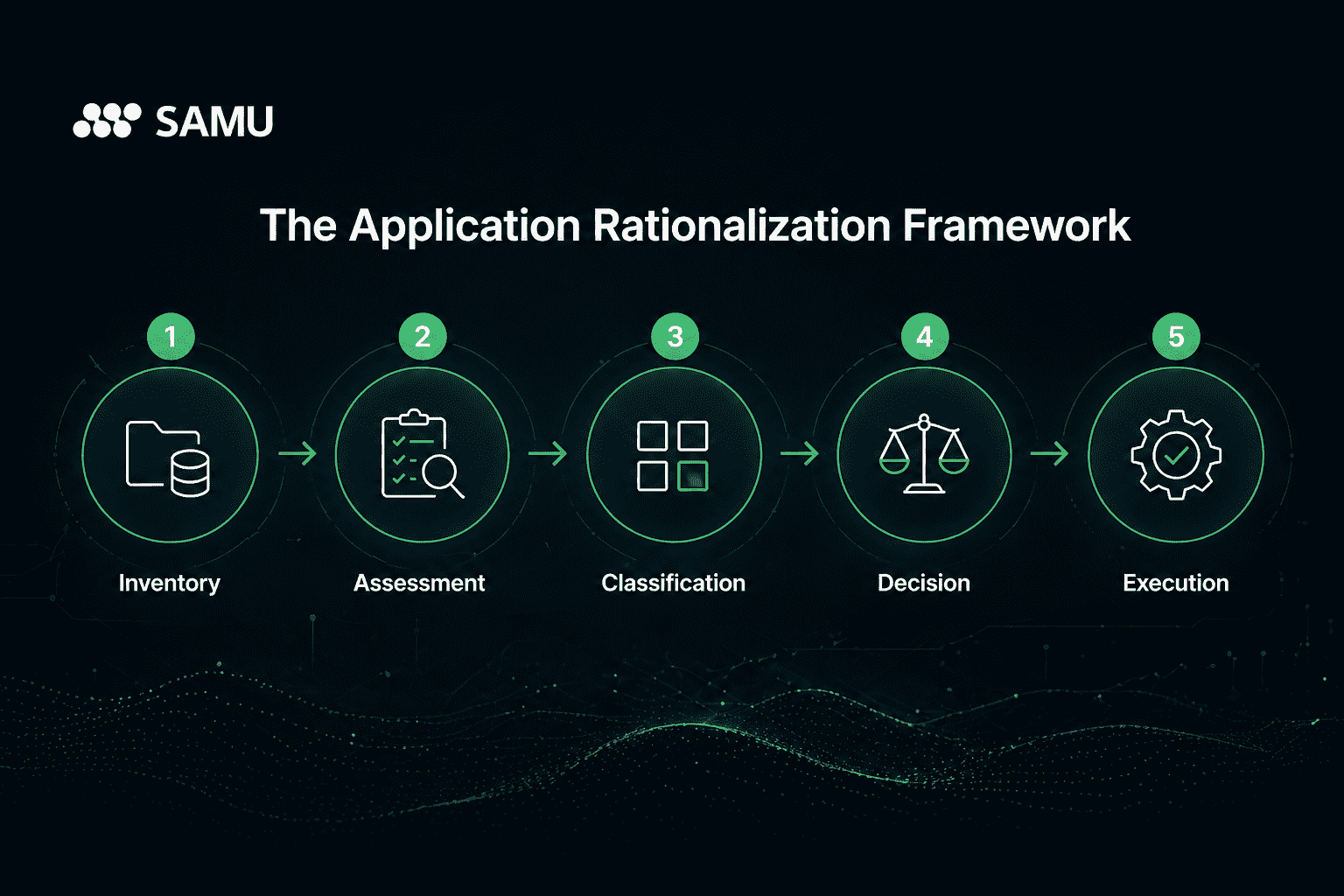
Successful application rationalization requires a structured approach. Without a framework, decisions become inconsistent and difficult to justify.
A typical application rationalization framework includes five stages.
1. Inventory
The organization identifies all of the applications in use across departments and environments.
This stage establishes visibility and transparency.
Without a complete inventory, rationalization cannot begin.
2. Assessment
Each application is evaluated based on defined criteria.
Common assessment factors can include:
- Business value
- Technical health
- Cost
- Risk
- Usage
- Dependencies
- Compliance requirements
This stage establishes understanding.
3. Classification
Applications are categorized according to their planned future role.
Typical classifications include:
- Retain
- Retire
- Replace
- Re-platform
- Refactor
This stage establishes direction.
4. Decision
Stakeholders determine the appropriate action for each application.
Decisions are based on the available data rather than ad-hoc assumptions.
This stage establishes accountability.
5. Execution
The organization implements changes.
Systems are consolidated, modernized, or retired according to the rationalization plan.
This stage establishes results.
Common Application Rationalization Strategies
Application rationalization strategies vary depending on organizational priorities, but several patterns appear consistently.
Consolidation
Multiple applications performing similar functions are replaced by a single standardized platform.
This strategy typically reduces licensing costs and simplifies integration.
Modernization
Legacy systems are updated to modern architecture platforms.
This may involve:
- Cloud migration
- Containerization
- API enablement
- Platform upgrades
Modernization improves performance and scalability without replacing core functionality.
Retirement
Applications that no longer provide value are removed from production.
Retirement reduces maintenance effort, reduces costs and eliminates security exposure.
Replacement
Outdated systems are replaced with new solutions that better support business requirements.
Replacement often occurs during digital transformation or other similar business initiatives.
Optimization
Applications remain in use but are reconfigured to improve performance or reduce costs.
Optimization is often the fastest way to deliver measurable results.
Challenges in Application Rationalization
Application rationalization is conceptually simple but operationally complex.
Organizations often encounter the same obstacles.
Lack of Visibility
Many enterprises do not have a complete list of applications.
Shadow IT and undocumented systems create blind spots and inherent risks and costs.
Incomplete Data
Decision-makers lack reliable information about usage, costs, and dependencies.
Without accurate data, rationalization becomes an act of guesswork.
Organizational Resistance
Departments may resist changes to familiar systems.
Users often perceive rationalization as a threat to stability and continuity.
Dependency Risk
Applications rarely operate independently.
Removing one system may affect multiple services.
Resource Constraints
Rationalization requires time, expertise, and coordination.
Organizations frequently underestimate the effort required.
These challenges are not technical problems, instead they are information problems.
Application rationalization tools exist to address these challenges.
Why Spreadsheets Fail in Application Rationalization
Many organizations begin rationalization projects using spreadsheets.
This approach appears to be simple, but it quickly can become unmanageable.
Spreadsheets struggle to handle:
- Large application inventories
- Complex dependency relationships
- Version tracking
- Access control
- Real-time updates
- Auditability
- Governance workflows
As the number of applications grows, spreadsheets become unreliable.
- Data becomes outdated.
- Decisions become inconsistent.
- Accountability disappears.
Application rationalization requires a methodology and tool designed to support complexity.
What Application Rationalization Tools Should Provide
Not all application rationalization tools are created equal.
Effective solutions share several essential capabilities.
Centralized Application Repository
All application information must be stored in a single authoritative source preferably a repository.
This eliminates duplication and ensures consistency.
Dependency Mapping
Understanding relationships between applications is critical for safe decision-making.
Dependency mapping reveals hidden connections.
Lifecycle Management
Applications should be tracked from introduction to retirement.
Lifecycle visibility supports long-term planning.
Data-Driven Decision Support
Rationalization decisions should be based on measurable criteria.
Analytics and dashboards provide objective insight.
Governance and Workflow
Rationalization requires coordination across teams.
Workflow automation ensures that decisions are documented and approved.
Reporting and Compliance
Organizations should demonstrate control over their application portfolio.
Reporting capabilities support audits and regulatory requirements.
How SAMU Supports Application Rationalization
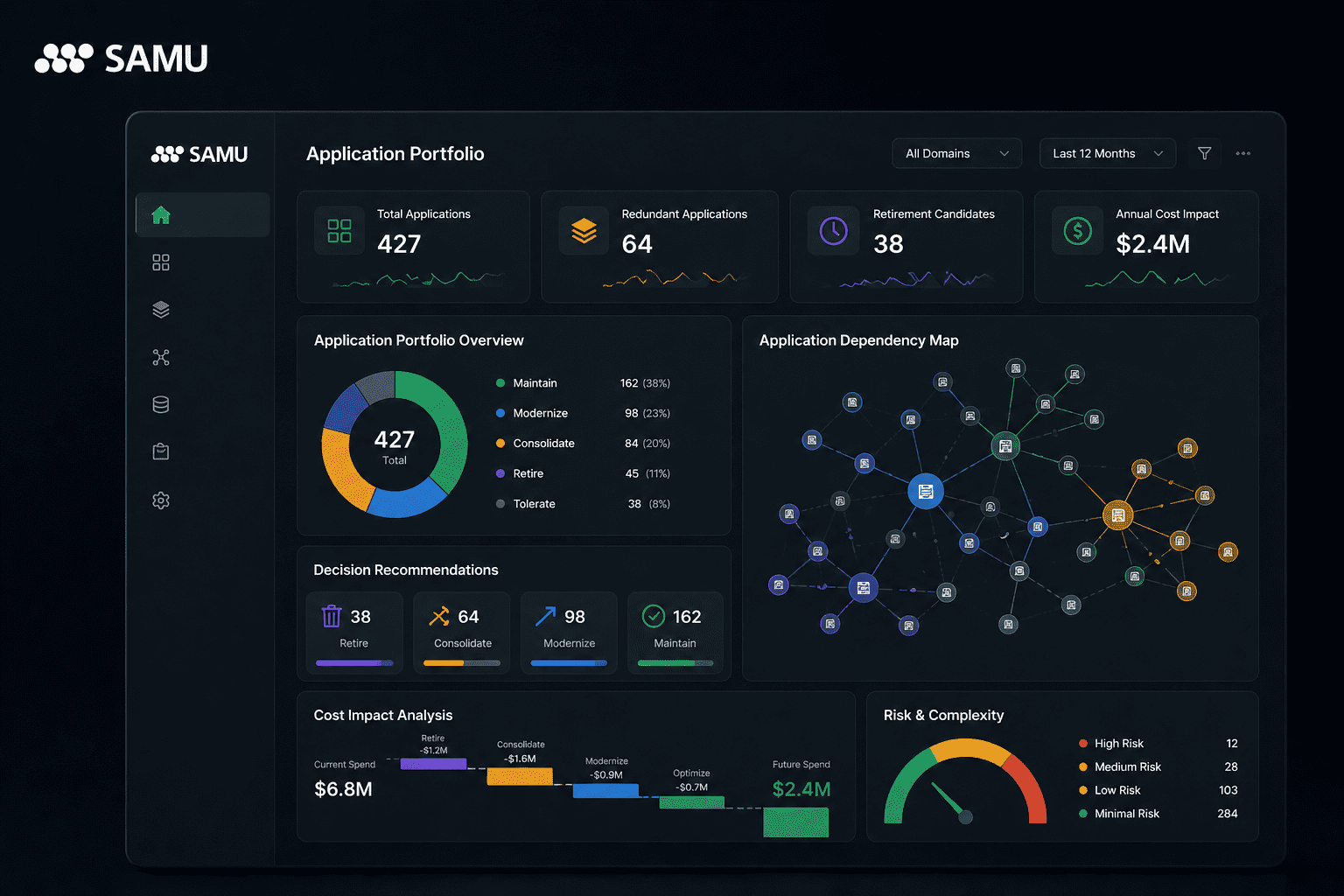
SAMU was designed specifically to manage complex enterprise application landscapes.
It provides a structured environment where rationalization decisions are transparent, consistent, and repeatable.
Instead of collecting data manually, teams can visualize their application ecosystem in real time.
This transforms application rationalization from just a one-time project into a continuous and repeatable capability.
Unified Application Visibility
SAMU creates a single source of truth for application information.
Organizations can see:
- Application inventory
- Dependencies
- Ownership
- Lifecycle status
- Technology stack
- Risk indicators
- Business value
Visibility is the foundation of rationalization.
Visual Architecture Modeling
Complex relationships are easier to understand when they are visual.
SAMU enables teams to map applications, services, and integrations into an intuitive and easy to understand graphical environment.
This reduces risks during consolidation and modernization initiatives.
Structured Evaluation Framework
SAMU supports standardized assessment and EA framework criteria. (TOGAF, ArchiMate, etc.)
Applications can be evaluated consistently across departments and regions.
This ensures fairness and transparency in decision-making.
Governance and Collaboration
Rationalization requires collaboration between architects, IT engineers, and business stakeholders.
SAMU provides a built-in workflow to coordinate activities and document decisions. (all changes are logged)
This improves accountability and expedites the internal governance processes.
Continuous Portfolio Optimization
Application rationalization should not be a one-time event but a continuous activity.
SAMU enables organizations to monitor their application portfolio continuously and to quickly adapt to the changing business requirements.
When Should Organizations Start Application Rationalization?
The best time to begin rationalization is before complexity becomes unmanageable.
However, there are certain signals that indicate action is needed urgently.
Organizations should consider application rationalization when:
- IT costs are rising faster than revenue
- Digital transformation initiatives are delayed
- Application inventories exceed visibility
- Security risks increase
- Integration complexity grows
- Cloud migration projects stall
- Mergers or acquisitions occur
- Technology audits reveal gaps
These signals are indicators that structural problems exist in the application portfolio.
Rationalization provides a path to resolution of these issues.
Application Rationalization and Digital Transformation
A successful Digital transformation is highly dependent on architectural clarity.
Organizations cannot modernize effectively if their application landscape is fragmented and poorly understood.
Legacy systems often limit innovation because they:
- Require manual integration
- Lack scalability
- Dependence on outdated technology
- Increases operational risks
Application rationalization removes these barriers.
By simplifying the application portfolio, organizations create a stable foundation for modernization.
Transformation becomes faster, safer, and more predictable.
Measuring the Success of Application Rationalization
Application rationalization delivers measurable outcomes.
Common success metrics include:
- Reduction in the number of applications
- Reduction in licensing costs
- Reduction in infrastructure consumption
- Reduction in support workload
- Improvement in system reliability
- Improvement in security posture
- Improvement in deployment speed
- Improvement in governance and compliance
These metrics demonstrate the value of rationalization to executives and stakeholders.
They also support long-term investment decisions.
Application Rationalization Is Not a One-Time Project
Many organizations treat application rationalization as a temporary initiative.
They conduct a large cleanup project and then return to normal operations.
This approach fails because Application portfolios evolve continuously.
New systems are introduced, old systems become obsolete and business priorities change.
Without ongoing application governance, complexity returns.
Sustainable application rationalization requires continuous visibility and internal processes for structured decision-making.
This is why modern enterprises integrate rationalization into their enterprise architecture management.
Why Enterprises Choose SAMU for Application Rationalization
Organizations select SAMU because it combines visibility, governance, and decision-making support into a single platform.
Instead of managing applications across multiple disconnected tools, teams work within a unified platform.
This reduces friction and improves consistency and communication.
Key advantages include:
- Centralized application portfolio management
- Real-time architecture visualization
- Structured application rationalization workflows
- Scalable data management
- Improved governance and compliance
- Faster modernization planning
- Reduced operational risk
These capabilities enable organizations to transform complexity into clarity.
Start Your Application Rationalization Journey
Every organization eventually reaches a point where application complexity limits its ability to grow.
The question is not whether application rationalization is necessary.
The question instead is when to begin.
Organizations that act early gain control over their technology landscape.
They reduce costs, improve resilience and accelerate innovation.
SAMU provides the visibility and structure required to make application rationalization a success.
Instead of reacting to complexity, you can manage it.
Instead of maintaining redundant systems, you can optimize your application portfolio.
Instead of uncertainty, you gain confidence.
What is application rationalization in simple terms?
Application rationalization is the process of reviewing all applications in an organization and deciding which systems should be kept, improved, replaced, or retired. The goal is to reduce complexity and ensure that every application supports business objectives.
How long does an application rationalization project typically take?
The duration depends on the size and complexity of the application portfolio. Small organizations may complete rationalization in a few months, while large enterprises may conduct phased programs over several years. Most organizations begin seeing measurable benefits within the first six to twelve months.
What is the difference between application rationalization and application modernization?
Application rationalization focuses on evaluating and optimizing the application portfolio. Application modernization focuses on updating individual systems. Rationalization determines which systems should be modernized in the first place.
How many applications should an enterprise have?
There is no universal number. The optimal application count depends on business size, industry, and operational requirements. The key indicator is not quantity but alignment. Every application should have a clear purpose and measurable value.
Who is responsible for application rationalization?
Application rationalization is typically led by enterprise architects, CIOs, or IT governance teams. However, successful programs involve collaboration across departments, including finance, security, operations, and business leadership.
Can application rationalization reduce cloud costs?
Yes. Many organizations discover that cloud costs increase when redundant or underused applications remain in operation. Rationalization identifies unnecessary workloads and enables more efficient resource allocation.
What data is required to start application rationalization?
Organizations need basic information about each application, including ownership, usage, cost, dependencies, lifecycle status, and business value. Modern application rationalization tools help collect and maintain this information automatically.