
Intuitive Enterprise Architecture modeling experience
Enterprise Architecture Modeling is the process of visually representing an organization’s structure, processes, systems, and technologies to align them with its goals and optimize performance.
Visualizing complexity
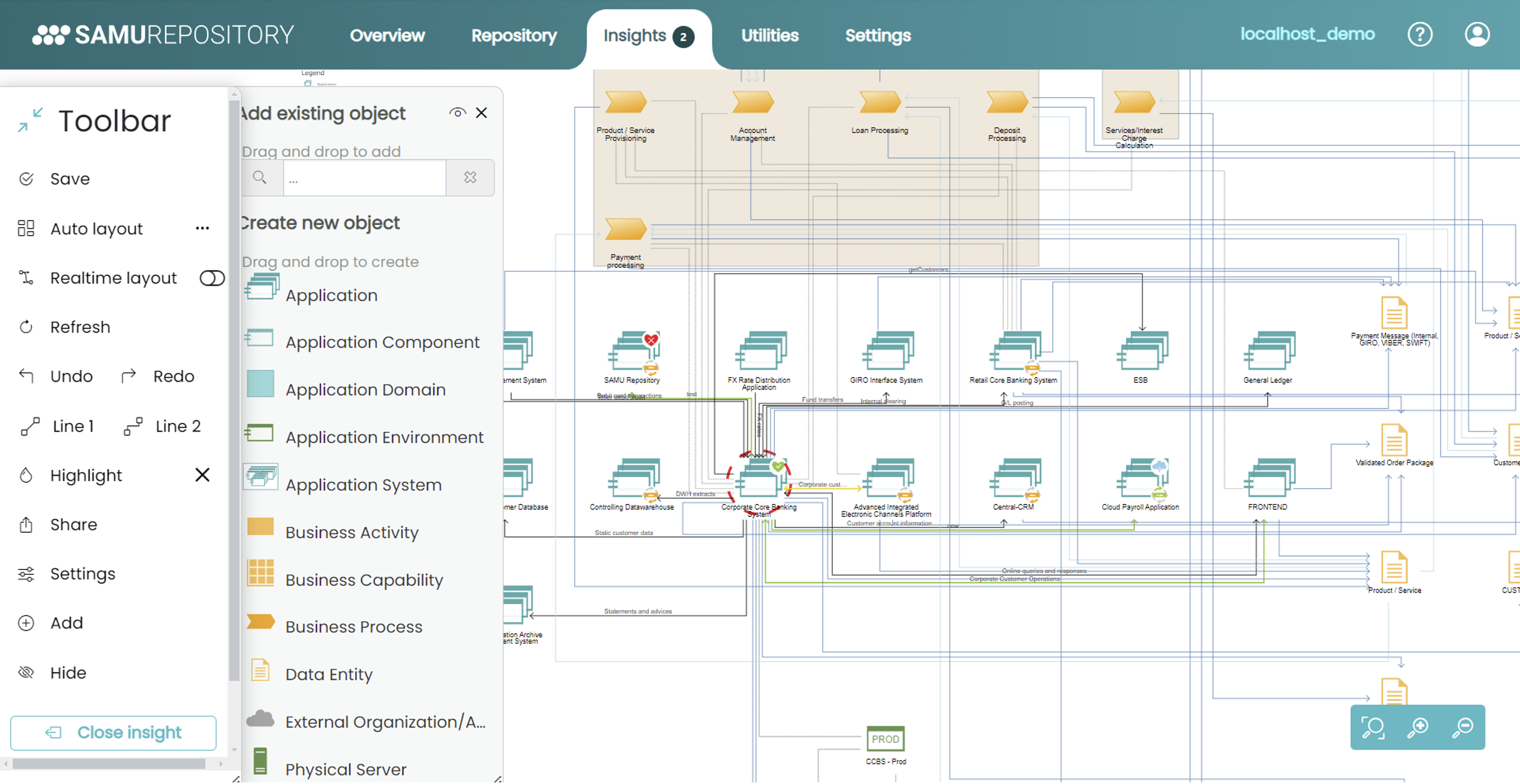
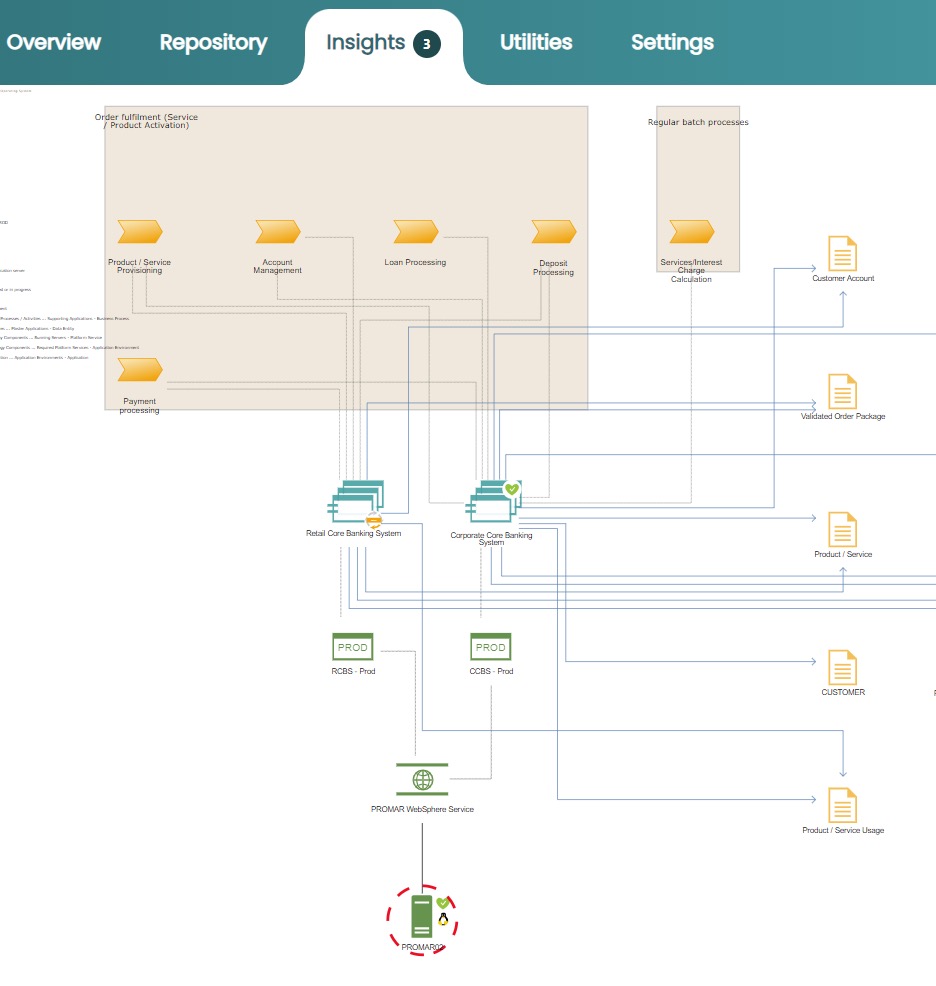
The whole architecture graph or any segment can be shown on self-explanatory diagrams. Through our data-driven approach, every screen generated by SAMU is based actual data from its repository. Queries deliver data for the report, while the visualization rules will determine how the components will appear (i.e. The symbol used for a certain object type, layout, level of detail).
By setting up user-defined displaying rules, analyzing the architecture can be made simple. For instance, you can highlight areas based on certain attributes (i.e. Show all data flows on an application communications diagram, which transfer personal data).
Modelling
Visuals are not just read-only and static, as users can update and model the architecture graph on the diagrams. You can build up your models using the drag & drop of symbols to the canvas, just like in Visio. However, in SAMU, all of these actions are database transactions – new components are new records, lines are associations between records, and as needed, you are able reuse components that already exist in the repository.
As soon as you update anything, it becomes shared and visible to everyone with the proper access rights.
Modelling projects
Most importantly, SAMU is an ideal platform for the enterprise to model and plan the upcoming transformation initiatives in a collaborative and agile manner. It will not only show the current as-is state, but also each and every future to-be planned changes to the architecture. If this is done practically, it will become a knowledge base and the most up-to-date architecture information source of truth in your organization.
Understanding the risks and the impact of changes
SAMU contains the entire architecture graph, thus the potential impacts of upcoming changes can be evaluated much more quickly and easily. Just pick any component and see how applying modifications on it can affect other components across the organization.
Similarly, in case an incident happens (and unfortunately, they do), reports in SAMU can help you identify the potential causes of the issue within seconds.
Evaluating portfolios
Portfolios of architecture (i.e. Business Capabilities, Application Portfolios, Service Catalogs, Asset Inventories, etc.) can be analyzed and evaluated from many perspectives in SAMU. For instance, survey and classify the business application portfolio, according to its strategic importance, cost and other attributes. Based on these findings, transformation and strategic initiatives can be launched to save resources and gain efficiencies.
Automation
Yes, we use automation where possible to maintain data quality, but our focus is to get the users interested in collaborating and shaping the future together. Nevertheless, SAMU is able to integrate with basically any other tools via web service API (SOAP, REST) and/or automatic data synchronizations.
Join our satisfied customers!
Digitally conscious businesses who trust us









Why us?
We offer a Free SAMU Trial and/or a Free Proof of Concept (We set up the trial using customer data)
SAMU is extremely flexible, the meta-model is fully flexible, custom reports can be created, sophisticated user permission rights
Our Best Practice Model based on 20+ years of experience in delivering successful EA projects
SAMU has been developed using a bottom-up approach. Product development is based on real-life customer needs.
Customer satisfaction and our approach. Each customer is unique. We strive to bring real value and to have a successful EA practice.
Powerful visualizations: Our visualizations are all data-driven generated from the live repository with multiple lifecycle views available.
Integration capabilities: Sophisticated API to automate data upload and maintain quality in the repository.
What is an enterprise architecture tool and who is it for?
An enterprise architecture tool is a platform designed to help organizations gain a clear, structured view of their entire IT landscape, including applications, systems, and business processes. Instead of working with fragmented data across multiple tools, teams can centralize everything in one place and understand how technology supports business goals.
Solutions like SAMU are built specifically for enterprises, CIOs, and IT leaders who need to make strategic decisions about their IT environment. Whether it’s optimizing legacy systems, planning digital transformation, or improving collaboration between business and IT, an enterprise architecture tool provides the visibility and control needed to move forward with confidence.
How does an enterprise architecture platform improve IT strategy and decision-making?
An enterprise architecture platform connects high-level business objectives with the underlying IT systems that support them. This makes it possible to see how changes in technology impact the organization as a whole, rather than evaluating systems in isolation.
With a well-implemented enterprise architecture platform, IT leaders can identify redundancies, reduce complexity, and prioritize investments based on real data. It becomes much easier to align IT strategy with business goals, manage risks, and ensure that every decision contributes to long-term value instead of short-term fixes.
What problems does enterprise architecture software solve for enterprises?
Enterprise architecture software addresses some of the most common challenges large organizations face: lack of transparency, duplicated systems, increasing IT costs, and difficulty managing change. In many companies, information about systems and processes is scattered, outdated, or incomplete.
By introducing a centralized enterprise architecture software solution, organizations can create a single source of truth for their IT landscape. This improves visibility, supports better governance, and enables faster, more informed decisions. It also helps reduce unnecessary complexity and ensures that technology investments are aligned with business priorities.
How does SAMU support IT landscape management and application portfolio management (APM)?
SAMU provides a comprehensive view of the IT landscape, allowing organizations to map, analyze, and continuously optimize their systems. Through advanced IT landscape management capabilities, users can understand how applications are connected, where dependencies exist, and which areas require attention.
In addition, SAMU supports application portfolio management (APM) by helping organizations evaluate the performance, cost, and business value of each application. This makes it easier to identify redundant or outdated systems, prioritize modernization efforts, and build a more efficient, future-ready IT environment.
Is SAMU suitable for large enterprises and CIO-level decision making?
Yes, SAMU is designed with enterprise-scale complexity in mind. It supports organizations that operate with large, distributed IT environments and need a reliable foundation for strategic decision-making at the highest level.
For CIOs and senior IT leaders, SAMU provides the insights required to balance innovation with stability. It enables better planning, clearer communication with stakeholders, and more effective governance across the entire IT landscape. This makes it a valuable tool not only for managing current systems, but also for guiding long-term digital transformation initiatives.
How is SAMU different from other enterprise architecture tools?
While many enterprise architecture tools focus primarily on documentation, SAMU is designed to actively support decision-making and continuous improvement. It goes beyond static diagrams and provides actionable insights that help organizations optimize their IT landscape in real time.
SAMU combines enterprise architecture, IT strategy, and application portfolio management into a single platform. This integrated approach reduces the need for multiple tools and ensures that all stakeholders work with consistent, up-to-date information. As a result, organizations can move faster, reduce complexity, and make more confident strategic decisions.
How long does it take to implement application portfolio management?
Implementation timelines depend on the size and complexity of the organization, as well as the availability of reliable application data. In most enterprises, the initial setup of application portfolio management can take between a few weeks and a few months.
The first phase typically focuses on creating an accurate application inventory and defining governance processes. Once this foundation is in place, organizations can gradually expand the scope to include lifecycle tracking, cost analysis, and modernization planning.
Many organizations start with a pilot initiative before scaling application portfolio management across the entire enterprise.
What is the difference between application portfolio management and application rationalization?
Application portfolio management is a continuous management discipline, while application rationalization is a specific activity within that discipline.
Application portfolio management focuses on maintaining visibility into applications, monitoring lifecycle status, and supporting long-term decision-making. Application rationalization, on the other hand, is the process of evaluating applications to determine whether they should be retained, replaced, consolidated, or retired.
Organizations typically perform application rationalization periodically as part of an ongoing application portfolio management strategy.
How often should an application portfolio be reviewed?
Most organizations review their application portfolio on a regular basis, typically quarterly or semi-annually. However, high-risk or business-critical applications may require more frequent monitoring.
Regular reviews help organizations identify outdated technologies, track licensing costs, and detect redundant systems before they create operational or security risks. Continuous monitoring is especially important in environments undergoing digital transformation or cloud migration.
Establishing a predictable review cycle is a key element of effective application portfolio governance.
What are the biggest challenges in application portfolio management?
One of the most common challenges is maintaining accurate and consistent application data across the organization. Many enterprises struggle with incomplete inventories, unclear ownership, and fragmented documentation.
Another challenge is aligning technical decisions with business priorities. Without strong governance processes, application portfolios can grow rapidly and become difficult to manage.
Successful application portfolio management requires not only technology, but also clear roles, responsibilities, and decision-making frameworks.
Can application portfolio management support cloud migration planning?
Yes, application portfolio management plays a critical role in planning and executing cloud migration initiatives. Before moving applications to the cloud, organizations must understand dependencies, technical requirements, and business value.
Application portfolio management provides visibility into application architecture, lifecycle status, and integration points. This information helps organizations identify which applications are suitable for migration, which require modernization, and which should be retired.
Without this visibility, cloud migration projects often become more complex, expensive, and risky than expected.
What metrics should be tracked in application portfolio management?
Effective application portfolio management relies on consistent and measurable indicators that reflect both business value and technical risk.
Common metrics include application cost, business criticality, lifecycle status, user adoption, and technical complexity. Organizations may also track security risk, vendor support status, and integration dependencies.
Tracking these metrics enables data-driven decision-making and helps IT leaders prioritize modernization and investment initiatives.
Contact us
Don't take our word for it!
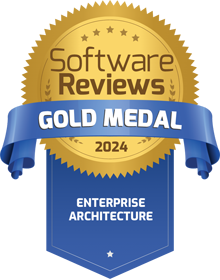

Atoll Technologies Ltd. EA tool SAMU is a leader in Info-Tech Research Group /SoftwareReview 2024 Enterprise Architecture Data Quadrant Report.

„Atoll Technologies Ltd.is the dominant vendor for EA tools in the Middle East. It also has regional strength in Central and Eastern Europe, and can provide strong support to these otherwise underserved markets."

Atoll Technologies Ltd. EA tool SAMU is included in the Forrester Now Tech: Enterprise Architecture Management Suites, Q2 2022.
