
SAMU vs SAP LeanIX: Which Enterprise Architecture Tool Fits Your Organization Better?
Enterprise architecture management is not just a documentation exercise. For modern CIOs, enterprise architects, IT portfolio managers, and transformation leaders, it has become a practical decision-supporting capability. Organizations need to understand which applications they run, how those applications support business capabilities, where dependencies exist, which technologies are becoming risky, and how planned changes will affect the wider enterprise landscape.
This is why enterprise architecture tools have become even more important. The right platform helps organizations move from fragmented spreadsheets, static diagrams, and scattered data ownership, into a living architecture repository that supports better decision-making.
This comparison looks at two enterprise architecture platforms: SAMU and SAP LeanIX. Both help organizations understand and manage complex IT landscapes, but they approach the problem from different directions.
SAP LeanIX is an internationally recognized enterprise architecture platform with strong SAP ecosystem alignment, a large marketplace presence, AI-enabled capabilities, and a strong fit for organizations that want a standardized, cloud-native enterprise architecture management solution. SAP describes LeanIX as a software-as-a-service offering used by more than 1,000 customers globally to visualize IT landscapes, identify obsolete applications, design target states, and plan architecture roadmaps.
SAMU, on the other hand, is a flexible enterprise architecture tool designed around a live repository, configurable meta-model, data-driven visualizations, workflow-based governance, application portfolio management, and practical transformation planning. SAMU is especially relevant for organizations that want their enterprise architecture platform to adapt to their operating model, terminology, maturity level, regulatory needs, and deployment preferences.
The most important difference is not simply a feature by feature comparison. It is strategic fit. LeanIX is strong when an organization wants a standardized SaaS platform aligned with the SAP transformation ecosystem. SAMU is strong when an organization needs flexibility, price competitiveness, deployment choices, configurable modeling, simpler adoption, and a platform that can reflect the organization’s own architecture reality quickly.
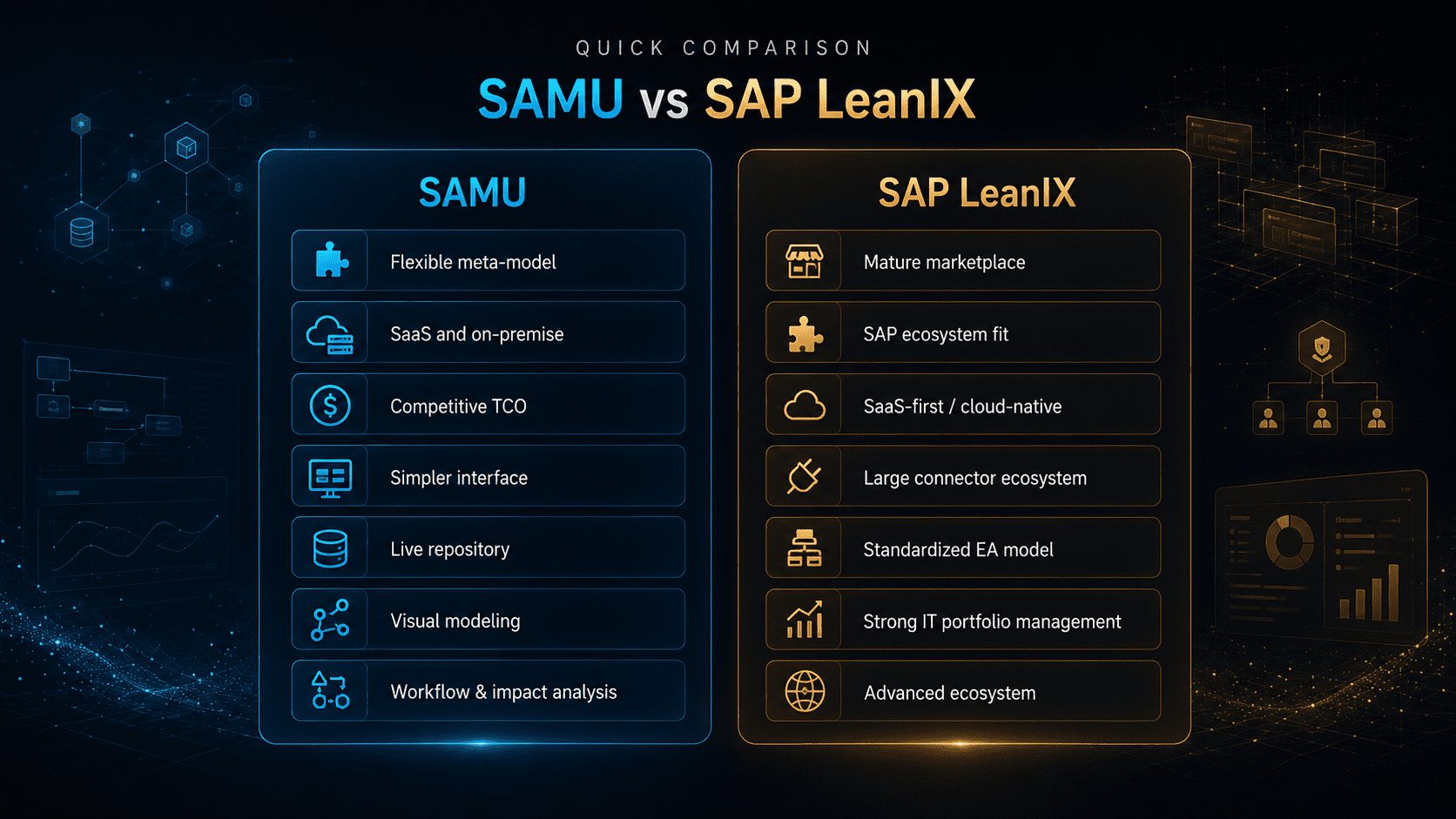
Quick comparison: SAMU vs SAP LeanIX
| Evaluation area | SAMU | SAP LeanIX |
|---|---|---|
| Core positioning | Flexible enterprise architecture, IT governance, application portfolio, and transformation platform | Mature enterprise architecture and transformation platform with strong SAP ecosystem fit |
| Deployment | SaaS and on-premise options | Public materials position LeanIX as SaaS / cloud-native SaaS |
| Pricing position | Price-competitive positioning; potentially attractive total cost of ownership, especially where customization and deployment flexibility matter | Public pricing model is based on number of applications, with tiered pricing and unlimited users |
| Meta-model flexibility | Fully flexible meta-model; configurable to customer-specific EA maturity and terminology | Predefined, configurable meta-model; SAP guidance recommends using the standard model first and extending only where business need is clear |
| Customization speed | Designed for configurable changes without heavy vendor intervention | Strong configuration capabilities, but more standardized governance and model discipline may increase change effort |
| User interface | Positioned as simpler and easier to use | Feature-rich, mature interface; can be powerful but more complex for some users |
| Visualization | Strong data-driven diagrams generated from the live repository | Strong dashboards, reports, and out-of-the-box visualization |
| Application portfolio management | Strong fit for application inventory, dependency mapping, rationalization, lifecycle, risk, and ownership | Strong APM capabilities, including dashboards, TCO, surveys, SaaS discovery, and reference catalogs |
| Governance | Workflow, permissions, repository control, and auditability | Strong collaboration, surveys, automations, quality seals, and standardized governance patterns |
| Best fit | Organizations needing flexibility, lower complexity, on-prem option, fast customization, and close customer support | Organizations prioritizing SAP ecosystem integration, global SaaS scale, standardized EA practice, and mature connector ecosystem |
Why this comparison matters
Enterprise architecture tool selection is often treated as a software procurement decision. In reality, it is an operating model decision.
A company does not only buy an EA tool to store application names but instead it buys a way of thinking about enterprise architecture management. It buys a way to connect business capabilities, systems, integrations, infrastructure, projects, risks, costs, owners, and future-state scenarios. It also buys a collaboration model: who updates the data, who approves changes, who consumes reports, and who trusts the repository when strategic decisions are made.
That is why the SAMU vs SAP LeanIX comparison matters. Both platforms support enterprise architecture, application portfolio management, and transformation planning. But they are not identical in their philosophy.
LeanIX is often a natural fit for organizations that want a mature, cloud-native, internationally recognized enterprise architecture platform with a strong SAP relationship. The platform is especially relevant for organizations already running large SAP landscapes, SAP Signavio, SAP Cloud ALM, or ERP transformation programs. SAP LeanIX is presented as part of SAP’s broader business transformation management direction, helping companies connect technology transformation with process transformation and AI governance.
SAMU is better understood as a flexible, repository-based EA platform that gives organizations more control over how they model their architecture. SAMU is a data-driven EA tool focused on the integrity and interdependency of architecture components in a central structured repository, and the more stakeholders use it, the better the data quality typically becomes.
For many organizations, this difference is critical. Some companies want a standardized enterprise architecture tool that tells them how to model. Others need a platform that can adapt to the way they already work, while still improving governance and decision quality. SAMU is especially compelling in the second scenario.
LeanIX strengths: maturity, SAP ecosystem, and standardized enterprise architecture
SAP LeanIX has clear strengths. It is a mature platform with strong global visibility and a large enterprise customer base. SAP’s 2024 G-Cloud service definition describes SAP LeanIX as a market leader for enterprise architecture, with software-as-a-service solutions that help organizations create transparency, visualize their IT landscape, assess its interconnections, and manage transition toward a target architecture.
LeanIX is particularly strong in application portfolio management. Its pricing page states that LeanIX charges based on the number of applications and provides unlimited user access. The LeanIX Application Portfolio Management package includes complete portfolio assessment, tiered pricing, default APM dashboards, AI capabilities, surveys, automations, open APIs, SaaS discovery, and SAP landscape and extension discovery.
This is valuable for organizations that want to quickly establish a structured, enterprise-wide application inventory. LeanIX provides predefined concepts, dashboards, reports, and reference catalogs that help teams move quickly if they are willing to align with the platform’s operating logic.
LeanIX also benefits from SAP ownership. For organizations already committed to SAP transformation, SAP LeanIX can fit naturally into the broader SAP ecosystem. It supports architecture and roadmap planning, technology risk and compliance, SAP landscape discovery, and business transformation management. The Microsoft Marketplace listing describes SAP LeanIX Enterprise Architecture as a SaaS solution for establishing a transparent as-is IT landscape, identifying optimization opportunities, planning roadmaps, and driving transformation with a shared understanding of IT reality.
None of this should be minimized. LeanIX is a strong platform. In many large organizations, especially SAP-centered global enterprises, it may be the expected choice.
But strengths can also come with trade-offs. Standardization can simplify adoption for some organizations, but it can also reduce flexibility for others. A predefined enterprise architecture model can accelerate time to value when it fits the customer’s needs. When it does not, customization, governance alignment, and change management can become more difficult and take a lot of time.
That is where SAMU’s positioning becomes especially important.
SAMU strengths: flexibility, live repository, and practical enterprise architecture
SAMU’s strongest value proposition is its flexibility. SAMU is not only an enterprise architecture documentation tool. It is a configurable platform to manage enterprise architecture, IT governance, application portfolio management, and digital transformation.
The SAMU product page describes the platform as a business software platform for enterprise architecture, IT governance, and digital transformation management, enabling organizations to model applications, business capabilities, and technology landscapes in a structured way.
SAMU’s key advantage is that it can reflect the customer’s own architecture reality. Many enterprises already have their own language for systems, domains, capabilities, products, services, integrations, vendors, data objects, and technology layers. Forcing all of that into a rigid tool structure can create resistance. The tool may be technically correct, but it may not match how the organization thinks.
SAMU addresses this by making the meta-model completely flexible and easily changeable. SAMU’s own use case page states that SAMU is extremely flexible, the meta-model is fully flexible, custom reports can be created, and sophisticated user permission rights are supported.
This is not a minor feature. In enterprise architecture, the meta-model defines what the organization wants to mange in terms of EA. It determines what object types exist, which relationships matter, which attributes can be maintained, which reports can be generated, and which decisions can be supported.
If the meta-model is too rigid, the EA team may spend months adapting the organization to the tool. If the meta-model is flexible, the tool can be adapted to the organization.
For many buyers, this is the decisive difference.
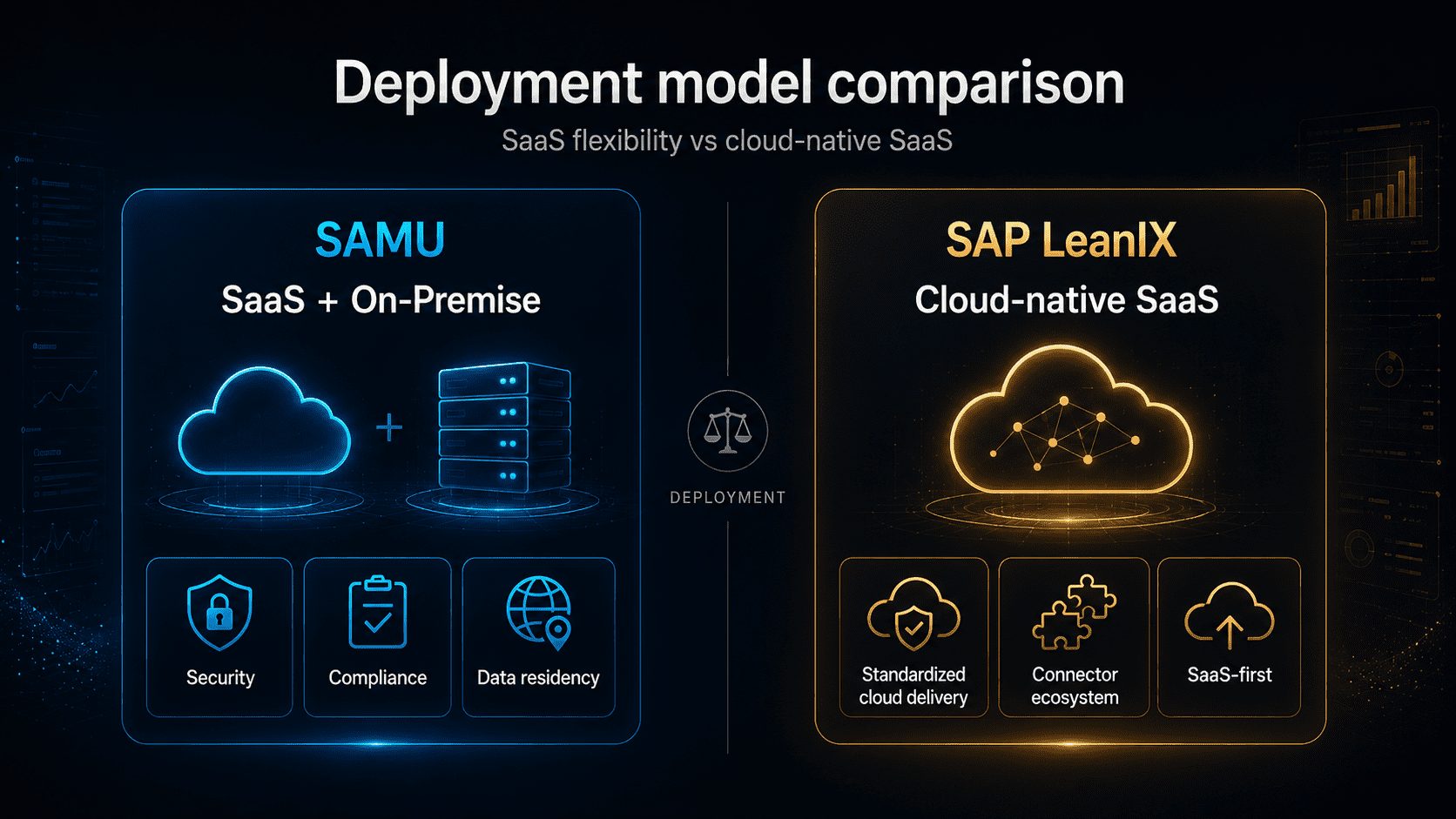
Deployment: SAMU offers SaaS and on-premise flexibility
Deployment model is often overlooked during EA tool selection. It should not be.
Enterprise architecture repositories can contain highly sensitive information: applications, infrastructure, integrations, vendors, data flows, compliance attributes, business capabilities, risk indicators, and transformation plans. For some organizations, a cloud-native SaaS model is ideal. For others, regulatory, security, data residency, or internal IT policy requirements may make on-premise deployment important. Also, some organizations may prefer the CAPEX financial advantages that an on-prem solution can offer compared to an OPEX cost.
Based on the public sources reviewed, SAP LeanIX is consistently positioned as a SaaS solution. SAP Help Portal describes SAP LeanIX as a SaaS application, SAP’s acquisition communication refers to LeanIX’s software-as-a-service offering, and the Microsoft Marketplace listing describes SAP LeanIX as cloud-native SaaS with daily deployments and global hosting clusters.
This is not necessarily a weakness. SaaS can be the right model for many enterprises. It can simplify updates, reduce infrastructure responsibilities, and support faster access to new product capabilities.
However, if a company requires an on-premise EA platform, this can become an important selection criteria. The competitor comparison material provided for SAMU explicitly lists “On-Prem Solution also offered” as a SAMU contrast point, while describing both SAMU and competitors as cloud-based EA management tools with repository models, basic integrations, collaboration features, and visualization tools.
That makes SAMU especially relevant for organizations that need deployment choice. A bank, public-sector organization, defense-related company, critical infrastructure provider, or heavily regulated enterprise may not want its architecture repository only in a public SaaS environment. In those cases, SAMU’s ability to support both SaaS and on-premise scenarios can be a practical advantage.
The right way to frame this in buyer conversations is simple:
LeanIX is a strong SaaS-first enterprise architecture platform. SAMU gives organizations more deployment flexibility, including on-premise availability when required.
Price competitiveness and total cost of ownership
Enterprise architecture tools are rarely evaluated only on subscription price. The real question is total cost of ownership.
A platform can appear affordable at license level but become expensive if implementation, customization, model changes, training, governance setup, integration, and administration require significant ongoing effort. Conversely, a tool with a straightforward commercial model and lower customization overhead can become more cost-effective over time.
LeanIX public pricing information states that pricing is based on the number of applications, with no limit on the number of users who can access LeanIX Enterprise Architecture. The APM package is described as priced per app, with tiered pricing and unlimited users. This model can be attractive for organizations that want broad user access and have a clear application inventory scope.
However, the application-based model also means that cost evaluation depends heavily on portfolio size. A company managing a few hundred applications will have a different cost profile from an enterprise managing thousands of applications, multiple subsidiaries, legacy systems, SaaS tools, and technology components.
SAMU’s competitor comparison material positions SAMU as having competitive pricing, while LeanIX is described as having higher pricing. Publicly, this should be expressed carefully. Final commercial comparisons always depend on the customer’s scope, negotiated terms, deployment model, required modules, number of architecture objects, implementation services, and support expectations.
Still, SAMU can be positioned as a price-competitive alternative to SAP LeanIX, especially when the buyer considers more than just the subscription price. The main TCO advantages can come from five areas.
First, SAMU’s flexible meta-model may reduce the cost of adapting the platform to the organization’s way of working. Second, a simpler interface can reduce training and adoption effort. Third, configurable reporting and visualization can reduce reliance on external customization. Fourth, on-premise availability may help organizations avoid architectural compromises where SaaS is not preferred. Fifth, close vendor support can reduce the hidden cost of slow change requests.
In other words, SAMU’s price advantage should not be framed only as “license price.” The stronger message is:
SAMU can offer a more price-competitive total cost of ownership for organizations that need flexibility, faster customization, simpler adoption, and deployment choice.
That is a more credible and more strategic claim.
Flexibility: configurable tool vs customizable architecture platform
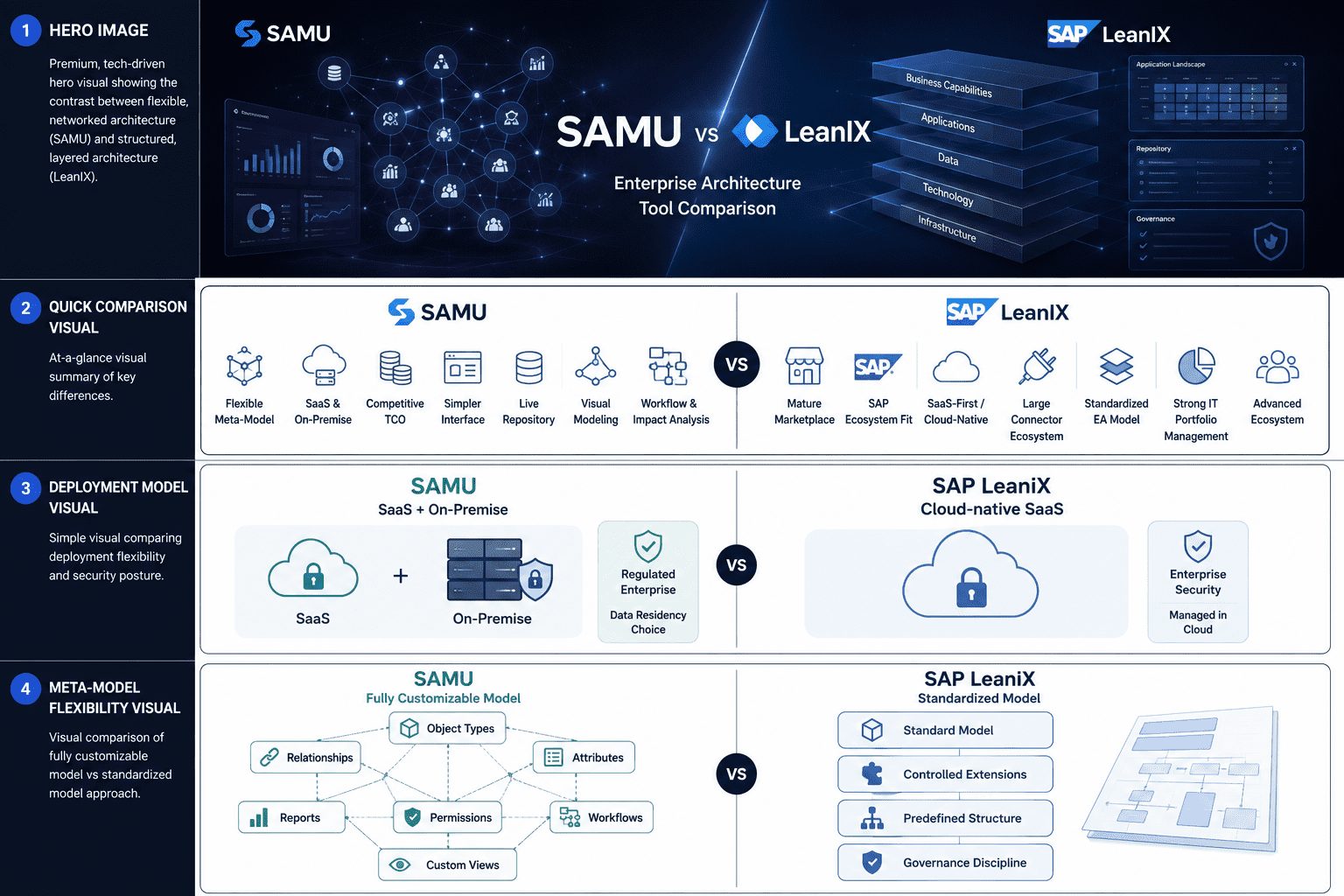
Flexibility is one of the most important differences between SAMU and LeanIX.
LeanIX is configurable. Its marketplace listing describes a predefined, fully configurable meta-model designed for fast time to value. The LeanIX pricing page also lists “Meta Model configuration” among its capabilities.
However, SAP’s own modeling guidance emphasizes discipline around the standard model. A 2026 SAP LeanIX modeling guide recommends using the standard LeanIX model first and extending it only when the business need is clear. It also states that adding subtypes, custom fields, tags, or hierarchies increases maintenance effort, so the model should be kept lean and purposeful.
That guidance is reasonable. In a standardized enterprise SaaS platform, uncontrolled customization can create complexity. LeanIX’s philosophy is to provide a strong, standard model and extend carefully.
SAMU’s philosophy is different. SAMU is built around the idea that each enterprise may need its own architecture model. The meta-model is fully flexible, and organizations can create custom reports and sophisticated permission models. SAMU comes with a Best Practice Model as a starting point based on TOGAF and ArchiMate standards but can be easily changed to meet the needs of the customer.
This matters in real projects. Enterprise architecture teams often discover that their company does not fit neatly into a generic object model. They may need to represent special business domains, regulatory classifications, integration types, data sensitivity levels, local ownership structures, service models, project stages, approval states, or technology risk categories.
In a more standardized tool, even a small change can trigger broader questions: Will the change break reports? Does it affect integrations? Does it conflict with the vendor’s recommended model? Does it need central governance approval? Will it require external consulting? How long will it take to implement across the workspace?
In SAMU, the positioning is much more configuration-driven. If the organization needs a new object type, relationship, attribute, report, or view, the platform is designed to support that level of adaptation. This can make SAMU significantly more practical for organizations whose enterprise architecture practice is still evolving or whose governance model is unique.
A good summary is:
LeanIX is configurable around a strong standard model. SAMU is designed for deeper customer-specific customization.
User interface and adoption
The best enterprise architecture repository is useless if people do not update it.
Many EA initiatives fail not because the architecture team lacks expertise, but because the tool is too difficult to use for non-architects. Application owners do not update lifecycle data. Business stakeholders do not review capability mappings. Project teams do not maintain dependencies. IT operations teams keep working in separate systems. Eventually, the EA repository becomes a specialist tool used by a small group, rather than a shared source of truth.
User interface and adoption therefore matter as much as advanced functionality.
The SAMU competitor material positions SAMU as having a simpler interface, while LeanIX is described as having a more complex interface. This should not be interpreted as LeanIX being unusable. LeanIX is a mature product and public materials describe it as user-friendly, web-based, and built for quick implementation.
The real question is different: which interface is easier for the customer’s broader stakeholder group?
LeanIX can be very powerful for mature EA teams that are comfortable with standardized fact sheets, dashboards, reports, surveys, and structured architecture governance. SAMU can be more approachable for organizations that want a simpler, more directly configurable interface focused on core EA use cases.
This is especially important when enterprise architecture needs to expand beyond architects. Application owners, security teams, compliance officers, project managers, business analysts, infrastructure teams, and senior decision makers may all need to interact with the platform. They do not necessarily want an expert modeling environment. They want clear views, relevant tasks, understandable relationships, and simple ways to update information.
SAMU’s advantage is that it can be configured around the user’s role and the organization’s process. If one stakeholder only needs to maintain application ownership, they should not see unnecessary modeling complexity. If another stakeholder needs a transformation roadmap, they should see the planned changes, dependencies, and risks that matter to them. If an executive needs a portfolio-level view, they should not need to understand the underlying meta-model.
A simpler interface is not only a usability advantage. It is a data quality advantage. The easier it is for stakeholders to contribute, the more likely the data quality of the repository remains accurate. Also, it means that more people will use it as a Source of Truth within the organization.
Visualization: SAMU’s live, data-driven architecture views
Visualization is already one of SAMU’s strongest points, and it should remain a major part of the comparison.
Many enterprise architecture tools can create diagrams. The difference is whether those diagrams are static drawings or live views of repository data.
SAMU’s enterprise architecture modeling approach is built around data-driven diagrams. SAMU can show the current as-is state and future to-be planned changes, helping the platform become the most up-to-date architecture source of truth in the organization.
This is important because static architecture diagrams become outdated quickly. A Visio diagram, PowerPoint slide, or manually maintained architecture map may be useful for a project meeting, but it often fails as a long-term governance artifact. Someone changes an application, retires an interface, adds a SaaS tool, updates ownership, or changes a lifecycle status. Unless the diagram is connected to the underlying repository, the visual layer becomes outdated.
SAMU addresses this by generating visualizations from the live repository. This means the diagram is not just a picture. It is a view of actual architecture data. The visuals may change if the underlying data changes.
The value is significant:
Teams can visualize dependencies between applications, interfaces, technologies, business capabilities, data objects, and infrastructure. They can analyze how one system change affects another. They can create views for different audiences without duplicating the underlying data. They can compare current-state and future-state architecture. They can support impact analysis with visual evidence rather than assumptions.
LeanIX also offers strong visualization capabilities. Its public materials mention out-of-the-box dashboards, reports, and diagramming capabilities, and its marketplace listing highlights powerful visualization with dashboards and reports for identifying opportunities and risks.
The difference is again philosophy. LeanIX offers strong standardized dashboards and reporting. SAMU emphasizes flexible, data-driven visual modeling generated from the live architecture repository.
For organizations that need visual clarity, this can be a major advantage. SAMU helps turn architecture from an abstract discipline into something stakeholders can see, discuss, challenge, and use.
Application portfolio management and application rationalization
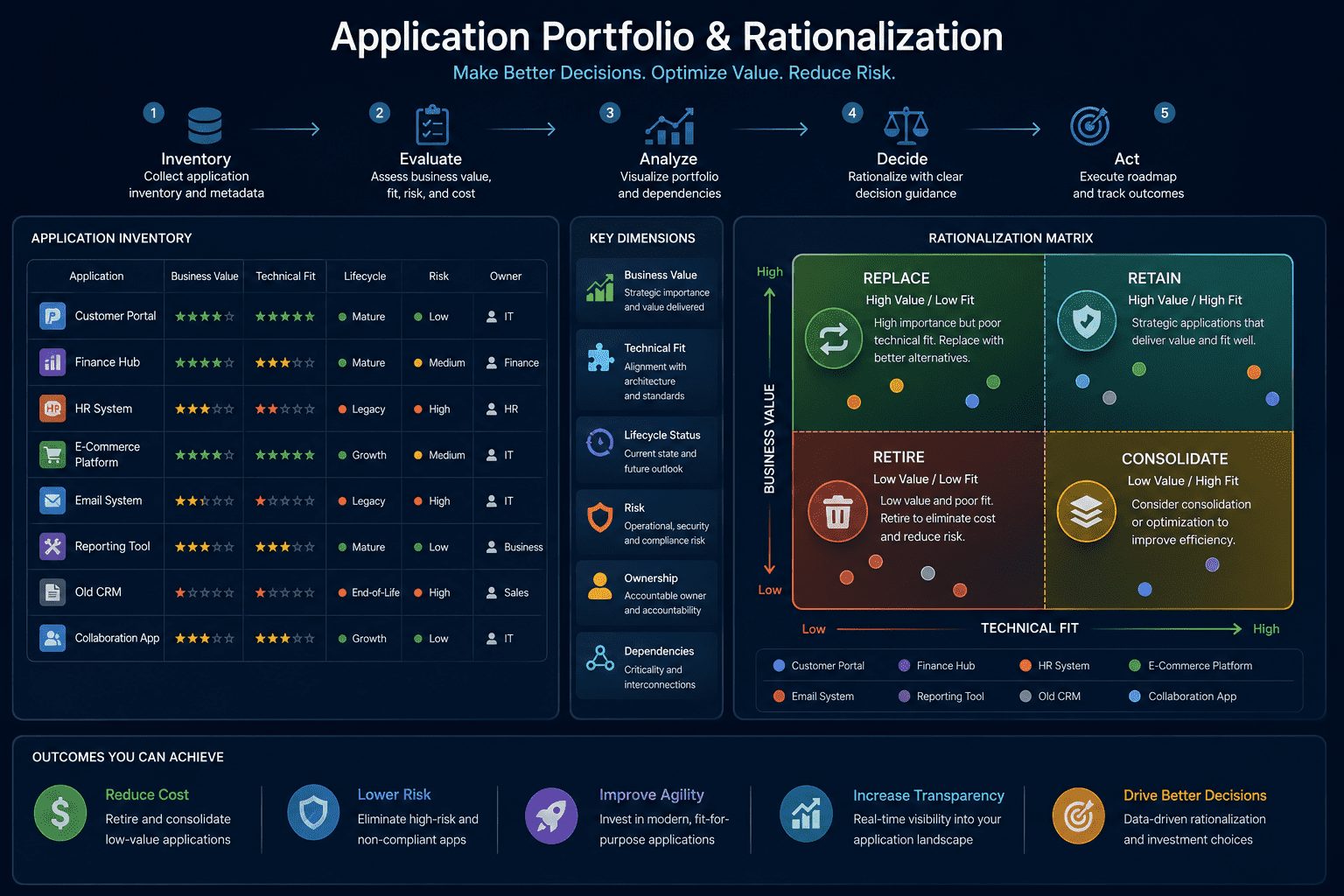
Application portfolio management is one of the strongest common use cases for both SAMU and LeanIX.
Most large organizations operate more applications than they need. Over time, portfolios grow through local purchasing, mergers, departmental autonomy, legacy modernization delays, and SaaS adoption. The result is duplication, unclear ownership, rising cost, integration complexity, and technology risk.
A good application portfolio management platform helps organizations identify redundant applications, reduce IT costs, manage technology risk, plan modernization, and support digital transformation. SAMU’s APM page describes these as core benefits of application portfolio management.
LeanIX is also strong in APM. Its Application Portfolio Management package includes portfolio assessment, technical and functional fit, dashboards, AI capabilities, surveys, SaaS discovery, APIs, and reference catalogs. This is a good fit for enterprises that want a structured approach to portfolio visibility and rationalization.
SAMU’s advantage is the way APM connects to a broader configurable repository. Application data does not live in isolation. It can be connected to business capabilities, processes, technologies, interfaces, owners, lifecycle status, risks, costs, compliance attributes, and transformation initiatives.
This makes application rationalization more practical. Instead of asking only “Which applications should we retire?”, organizations can ask better questions:
Which applications support the same business capability? Which systems are technically outdated? Which applications have high cost but low business value? Which tools are used by only one business unit? Which technologies are approaching end of life? Which integrations would break if an application were retired? Which applications are subject to compliance constraints? Which systems are needed for an upcoming transformation program?
This is where SAMU’s impact analysis and visualization capabilities become important. Application rationalization is not only about reducing the application count. It is about making confident decisions without creating unexpected business or operational risk.
SAMU can support application rationalization as a continuous capability rather than a one-time project. That matters because application landscapes keep changing. New SaaS tools appear. Business units adopt new systems. Legacy platforms remain longer than expected. Cloud migration changes dependencies. M&A activity introduces duplicates. Security requirements evolve.
A portfolio that is reviewed once a year will always be partly outdated. A live repository that supports ongoing governance creates much stronger long-term value.
Governance, workflow, and compliance
Enterprise architecture becomes truly valuable when it influences decisions. But to influence decisions, the data must be trusted.
Trusted data requires governance. It must be clear who owns each object, who can edit it, who approves changes, which attributes are mandatory, how data quality is checked, and how updates are triggered.
SAMU’s governance value comes from combining repository, permissions, workflow, visualization, and configurable modeling. Its enterprise architecture platform supports a central source of truth, while its flexibility makes it possible to align governance with the organization’s actual operating model. SAMU’s product page explains that a centralized EA solution improves visibility, supports better governance, and enables faster, more informed decisions.
SAMU can also support governance and compliance initiatives. Its compliance page states that SAMU can serve as a centralized repository for EA data that may be essential for regulatory or compliance requirements, and that compliance-related attributes can be created on any object in the SAMU repository.
This is a strong point. Compliance is rarely a separate world from architecture. Regulatory obligations often depend on systems, data, ownership, processes, infrastructure, integrations, and vendor relationships. If compliance attributes can be connected to architecture objects, the organization can understand risk in context.
For example, a compliance team may need to know which applications process sensitive data, which systems support regulated business capabilities, which integrations move data across borders, or which technologies are unsupported. A static compliance spreadsheet cannot easily answer these questions. A living architecture repository can.
LeanIX also has strong governance capabilities, including surveys, automations, quality seals, technology risk and compliance, and collaboration features. The difference is that SAMU’s flexible meta-model can make compliance modeling more adaptable where regulatory categories or internal governance structures are customer-specific.
This is especially relevant in highly regulated markets. Banks, telecoms, public-sector organizations, utilities, healthcare organizations, and critical infrastructure providers often need to represent compliance data in very specific ways. A flexible model helps them do that without forcing all compliance logic into generic fields.
Transformation planning and future-state architecture
Enterprise architecture is not only about understanding the current state. It is also about planning change.
Organizations use EA platforms to support cloud migration, ERP modernization, application rationalization, post-merger integration, technology lifecycle management, cost optimization, cybersecurity improvement, and digital transformation. These initiatives require future-state architecture thinking.
SAMU’s transformation planning capabilities are important here. SAMU’s transformation page emphasizes the ability to prioritize ideas based on real cost compared to business benefits, helping teams make decisions about the business value of emerging ideas.
The SAMU modeling page also states that SAMU is an ideal platform for modeling and planning upcoming transformation initiatives in a collaborative and agile way, showing not only the current as-is state but also future to-be planned changes and in multiple scenarios.
This matters because transformation planning is where many EA tools struggle. A tool may show the current architecture clearly, but transformation requires multiple additional capabilities:
It must show what will change. It must show when changes will happen. It must show which applications, capabilities, integrations, and technologies are affected. It must support scenarios. It must help estimate impact and cost. It must allow collaboration between architects, project teams, business owners, and leadership.
LeanIX also supports roadmap and scenario planning. Its public materials describe Architecture and Roadmap Planning as a way to define the to-be state, understand the impact of transformations, and create actionable technology roadmaps.
SAMU’s advantage is the combination of transformation planning with configurable repository modeling and visual impact analysis. If the organization has a unique transformation governance model, SAMU can adapt to it. If the company wants to represent project waves, target states, dependencies, risks, and approvals in a specific way, the flexible meta-model can also support that.
Transformation is not generic. A bank transformation program is different from a telecom modernization program. A public-sector architecture roadmap is different from a manufacturing digitalization program. A rigid model can make transformation planning feel disconnected from reality. A flexible model can make it operational.
Technology lifecycle management and modernization
Technology lifecycle management is another area where enterprise architecture tools create measurable business value.
Legacy systems, unsupported platforms, outdated integrations, and end-of-life technologies increase risk. They can also increase operational cost, reduce agility, create security exposure, and slow down transformation initiatives.
SAMU’s application portfolio management page highlights lifecycle tracking, end-of-life technologies, and technology lifecycle management as part of reducing technology risk.
This is important because technology lifecycle decisions are rarely isolated. A technology may be outdated, but the business may still depend on applications built on it. An application may be expensive, but it may support a critical capability. A platform may be risky, but migration may affect multiple integrations. A vendor may end support, but replacement may require coordination across business units.
SAMU’s live repository can connect technology lifecycle information to applications, capabilities, owners, projects, dependencies, and costs. This makes lifecycle management more actionable. The visualizations can show lifecycle information on the objects.
Instead of producing a list of outdated technologies, SAMU can help answer practical questions:
Which applications use this technology? Which business capabilities depend on those applications? Which systems must be modernized first? Which projects already plan to replace them? Which risks require immediate escalation? Which modernization initiatives create the highest business value?
LeanIX also has technology risk and compliance capabilities and can support modernization planning. For organizations deeply invested in the SAP ecosystem, this may be particularly useful. But SAMU’s flexibility can be especially valuable where lifecycle categories, risk scoring, modernization waves, or local governance rules need to be customized.
Integration, data quality, and the source of truth problem
Every EA platform faces the same challenge: data quality.
Most organizations already have architecture data, but it is scattered. Application data may live in a CMDB. Project data may live in a project portfolio tool. Cost data may live in finance systems. Ownership data may live in spreadsheets. Technology lifecycle data may come from vendors or internal standards. Business capability data may be maintained by enterprise architects. Compliance data may live in GRC tools.
An EA platform must bring these sources together without becoming another disconnected repository.
LeanIX has a strong integration story. Public materials mention out-of-the-box integrations, open APIs, reference catalogs, SaaS discovery, SAP landscape discovery, and integration with tools such as ServiceNow, Jira, Collibra, and SAP Signavio.
SAMU also supports integration and repository automation. SAMU’s public materials emphasize integration capabilities, a sophisticated API to automate data upload, and data-driven repository quality.
The practical difference is that SAMU’s flexible meta-model can make integration more adaptable. If incoming data does not fit a predefined model, the model can be adjusted. If the organization wants to create a custom object type, attribute, relationship, or permission rule, SAMU is designed to support that.
This matters because enterprise architecture data is rarely clean at the beginning. The tool must support reality before it can improve reality.
A flexible EA platform lets organizations start with what they have, define the model they need, connect data sources gradually, and improve maturity over time. For many organizations, this is more realistic than implementing a highly standardized model immediately.
AI and automation
AI is becoming increasingly important in enterprise architecture. LeanIX has invested strongly in this direction. SAP LeanIX communications highlight AI-enabled inventory building, AI assistants, AI governance, and AI-enabled recommendations. SAP LeanIX also positions itself as part of the future of SAP business transformation and AI governance.
This is a real advantage for LeanIX, especially for organizations that want advanced AI capabilities inside a large enterprise SaaS ecosystem.
SAMU’s opportunity is different. SAMU can position AI not as a standalone feature, but as an accelerator for a flexible, trusted architecture repository. AI is only useful if the underlying architecture data is structured, accurate, and meaningful. If the repository is wrong, AI will only automate bad conclusions. SAMU’s AI Visual Recognition can help in uploading date faster from pictures or drawings.
This is where SAMU’s live repository, configurable model, governance workflows, and visual impact analysis become important. The more accurately SAMU represents the real enterprise landscape, the more valuable automation and AI-assisted analysis can become.
For buyers, the question should not be “Which tool mentions AI more?” The better question is:
Which platform gives us the most reliable architecture data foundation for future AI-assisted decision-making?
For SAP-centered organizations, LeanIX may be attractive because AI capabilities are developing inside the SAP ecosystem. For organizations that first need to build a flexible, trusted, highly tailored architecture repository, SAMU may be the better foundation.
When SAMU may be the better choice
SAMU may be the better fit when flexibility matters more than standardization.
This is especially true if the organization needs a fully customizable meta-model. If the architecture team expects to model unique business objects, regulatory structures, local ownership models, custom lifecycle states, specific integration categories, or organization-specific governance workflows, SAMU’s flexibility becomes a strong advantage.
SAMU may also be the better fit when on-premise deployment is required. Since public SAP LeanIX materials position LeanIX as SaaS / cloud-native SaaS, organizations with strict on-premise requirements should evaluate SAMU carefully.
SAMU is also attractive when price competitiveness and total cost of ownership are key evaluation criteria. The strongest commercial argument is not only lower price, but lower operational friction: faster configuration, simpler interface, flexible deployment, and less need to force the organization into a rigid model.
SAMU may be the better option when enterprise architecture maturity is still evolving. Some organizations are not ready for a highly standardized EA operating model. They need to start with core use cases, build stakeholder trust, improve data quality, and expand gradually. SAMU’s practical, configurable approach can support that journey.
SAMU can also be a strong fit for organizations that need regional support and a customer-oriented vendor relationship. Public SAMU materials highlight regional strength in Central and Eastern Europe and the Middle East, and note that SAMU has been recognized in industry reports.
In short, SAMU is especially compelling for organizations that want:
- a flexible enterprise architecture platform;
- a fully customizable meta-model;
- SaaS and on-premise deployment options;
- price-competitive ownership;
- simpler user experience;
- live repository-based visualizations;
- application portfolio management;
- application rationalization;
- workflow-based governance;
- impact analysis;
- transformation planning;
- close vendor support.
When SAP LeanIX may be the better choice
LeanIX may be the better fit when the organization prioritizes standardized enterprise architecture management at global scale.
It is especially strong for companies already invested in SAP transformation. If the enterprise is running SAP S/4HANA programs, SAP Signavio, SAP Cloud ALM, SAP BTP, or SAP-driven business transformation initiatives, LeanIX can fit naturally into that ecosystem.
LeanIX may also be better when the organization wants a mature SaaS platform with a large connector ecosystem, predefined dashboards, reference catalogs, AI roadmap, and broad international market recognition.
A large global enterprise with a mature EA practice may prefer LeanIX because it provides a strong out-of-the-box operating model. If the standard model fits, the organization can benefit from faster structure, clearer reporting, and established best practices.
LeanIX may also be attractive when unlimited user access under an application-based pricing model is commercially favorable. Its pricing page states that there is no limit on the number of users who can access LeanIX Enterprise Architecture, with pricing based on number of applications.
So the comparison should not claim that LeanIX is weak. It is not. LeanIX is a strong, mature, enterprise-grade EA platform.
The better positioning is:
LeanIX is a strong choice for standardized, SAP-aligned, cloud-native enterprise architecture. SAMU is a strong choice for flexible, configurable, price-competitive, deployment-flexible enterprise architecture.
Decision checklist: SAMU vs LeanIX
Use this checklist to evaluate which platform fits better.
Choose SAMU if your organization needs a flexible meta-model that can be adapted to your own terminology, governance model, and EA maturity. SAMU is also a strong fit if on-premise deployment is required, if a simpler interface is important for stakeholder adoption, or if total cost of ownership is a major decision factor.
Choose SAMU if your EA team wants to build a live, shared architecture repository that reflects the real organization rather than forcing the organization into a predefined model. It is also a strong fit when visual modeling, impact analysis, application rationalization, technology lifecycle management, and transformation planning need to be adapted to local business reality.
Choose LeanIX if your organization wants a mature cloud-native SaaS platform with strong SAP alignment, predefined dashboards, standardized modeling guidance, AI-enabled capabilities, a large connector ecosystem, and a broad global customer base.
Choose LeanIX if your transformation is deeply SAP-centered and your organization is comfortable adopting a standardized EA model as the foundation for architecture governance.
The practical question is not “Which tool has more features?” The better question is:
Do we want to adapt our architecture practice to a standardized platform, or do we need a platform that adapts to our architecture practice?
For many organizations, that question will make the decision much clearer.
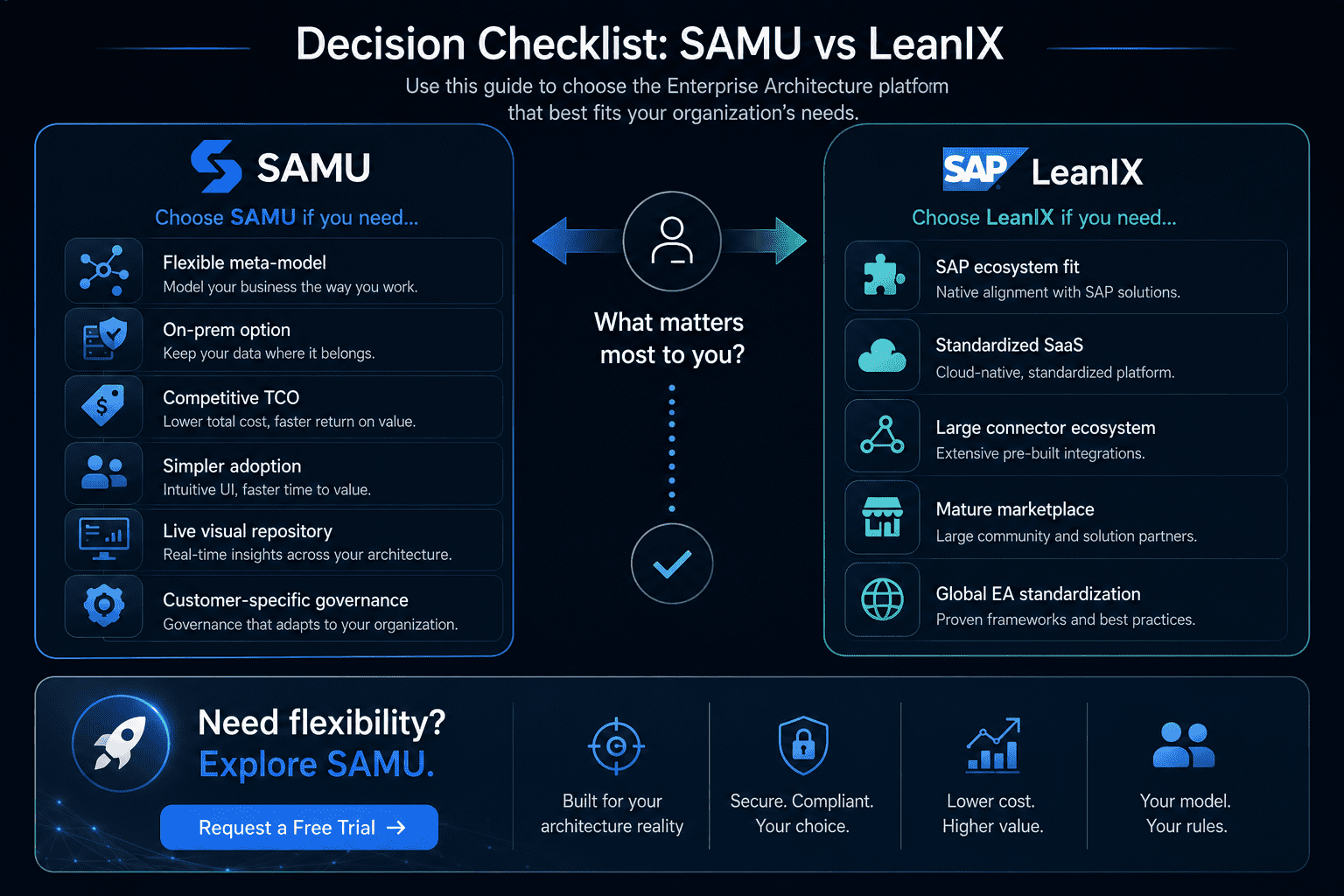
Conclusion: LeanIX is the standardized enterprise path; SAMU is the flexible architecture reality platform
SAMU and SAP LeanIX are both serious enterprise architecture platforms. Both can help organizations improve IT transparency, manage application portfolios, support transformation planning, and make better architecture decisions.
But they are optimized for different buyers.
SAP LeanIX is a strong choice for global enterprises that want a mature, cloud-native SaaS platform with SAP ecosystem alignment, standardized enterprise architecture practices, broad integrations, and advanced AI direction. It is particularly relevant for organizations already committed to SAP-centered transformation.
SAMU is a strong choice for organizations that need flexibility, deployment choice, price competitiveness, simpler adoption, and deep customization. Its fully flexible meta-model, live repository, data-driven visualization, workflow capabilities, impact analysis, and application portfolio management make it especially valuable where the organization’s architecture reality cannot be forced into a generic structure.
If the goal is to standardize enterprise architecture around SAP transformation at global scale, LeanIX is a strong candidate.
If the goal is to build a flexible, practical, living architecture repository that fits the organization’s own model, supports both SaaS and on-premise requirements, and keeps total cost of ownership competitive, SAMU deserves serious consideration.
For many enterprises, SAMU is not just a LeanIX alternative. It may be the better fit.
What could better Enterprise Architecture be worth to your organization?
Use our Enterprise Architecture Value Assessment to estimate the potential annual business value of stronger architecture practices and identify the areas where improvement could create the most value.
Comparing Other Enterprise Architecture Platforms?
Also evaluating Ardoq? Explore our detailed SAMU vs Ardoq comparison to see how the platforms compare on AI, deployment flexibility, application portfolio management, governance, and pricing.
Already evaluating EA platforms and ready to try SAMU?