
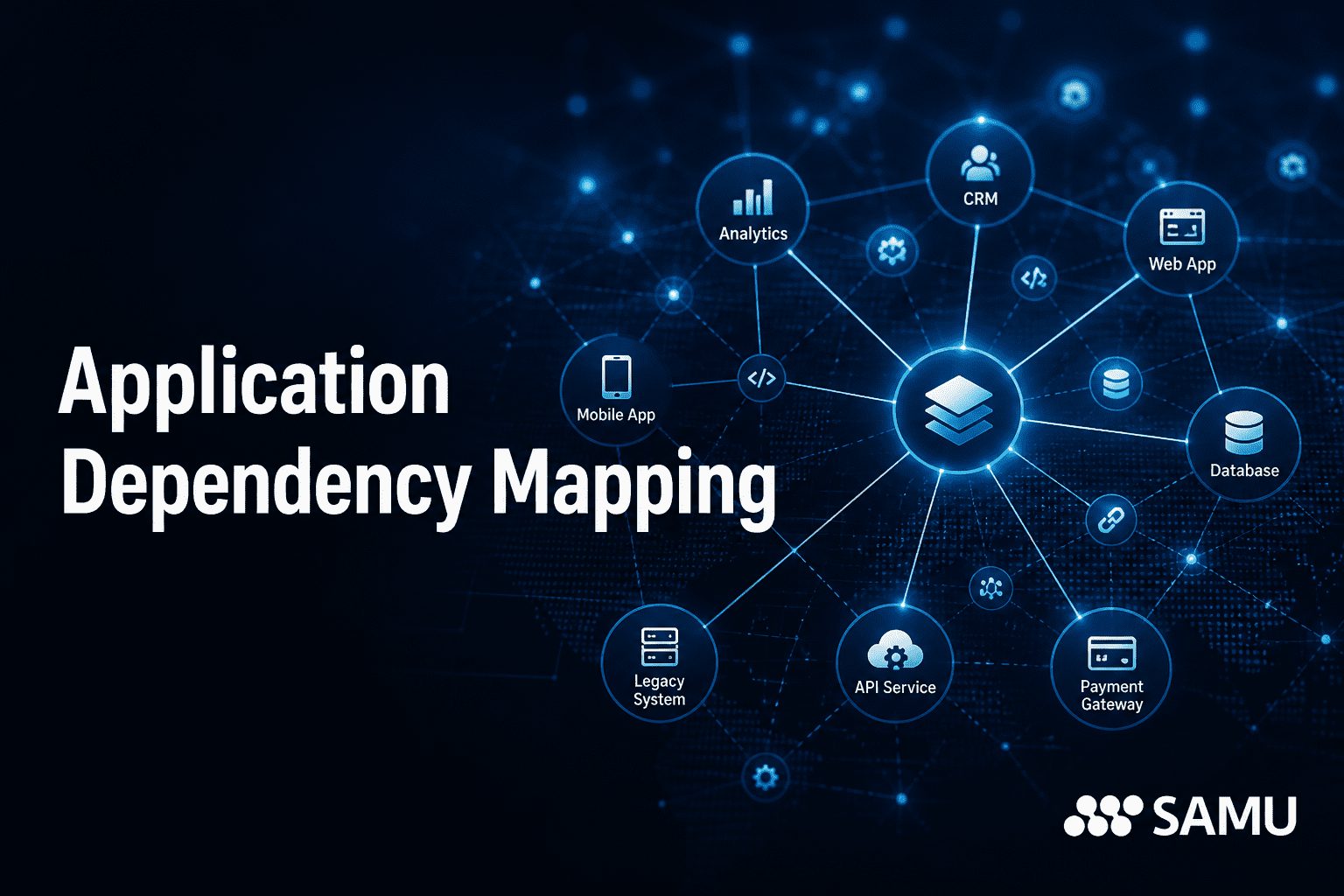
Application Dependency Mapping: The Hidden Structure Behind Every IT Decision
Modern IT environments are rarely simple. Over time, systems evolve, integrations multiply, and what once felt like a clean enterprise architecture, instead becomes a tightly interconnected web. Most organizations believe they understand their application landscape—until a minor change causes an unexpected failure somewhere unexpectedly.
This is where Application Dependency Mapping becomes critical.
It should demonstrate how applications, systems, and services truly interact behind the scenes. Not how they were originally designed years ago—but how they actually function today.
What Is Application Dependency Mapping?
Application Dependency Mapping (ADM) is the process of identifying interdependencies and visualizing how applications are connected to each other, to infrastructure, and/or to external services.
It should answer questions like:
- Which systems rely on each other?
- What is impacted if an application fails?
- Where are the hidden dependencies that have not been documented?
- Which applications are truly critical to business operations?
Instead of assumptions or outdated diagrams, ADM provides a real, data-driven view of your IT ecosystem, especially when it is combined with a structured application assessment..
Why Dependency Mapping Matters More Than Ever
As organizations adopt cloud services, extend APIs, and implement microservices, dependencies become more complex—and less visible.
Without clear mapping:
- Small changes can trigger major incidents
- Legacy systems remain unknowingly critical
- Modernization efforts become risky
- Costs increase due to overlapping or unnecessary systems
Dependency mapping transforms this uncertainty into clarity.
It allows teams to move from reactive firefighting to informed decision-making.
The Real Problem: Invisible Complexity
Most IT teams do not struggle because they lack tools, as detailed in IT Landscape Management: When Technology Becomes Too Big to Understand. They struggle because they lack visibility and transparency, which is quite a common challenge today when managing IT system complexity.
Dependencies are often include:
- lack of documentation
- outdated information
- information distributed across teams
- hidden integrations or scripts
This can create a dangerous situation where decisions are made based on incorrect or incomplete information.
A system might look safe to retire—at least until a critical business process is impacted by this and suddenly stops working.
What Effective Dependency Mapping Looks Like
A meaningful dependency map goes beyond static diagrams.
It should:
- reflect real-time relationships between applications
- show both direct and indirect dependencies
- include infrastructure and data flows
- highlight critical paths and bottlenecks
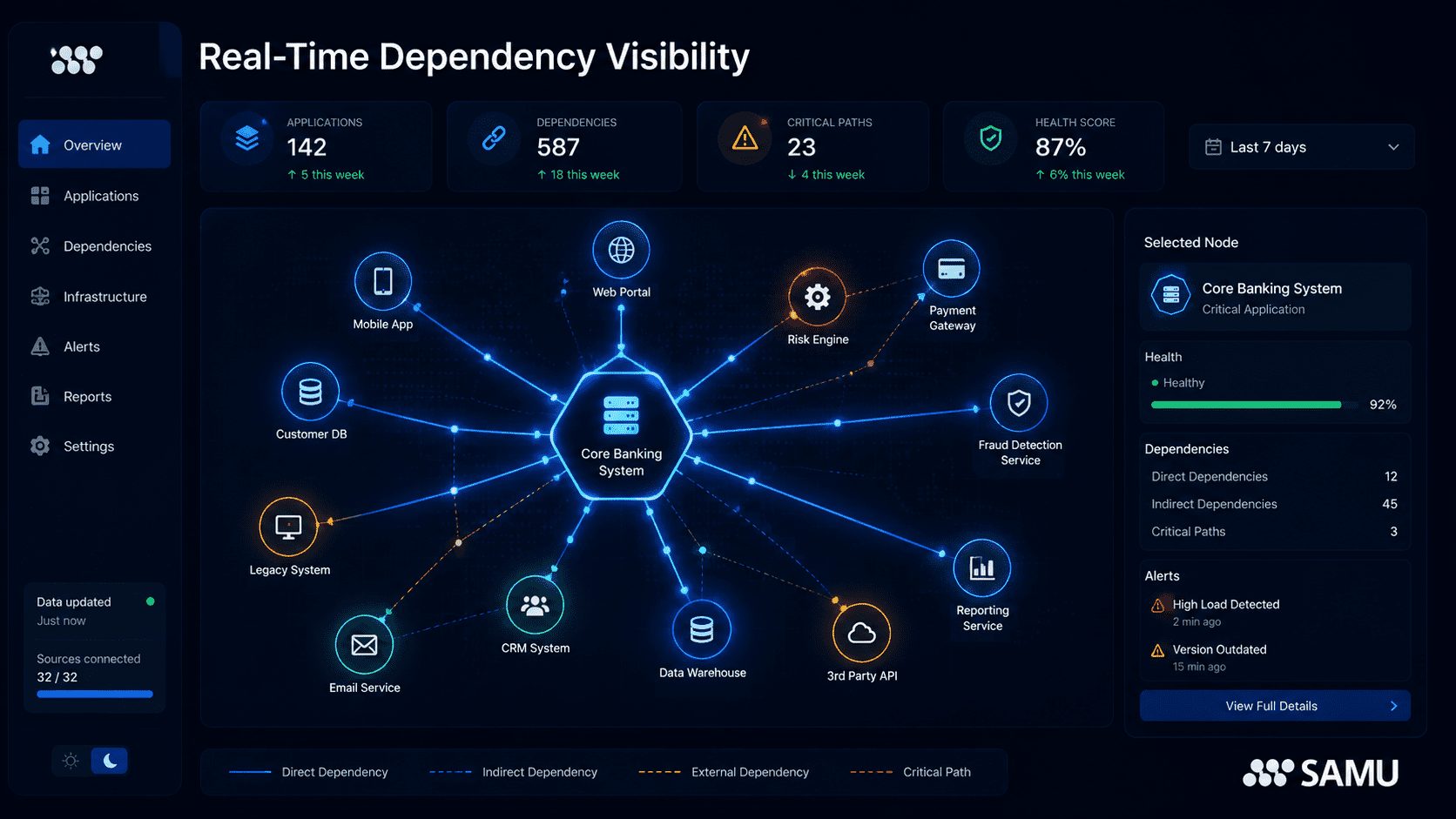
Most importantly, it must be continuously updated and maintained—and not a one-time exercise, as it is common that in dynamic IT environments, things will change quickly and require an iterative approach.
How SAMU Solves Dependency Mapping
SAMU approaches dependency mapping as part of a broader application intelligence platform.
Instead of manual documentation, it builds a living model of your IT ecosystem in a repository.
With SAMU, you can:
- visualize application relationships instantly
- identify hidden dependencies before they cause issues
- understand and perform impact analysis, before making changes
- support rationalization and modernization decisions with confidence
The aim is simple: replace guesswork with clarity.
From Mapping to Action
Dependency mapping is not the end goal—it’s the foundation.
Once dependencies are clear, organizations can safely decommission redundant applications and support more effective application rationalization.
- safely decommission redundant applications
- reduce operational risk
- optimize system architecture
- accelerate digital transformation initiatives
Without this step, every major IT decision carries unnecessary risk, which is why understanding what is application rationalization is critical for IT leaders.
Common Mistakes to Avoid
Even when organizations attempt dependency mapping, they often fall into the same traps:
- Treating it as a one-time project
- Relying on manual documentation without involving relevant stakeholders
- Ignoring indirect dependencies
- Failing to connect mapping with business impacts
These mistakes lead to outdated insights and missed opportunities.
The Strategic Advantage
Organizations that invest in proper dependency mapping gain more than technical visibility.
They gain control.
Control over:
- change management
- cost optimization
- system reliability
- long-term IT strategy
In a landscape where complexity keeps growing, clarity becomes a competitive advantage.
Conclusion
Application Dependency Mapping exposes the structure that holds your IT environment together.
Without it, decisions are based on assumptions. With it, they are based on reality.
And in complex systems, that difference can be everything.
What is application dependency mapping in simple terms?
Application dependency mapping is the process of identifying and understanding how different applications, systems, and services within an IT environment are connected to each other. Instead of relying on outdated documentation or assumptions, it provides a clear and often visual representation of how data flows and systems interact.
This helps organizations see not only direct connections, but also indirect dependencies that are often hidden. For example, an application might rely on another system through multiple layers of integrations, APIs, or shared databases. Without mapping these relationships, even small changes can have unexpected consequences.
In simple terms, it answers one critical question: “What depends on what?”—and makes that answer visible and actionable.
Why is dependency mapping important for IT teams?
Dependency mapping is essential because it reduces uncertainty and risk in complex IT environments. Without a clear understanding of how systems are connected, teams are forced to make decisions based on incomplete information, which often leads to outages, performance issues, or failed transformation projects.
For example, retiring an application without knowing its dependencies can break critical business processes. Similarly, updating a system without understanding upstream and downstream impacts can create cascading failures.
With proper dependency mapping, IT teams can:
- predict the impact of changes before they happen
- avoid unplanned downtime
- prioritize critical systems more effectively
- support faster and safer decision-making
Ultimately, it shifts teams from reactive problem-solving to proactive system management.
How often should dependency mapping be updated?
In modern IT environments, dependency mapping should not be treated as a one-time project. Systems are constantly changing due to updates, new integrations, cloud migrations, and evolving business needs.
Because of this, dependency maps should be updated continuously or at regular intervals using automated tools whenever possible. Static diagrams become outdated very quickly and can even create a false sense of security if teams rely on them.
The most effective approach is to maintain a living, continuously updated model of the IT environment. This ensures that decision-makers always work with accurate and current information when planning changes or evaluating risks.
Can dependency mapping support application rationalization?
Yes, dependency mapping plays a critical role in successful application rationalization. One of the biggest challenges in rationalization is determining which applications can be removed, replaced, or consolidated without disrupting business operations.
Without visibility into dependencies, organizations often avoid making changes due to fear of breaking something—or worse, they proceed and cause unintended disruptions.
Dependency mapping provides the missing layer of insight by showing:
- which systems are truly critical
- where redundancies exist
- which applications can be safely decommissioned
When combined with business and technical evaluation, it enables more confident, data-driven rationalization decisions that reduce cost and complexity without increasing risk.
Is manual dependency mapping enough?
In smaller or very stable environments, manual dependency mapping may provide some value. However, in most modern IT landscapes, it is not sufficient.
Manual approaches are typically:
- time-consuming
- prone to human error
- difficult to maintain over time
- quickly outdated
As systems grow more complex and dynamic, automated solutions become necessary. These tools can continuously discover and update dependencies, ensuring accuracy and scalability.
Relying solely on manual mapping often leads to incomplete visibility, which can be just as risky as having no mapping at all. For most organizations, a combination of automation and expert validation provides the best results.

Oliver holds a degree in Economics from the University of California, Berkeley, and was raised in the United States. With over 25 years of extensive experience in sales, business development, and account management, he has specialized in managing enterprise accounts within the Information and Communications Technology (ICT) sector.
For more than eight years, Oliver has been a key contributor at Atoll, where he has played a pivotal role in expanding SAMU’s customer base. Currently, he is focused on growing SAMU’s international presence, with a strategic emphasis on the North American market.
Outside of his professional life, Oliver is a dedicated family man, proud father to a son and daughter. He is passionate about sports, avidly following all major US sports leagues, and actively competes in golf and basketball. His competitive spirit and team-oriented mindset extend beyond the office, reflecting his dynamic approach both professionally and personally.