
Enterprise Architecture Lifecycle Management for Better IT Decisions
Modern organizations depend on technology more than ever before. New applications are introduced to support business initiatives, improve efficiency, and enhance customer experiences. Over time, however, the IT landscape grows increasingly complex. Systems evolve, technologies age, business requirements change, and applications that once delivered significant value can become costly, risky, or difficult to maintain.
This is where Enterprise Architecture Lifecycle Management becomes essential.
Enterprise Architecture Lifecycle Management is the practice of overseeing IT systems throughout their entire lifespan—from initial planning and implementation to modernization, replacement, or retirement. It provides organizations with the visibility and governance needed to make informed decisions about technology investments, reduce operational risk, and maintain a healthy application landscape.
Without a structured lifecycle management approach, organizations often find themselves supporting outdated systems, accumulating technical debt, and struggling to prioritize modernization initiatives. By understanding where each system stands in its lifecycle, enterprise architects and IT leaders can align technology decisions with business objectives and ensure resources are invested where they create the greatest value.
Why Enterprise Architecture Lifecycle Management Matters
Most enterprises operate far more applications than they realize.
Some support critical business functions, while others serve smaller teams or specific processes. New systems are frequently introduced, but old ones are not always retired. Over time, organizations accumulate overlapping capabilities, redundant technologies, and applications that remain in use simply because nobody has formally evaluated them.
This creates several challenges.
Maintenance costs increase as systems age. Vendor support eventually ends. Security vulnerabilities become more difficult to address. Integration complexity grows. Business stakeholders lose visibility into which systems are still providing value and which are simply consuming resources.
Many organizations only discover these issues when they begin a digital transformation initiative, prepare for an audit, or encounter a major technology failure.
Effective lifecycle management helps prevent these situations by creating a structured approach to monitoring, evaluating, and governing systems throughout their lifecycle. Instead of reacting to problems, organizations can proactively identify risks, optimize investments, and plan modernization activities before issues become critical.
The Typical Lifecycle of an IT System
Although every organization operates differently, most IT systems follow a similar lifecycle pattern.
Planning
The lifecycle begins when a business need is identified. During this stage, stakeholders evaluate requirements, define objectives, assess potential solutions, and estimate costs.
Enterprise architects often play an important role by reviewing technology standards, integration requirements, security considerations, and long-term business alignment.
Implementation
Once a solution is selected, the system is deployed and integrated into the existing technology environment.
This phase typically involves configuration, testing, data migration, user training, and integration with other applications.
Growth and Optimization
After deployment, systems often expand beyond their original scope. Additional users adopt the platform, new features are introduced, and integrations increase.
During this stage, organizations focus on maximizing business value while ensuring performance, reliability, and scalability.
Mature Operation
The system becomes a stable component of the technology landscape and supports day-to-day business operations.
Many applications spend the majority of their lifespan in this phase. While they continue delivering value, organizations must monitor costs, technical health, supportability, and alignment with changing business requirements.
Decline
Eventually, business priorities change or technology evolves.
The application may become difficult to maintain, vendor support may be approaching end-of-life, or newer solutions may offer significantly better capabilities.
At this stage, organizations must determine whether modernization, replacement, consolidation, or retirement is the most appropriate path forward.
Retirement
The final stage involves decommissioning the system and migrating users, data, and processes to alternative solutions.
This process often requires careful planning because dependencies, integrations, compliance requirements, and historical data must be managed appropriately.
Organizations that actively manage these lifecycle stages are far more successful at controlling costs and reducing technology risk.
Warning Signs Your Organization Has Lifecycle Management Problems
Many organizations believe they are managing their systems effectively until they take a closer look at their application portfolio.
Several warning signs often indicate lifecycle management challenges.
Limited Visibility Into the Application Landscape
If different teams maintain separate application inventories—or if no inventory exists at all—it becomes difficult to understand the true state of the technology environment.
Without visibility, lifecycle decisions become largely based on assumptions rather than facts.
Rising Technology Costs
Technology spending often increases gradually over time.
Organizations may continue investing in systems that no longer provide sufficient business value, simply because nobody has reviewed their role within the broader portfolio.
Increasing Technical Debt
Older systems frequently accumulate unsupported components, custom integrations, and outdated technologies.
Technical debt increases maintenance effort and reduces organizational agility.
End-of-Life Technologies
Many organizations discover too late that critical systems rely on technologies that are no longer supported by vendors.
These situations often create security, compliance, and operational risks.
Difficult Modernization Decisions
When application data is incomplete or outdated, leaders struggle to determine which systems should be upgraded, replaced, consolidated, or retired.
Lifecycle management provides the information needed to make these decisions with confidence.
Lifecycle Management vs Application Portfolio Management
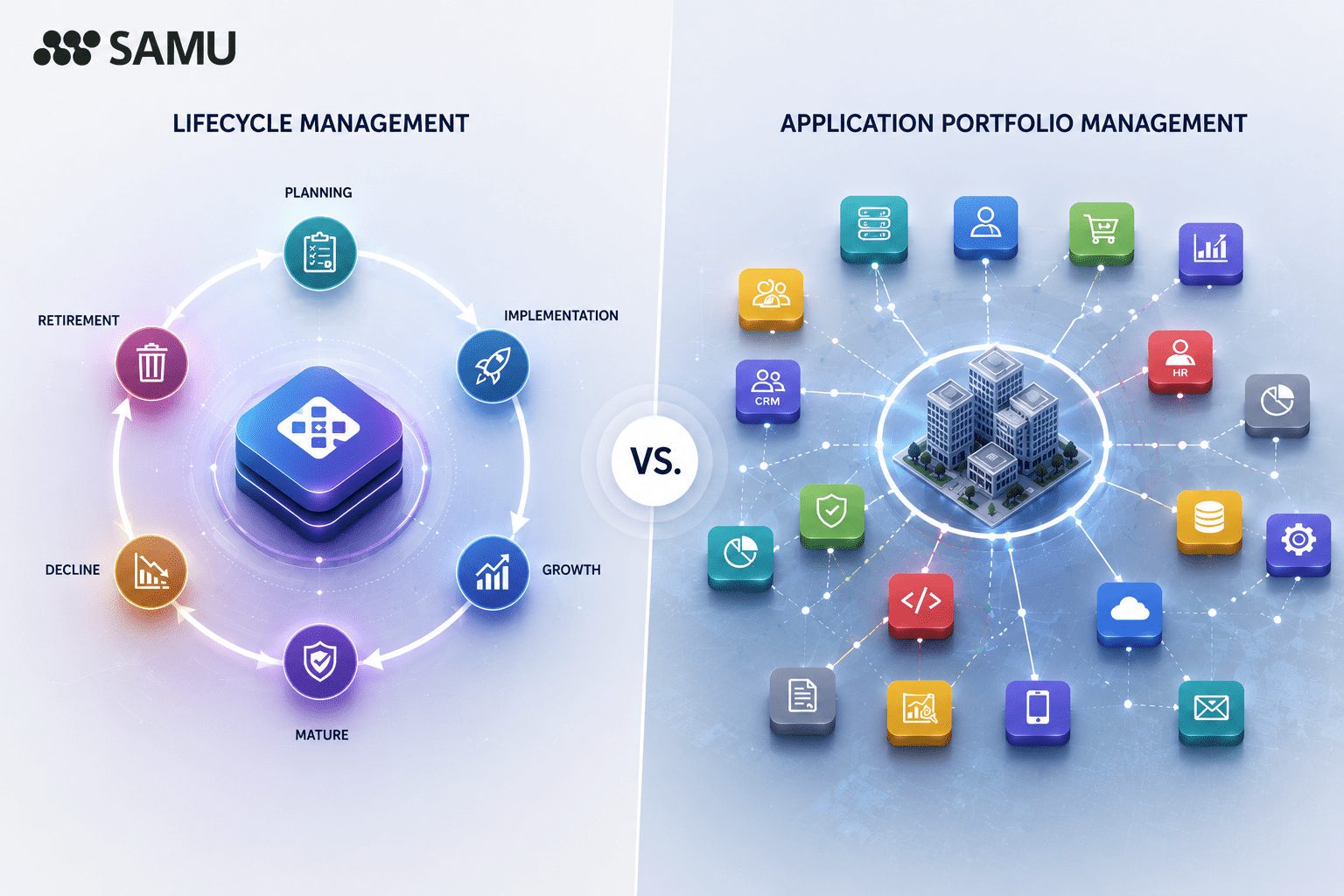
IT System Lifecycle Management and Application Portfolio Management are closely related disciplines, but they are not the same.
Lifecycle management focuses on understanding where each system sits within its lifecycle and determining the actions required to manage its future effectively.
Application Portfolio Management takes a broader perspective by evaluating the overall application landscape. It helps organizations assess business value, identify redundancies, optimize investments, and improve portfolio performance.
In practice, lifecycle management provides critical data that supports portfolio management decisions.
For example, understanding that an application is approaching end-of-life may influence decisions regarding modernization priorities, investment planning, or application rationalization initiatives.
Organizations achieve the best results when both disciplines work together.
Lifecycle Management vs Application Rationalization
Application Rationalization focuses on simplifying the application landscape by identifying opportunities to eliminate, consolidate, replace, or modernize applications.
Lifecycle management contributes directly to these efforts.
An application nearing retirement may be a strong candidate for rationalization. Similarly, systems with declining business value and rising costs often become priorities for consolidation or replacement.
While lifecycle management focuses on monitoring and governing systems throughout their lifespan, rationalization focuses on optimizing the portfolio itself.
Together, they help organizations reduce complexity, lower costs, and improve strategic alignment.
Key Components of Effective IT System Lifecycle Management
Successful lifecycle management requires visibility across multiple dimensions of each system.
Business Value
Organizations must understand how important a system is to business operations.
Applications that support critical capabilities may justify ongoing investment, while systems providing limited value may require reevaluation.
Technical Health
Technical health reflects the condition of the underlying technology stack.
Factors such as technology currency, maintainability, performance, scalability, and supportability all influence technical health.
Cost
Understanding the total cost of ownership is essential.
This includes licensing, infrastructure, maintenance, support, development, and operational costs.
Applications that consume significant resources while delivering limited value often become candidates for modernization or retirement.
Risk
Lifecycle decisions should always consider risk.
Security vulnerabilities, compliance concerns, operational dependencies, and vendor-related issues can significantly impact future planning.
Dependencies
Few applications operate independently.
Systems often support multiple business processes, integrations, and stakeholders.
Dependency visibility helps organizations avoid unexpected disruptions when making lifecycle decisions.
Building a Lifecycle Management Framework
Effective lifecycle management does not happen automatically.
Organizations need a structured framework that supports continuous assessment and decision-making.
Create a Complete Application Inventory
The first step is establishing a reliable inventory of applications and systems.
This inventory should include ownership information, business purpose, technical details, costs, dependencies, and lifecycle status.
Without a complete inventory, lifecycle management becomes extremely difficult.
Assess Business and Technical Value
Applications should be evaluated using consistent criteria.
Business value, technical health, strategic alignment, risk, and cost are commonly used dimensions.
This assessment creates a foundation for future lifecycle decisions.
Define Lifecycle Stages
Organizations should establish clear lifecycle definitions and governance processes.
A common lifecycle model might include planning, implementation, active use, maintenance, modernization, and retirement.
Consistent definitions improve reporting and decision-making.
Establish Governance
Governance ensures lifecycle decisions are reviewed regularly and aligned with organizational objectives.
Enterprise architects, application owners, business stakeholders, and technology leaders should participate in lifecycle reviews.
Continuously Review the Portfolio
Lifecycle management is not a one-time exercise.
Technology environments constantly change, making regular reviews essential.
Organizations that update lifecycle information continuously are far better prepared to respond to new challenges and opportunities.
Lifecycle Metrics Every Enterprise Architect Should Track
Metrics help transform lifecycle management from a subjective process into a data-driven discipline.
Technology Age
Older technologies often require greater maintenance effort and may present support challenges.
Tracking technology age helps identify systems that may require attention.
Vendor Support Status
Understanding vendor support timelines helps organizations avoid unexpected end-of-life situations.
This metric is particularly important for commercial software products.
Total Cost of Ownership
TCO provides insight into the financial impact of each application.
Comparing cost against business value helps identify optimization opportunities.
Business Criticality
Not all systems are equally important.
Tracking business criticality ensures that investment and modernization efforts focus on the applications that matter most.
Risk Scores
Risk assessments provide visibility into security, operational, compliance, and technology-related concerns.
Risk scoring helps prioritize lifecycle activities and investment decisions.
Lifecycle Management and Digital Transformation
Digital transformation initiatives often fail to deliver expected outcomes because organizations underestimate the complexity of their existing technology landscape.
Transformation requires more than introducing new technologies.
It requires understanding which systems should be retained, modernized, integrated, or retired.
Lifecycle management provides the visibility needed to support these decisions.
Organizations with mature lifecycle management practices typically execute modernization programs more efficiently because they understand the condition, dependencies, and strategic value of their systems before major transformation efforts begin.
The Role of Enterprise Architects
Enterprise architects play a central role in lifecycle management.
They help organizations understand relationships between applications, technologies, business capabilities, processes, and strategic objectives.
By maintaining architectural visibility across the enterprise, architects can identify risks, evaluate modernization opportunities, and support informed decision-making.
Rather than focusing solely on technology, enterprise architects help ensure lifecycle decisions align with broader business goals.
This strategic perspective is increasingly important as organizations face growing technology complexity.
Practical Example: Managing a Legacy Application Portfolio
Consider an organization that has operated for more than fifteen years and accumulated hundreds of applications across multiple business units.
Some systems are actively maintained and strategically important. Others were implemented years ago and continue operating with minimal oversight.
Without lifecycle management, leadership may struggle to determine which systems deserve investment.
After implementing a lifecycle management framework, the organization gains visibility into application age, business value, technical health, costs, and dependencies.
Several applications are identified as retirement candidates. Others are selected for modernization because they support critical business capabilities but rely on aging technologies.
As a result, the organization reduces complexity, lowers maintenance costs, and improves technology alignment with business strategy.
How SAMU Supports IT System Lifecycle Management
Successful lifecycle management depends on visibility.
SAMU helps organizations maintain a centralized view of their application landscape, technology environment, business capabilities, and dependencies.
By bringing architecture information together in a single platform, teams can better understand where systems are in their lifecycle and identify opportunities for modernization, consolidation, or retirement.
SAMU supports lifecycle management by helping organizations:
Maintain accurate application inventories
Map application dependencies
Assess business and technical value
Identify technology risks
Support modernization planning
Enable application rationalization initiatives
Improve governance and decision-making
Instead of relying on spreadsheets and disconnected documentation, organizations gain a single source of truth that supports continuous lifecycle management across the enterprise.
Lifecycle Management Is a Continuous Discipline
One of the most common misconceptions about lifecycle management is that it is a project.
In reality, it is an ongoing discipline.
Applications evolve. Technologies change. Business priorities shift. New risks emerge.
Organizations that continuously monitor and evaluate their systems are far better positioned to adapt to these changes.
IT System Lifecycle Management provides the structure, visibility, and governance required to maintain a healthy technology landscape, reduce risk, control costs, and support long-term business success.
For enterprise architects and technology leaders, it is not simply a maintenance activity—it is a critical capability that enables smarter technology decisions across the entire organization.
Frequently Asked Questions
What is IT System Lifecycle Management?
IT System Lifecycle Management is the process of managing IT systems throughout their entire lifespan, from initial planning and implementation to modernization, replacement, or retirement. The goal is to ensure that technology investments continue to support business objectives while minimizing risk, controlling costs, and maintaining operational efficiency.
A structured lifecycle management approach helps organizations understand the current state of their systems, identify future risks, and make informed decisions about upgrades, modernization initiatives, and application retirement. Rather than reacting to technology issues as they arise, organizations can proactively manage their technology landscape and align IT investments with long-term business goals.
Why is IT System Lifecycle Management important?
As organizations grow, their technology environments become increasingly complex. New applications are added, existing systems evolve, and older technologies often remain in use long after their intended lifespan.
Without lifecycle management, organizations may struggle with rising maintenance costs, unsupported technologies, security vulnerabilities, and duplicate applications. They may also find it difficult to prioritize modernization initiatives or understand which systems deliver the greatest business value.
IT System Lifecycle Management provides visibility into the health, cost, risk, and strategic importance of each system, helping organizations make better technology decisions and reduce unnecessary complexity.
What are the stages of an IT system lifecycle?
Although lifecycle models vary between organizations, most IT systems move through six common stages:
- Planning
- Implementation
- Growth and Optimization
- Mature Operation
- Decline
- Retirement
During the planning phase, business requirements and technology options are evaluated. The implementation phase focuses on deployment and integration. As systems mature, organizations monitor performance, costs, and business value. Eventually, changing business needs or aging technology may lead to modernization, replacement, or retirement decisions.
Understanding these stages helps organizations manage systems proactively instead of waiting for problems to emerge.
How does lifecycle management help reduce IT costs?
Many organizations spend significant resources maintaining systems that no longer provide sufficient value.
Lifecycle management helps identify applications with high operating costs, overlapping functionality, or limited business relevance. By evaluating systems based on cost, value, risk, and technical health, organizations can make informed decisions about consolidation, modernization, or retirement.
Over time, this leads to a more efficient technology landscape, lower maintenance costs, reduced technical debt, and better allocation of IT budgets.
What is the difference between IT System Lifecycle Management and Application Portfolio Management?
IT System Lifecycle Management focuses on understanding where individual systems are within their lifecycle and determining the actions needed to manage them effectively.
Application Portfolio Management (APM) takes a broader perspective by evaluating the overall application landscape. It helps organizations optimize their portfolios, reduce redundancy, improve investment decisions, and align technology with business priorities.
The two disciplines work closely together. Lifecycle data provides valuable input for portfolio management decisions, while portfolio management helps organizations prioritize lifecycle activities across the enterprise.
How does lifecycle management support digital transformation?
Digital transformation initiatives often require organizations to modernize legacy systems, adopt new technologies, and simplify complex application landscapes.
Lifecycle management provides the visibility needed to support these efforts. It helps organizations understand which systems should be retained, upgraded, replaced, integrated, or retired as part of a transformation program.
Without accurate lifecycle information, modernization projects can become more expensive, more complex, and significantly riskier.
What role do enterprise architects play in lifecycle management?
Enterprise architects provide the strategic oversight needed to manage technology lifecycles effectively.
They help maintain visibility into applications, technologies, business capabilities, processes, and dependencies. By understanding how systems support the organization, architects can identify modernization opportunities, assess risks, and guide lifecycle decisions.
Enterprise architects also help establish governance processes that ensure lifecycle information remains accurate and aligned with business objectives over time.
What are the biggest risks of poor lifecycle management?
Poor lifecycle management can create several challenges for organizations.
Common risks include:
- Rising maintenance and support costs
- Increasing technical debt
- Security vulnerabilities
- Compliance issues
- Unsupported technologies
- Lack of visibility into dependencies
- Failed modernization initiatives
- Inefficient technology investments
These issues often develop gradually and may remain hidden until they cause operational disruptions, audit findings, or major project delays.
How often should organizations review lifecycle information?
Lifecycle information should be reviewed regularly rather than treated as a one-time exercise.
Many organizations conduct formal reviews annually or semi-annually, while critical systems may require more frequent assessment. Significant business changes, technology upgrades, acquisitions, or regulatory requirements may also trigger additional reviews.
The most effective organizations treat lifecycle management as a continuous process that evolves alongside the technology landscape.
How can SAMU help with IT System Lifecycle Management?
SAMU provides a centralized platform for managing enterprise architecture information, application inventories, dependencies, and technology landscapes.
By bringing lifecycle-related information into a single source of truth, SAMU helps organizations gain visibility into application health, business value, technical risk, and modernization opportunities.
This enables enterprise architects, IT leaders, and business stakeholders to make more informed decisions about investments, modernization initiatives, application rationalization programs, and long-term technology strategy.