
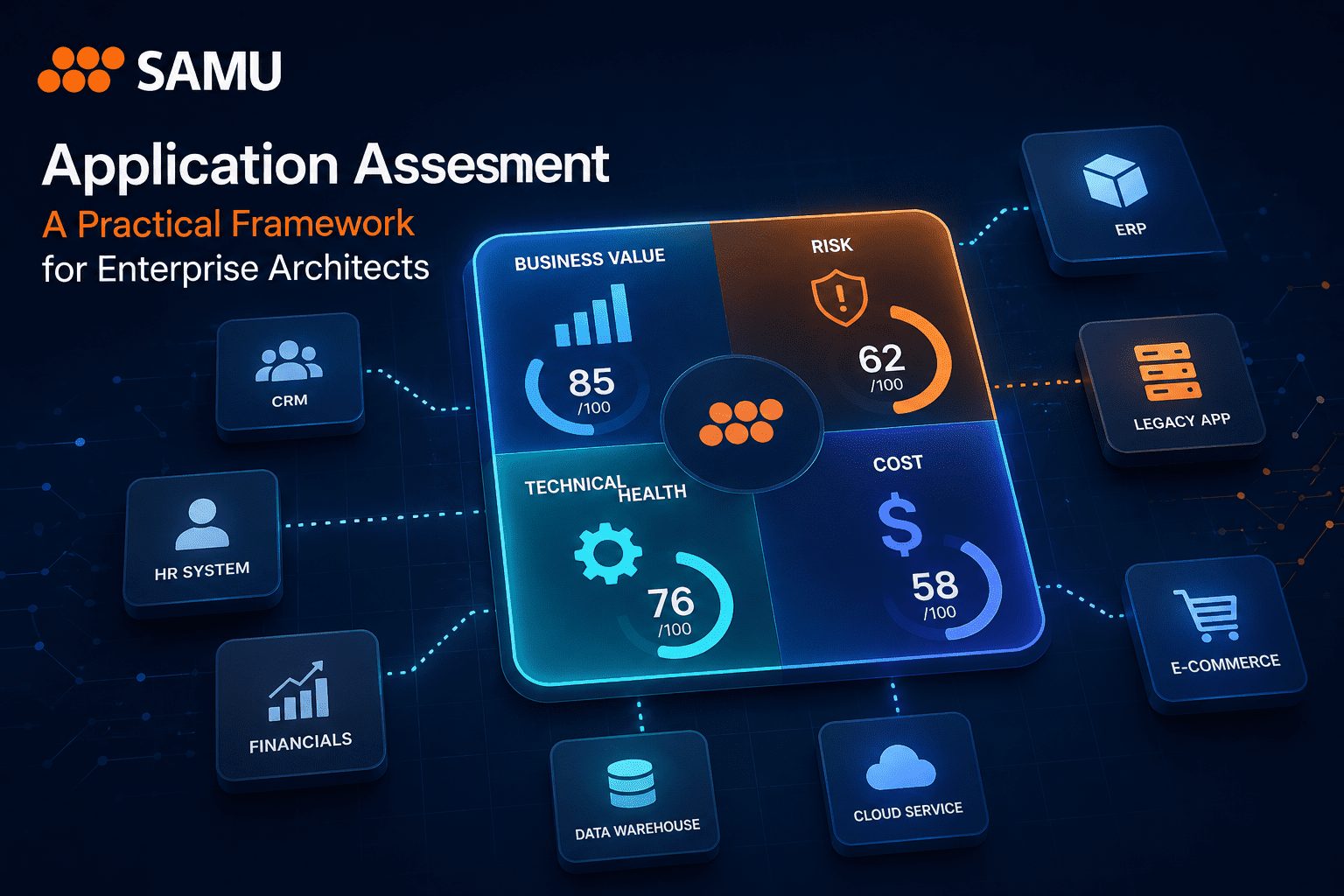
Organizations today manage hundreds or even thousands of applications that support critical business processes. While these systems are essential to daily operations, many organizations struggle to answer fundamental questions:
- Which applications provide the most business value?
- Which systems create unnecessary costs?
- Which applications should be modernized, replaced, or retired?
- Which technologies introduce operational or security risks?
Without a structured approach to evaluating applications, technology portfolios become increasingly complex, expensive, and difficult to manage.
This is where application assessment plays a critical role.
What Is Application Assessment?
Application assessment is the process of evaluating business applications against a defined set of technical, operational, financial, and business criteria.
The goal is to understand the current state of each application and determine the most appropriate future action.
Application assessments help organizations answer questions such as:
- Should this application be retained?
- Does it require modernization?
- Is replacement a better option?
- Can it be consolidated with another system?
- Should it be retired entirely?
Rather than making decisions based on assumptions, organizations can rely on objective data and standardized evaluation criteria.
Why Application Assessment Matters
Many organizations continuously invest in new technologies while carrying a growing portfolio of aging applications.
Over time, this creates several challenges:
Rising Operational Costs
Legacy applications often require specialized support, custom integrations, and outdated infrastructure.
These systems can consume significant resources while delivering limited business value.
Increased Technology Risk
Applications running on unsupported platforms or outdated technologies introduce security, compliance, and operational risks.
Without regular assessments, these risks often remain hidden until they become critical issues.
Limited Visibility
Enterprise Architects frequently encounter environments where application ownership, usage, and business value are poorly documented.
This makes strategic planning significantly more difficult.
Slower Digital Transformation
Modernization initiatives depend on understanding the current application landscape.
Organizations that lack accurate assessment data often experience project delays, budget overruns, and unexpected dependencies.
A Practical Application Assessment Framework
Successful application assessments combine business and technical perspectives.
The following framework can be used to evaluate applications consistently across the enterprise.
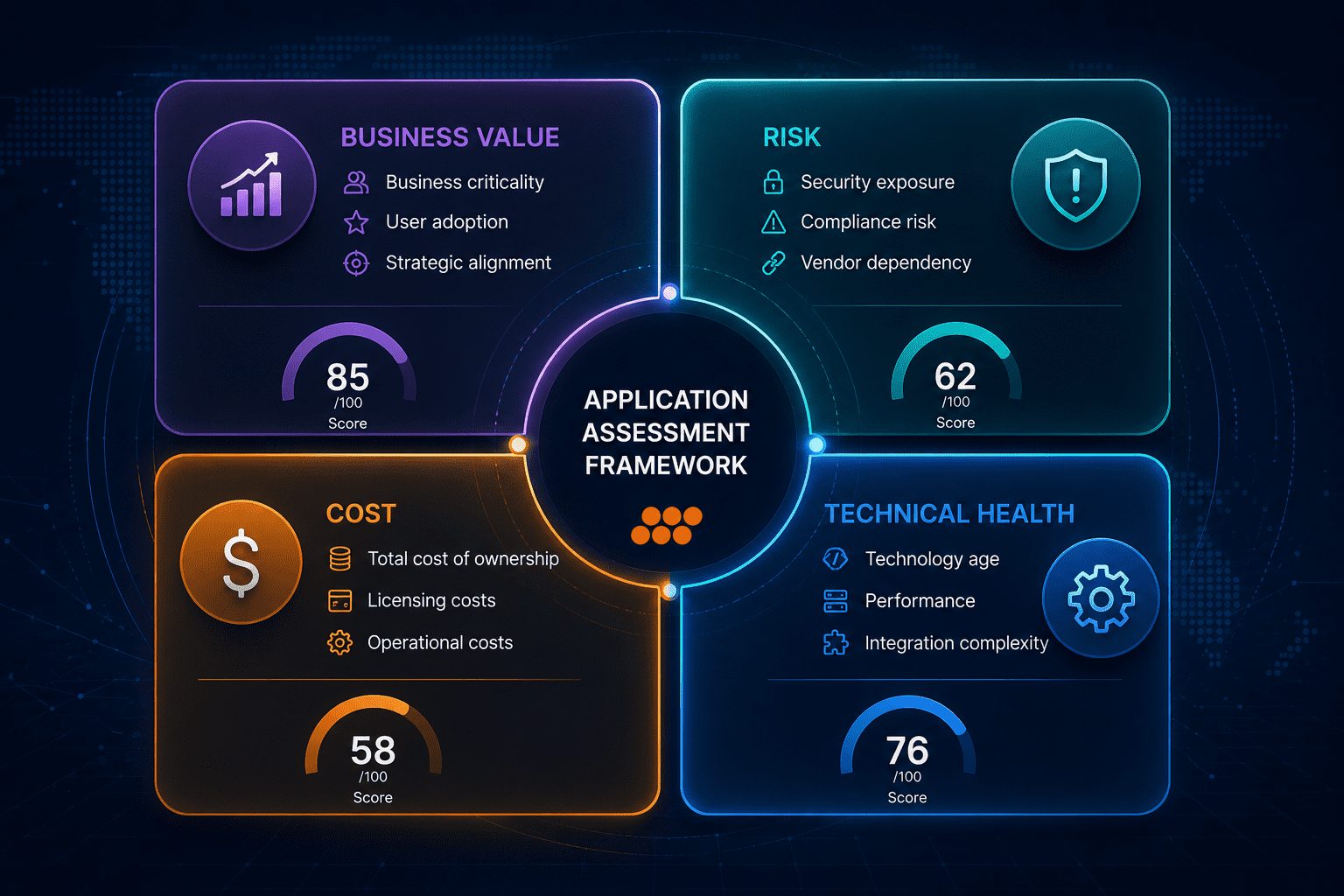
Business Value Assessment
The first step is determining the value an application provides to the organization.
Key evaluation criteria include:
- Business criticality
- User adoption
- Process support
- Revenue contribution
- Customer impact
- Strategic alignment
Applications with high business value typically receive greater investment and protection.
Technical Health Assessment
The next step is evaluating the technical condition of the application.
Common criteria include:
- Technology stack age
- Vendor support status
- Technical debt
- Performance and scalability
- Architecture quality
- Integration complexity
This assessment helps identify systems that may create future operational challenges.
Risk Assessment
Every application introduces a level of business and technical risk.
Evaluation areas include:
- Security vulnerabilities
- Compliance concerns
- Single points of failure
- Data management risks
- Vendor dependency risks
- Disaster recovery readiness
Understanding risk exposure allows organizations to prioritize remediation efforts effectively.
Financial Assessment
Cost visibility is essential for informed decision-making.
Organizations should evaluate:
- Licensing costs
- Infrastructure costs
- Support costs
- Development costs
- Vendor contracts
- Total cost of ownership
Applications with high costs and low business value often become strong candidates for consolidation or retirement.
Common Assessment Outcomes
Application assessments typically lead to one of several strategic decisions.
Retain
The application continues to provide strong business value and remains technically healthy.
No significant changes are required.
Modernize
The application remains valuable but requires technical improvements to support future business needs.
Common modernization activities include cloud migration, platform upgrades, or architectural improvements.
Replace
The application no longer meets organizational requirements and should be replaced with a more suitable solution.
Consolidate
Multiple applications perform similar functions and can be merged to reduce complexity and costs.
Retire
The application no longer delivers sufficient value and can be safely decommissioned.
Application Assessment and Enterprise Architecture
Application assessment is a foundational capability within Enterprise Architecture.
Enterprise Architects use assessment data to:
- Support application rationalization initiatives
- Guide modernization programs
- Improve technology governance
- Reduce portfolio complexity
- Prioritize investments
- Strengthen strategic planning
When assessments are performed consistently across the application landscape, decision-makers gain a reliable view of technology health, business value, and future investment priorities.
Best Practices for Application Assessment
Organizations that achieve the greatest value from application assessments typically follow several best practices.
Establish Standard Evaluation Criteria
Using a consistent framework ensures applications can be compared objectively.
Involve Business and IT Stakeholders
Assessment results should reflect both business priorities and technical realities.
Maintain Current Data
Application portfolios change continuously.
Assessment data should be reviewed and updated regularly.
Connect Assessments to Strategic Goals
Application evaluations should support broader initiatives such as modernization, digital transformation, cost optimization, and governance improvement.
Conclusion
Application assessment provides the foundation for informed technology decision-making.
Without a structured evaluation framework, organizations risk investing in the wrong systems, overlooking critical risks, and increasing portfolio complexity over time.
By assessing business value, technical health, risk exposure, and financial impact, Enterprise Architects can create a clear roadmap for modernization, optimization, and long-term technology success.
Organizations that consistently evaluate their application landscape are better positioned to reduce risk, control costs, and align technology investments with business objectives.
Frequently Asked Questions
What is application assessment?
Application assessment is the process of evaluating business applications based on factors such as business value, technical health, risk exposure, and cost. The goal is to determine whether an application should be retained, modernized, replaced, consolidated, or retired.
Why is application assessment important for Enterprise Architecture?
Application assessment provides Enterprise Architects with the information needed to make informed technology decisions. It helps organizations identify risks, reduce unnecessary costs, prioritize modernization efforts, and align technology investments with business objectives.
What criteria are commonly used in an application assessment?
Most organizations evaluate applications using four primary categories: business value, technical health, risk, and financial impact. Additional criteria may include compliance requirements, user satisfaction, scalability, integration complexity, and vendor support status.
How often should applications be assessed?
Application assessments should be performed regularly, especially before major initiatives such as cloud migrations, modernization projects, mergers and acquisitions, or application rationalization programs. Many organizations review critical applications annually and update assessment data continuously.
What are the possible outcomes of an application assessment?
The most common outcomes are retain, modernize, replace, consolidate, or retire. These decisions help organizations optimize their application portfolio while reducing risk and improving operational efficiency.
What is the difference between application assessment and application rationalization?
Application assessment focuses on evaluating individual applications and gathering decision-making data. Application rationalization uses those assessment results to optimize the overall application portfolio by reducing redundancy, lowering costs, and improving business alignment.

Oliver holds a degree in Economics from the University of California, Berkeley, and was raised in the United States. With over 25 years of extensive experience in sales, business development, and account management, he has specialized in managing enterprise accounts within the Information and Communications Technology (ICT) sector.
For more than eight years, Oliver has been a key contributor at Atoll, where he has played a pivotal role in expanding SAMU’s customer base. Currently, he is focused on growing SAMU’s international presence, with a strategic emphasis on the North American market.
Outside of his professional life, Oliver is a dedicated family man, proud father to a son and daughter. He is passionate about sports, avidly following all major US sports leagues, and actively competes in golf and basketball. His competitive spirit and team-oriented mindset extend beyond the office, reflecting his dynamic approach both professionally and personally.