
SAMU vs Ardoq: Which Enterprise Architecture Tool Fits Your Organization Better?
Enterprise architecture management is no longer just about documenting applications and creating architecture diagrams. For CIOs, enterprise architects, IT portfolio managers, and transformation leaders, it has become a critical capability for understanding complex technology environments, managing risks, and making better business decisions.
Organizations need to know which applications they operate, how those applications support business capabilities, where dependencies exist, which technologies are becoming obsolete, and how planned changes could affect the wider enterprise.
The right enterprise architecture tool helps transform fragmented spreadsheets, disconnected documentation, and isolated technology inventories into a living architecture repository.
Two platforms that deserve serious consideration are SAMU and Ardoq.
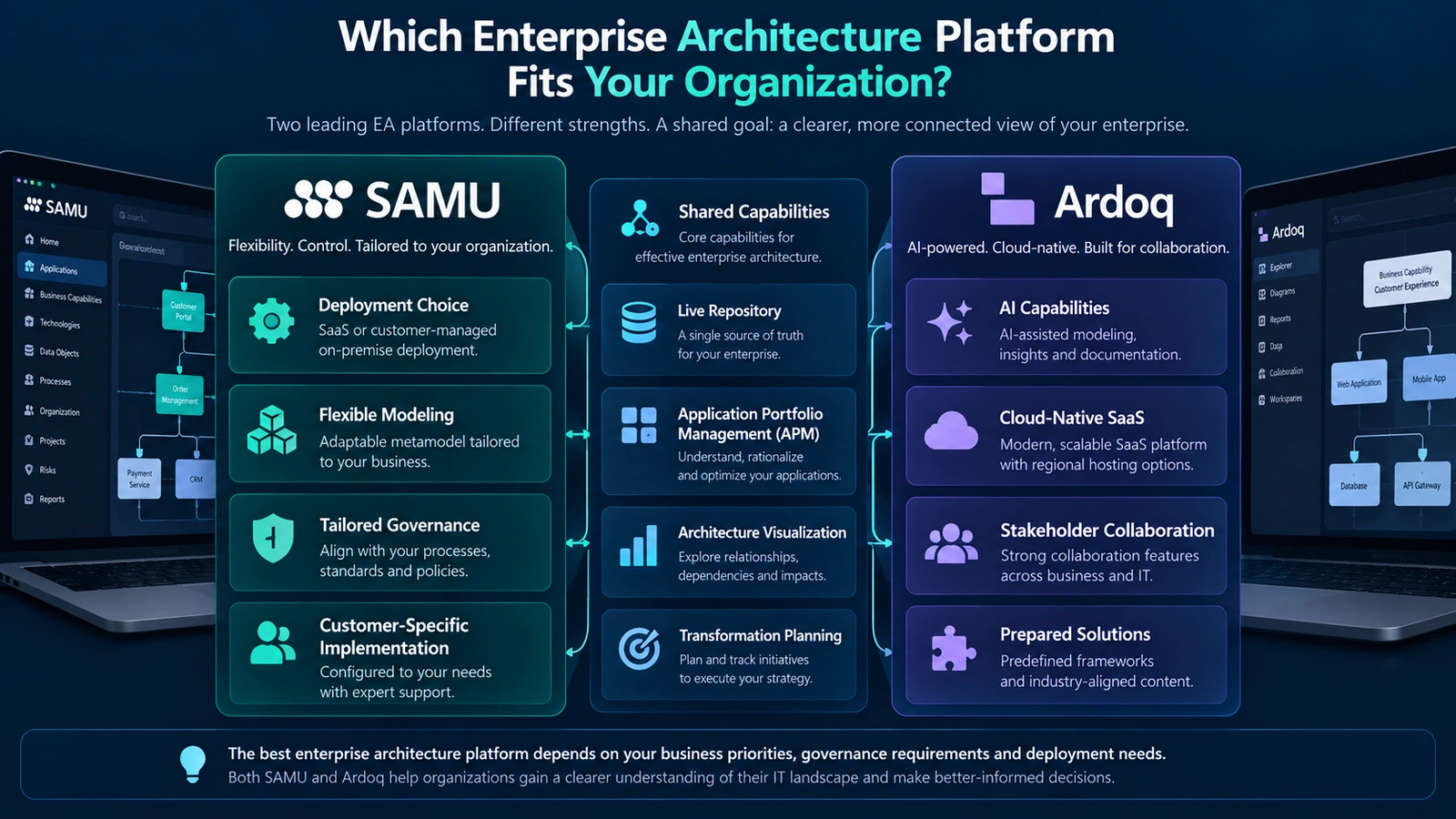
Both provide data-driven enterprise architecture management, configurable architecture models, visualization, application portfolio management, and capabilities for supporting digital transformation.
However, their priorities are different.
Ardoq is a cloud-native, graph-based enterprise architecture platform with strong collaboration features, an extensive integration ecosystem, and a rapidly developing portfolio of AI capabilities.
SAMU is a flexible enterprise architecture and IT governance platform built around a live repository, a fully configurable metamodel, data-driven visualization, workflow-based governance, and practical transformation planning. It also offers SaaS and on-premise deployment options.
The most important difference is not simply which platform offers more features. It is which platform can deliver greater business value within your organization’s architecture practice, operating model, and technology environment.
This detailed SAMU vs Ardoq comparison examines functionality, flexibility, integrations, governance, AI, deployment, pricing, and customer experiences to help organizations make an informed decision.
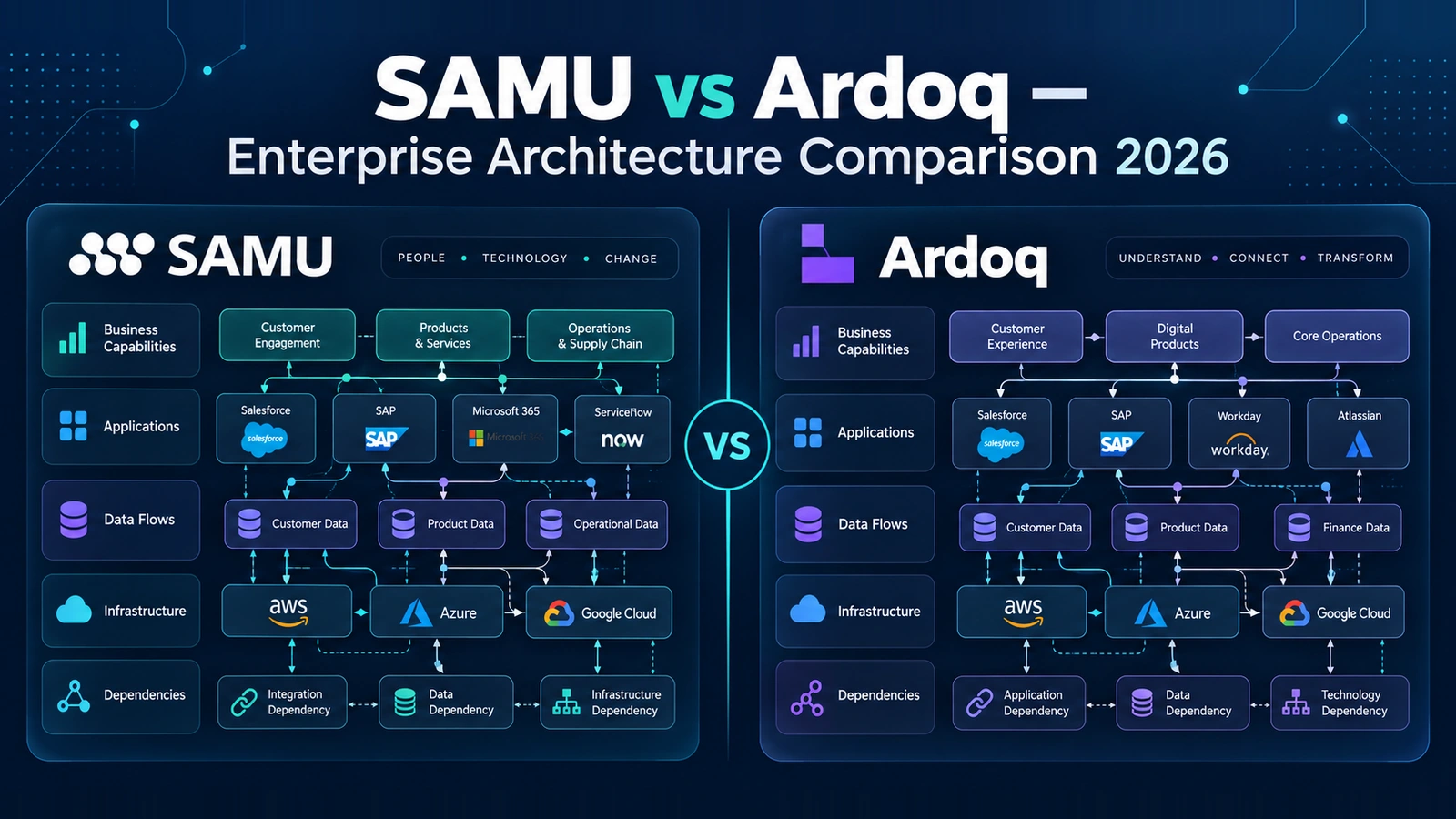
Quick Comparison: SAMU vs Ardoq
The following table summarizes the most important differences between the two enterprise architecture platforms.
| Evaluation Area | SAMU | Ardoq |
|---|---|---|
| Core positioning | Flexible enterprise architecture, IT governance, and transformation management platform | Cloud-native, graph-based, AI-focused enterprise architecture platform |
| Deployment | SaaS and on-premise options | SaaS with regional hosting options |
| Metamodel | Fully configurable to customer-specific requirements | Highly configurable, graph-based metamodel |
| Architecture repository | Centralized, live architecture repository | Connected, graph-based architecture repository |
| Visualization | Dynamic diagrams, customizable reports, dependency analysis | Dynamic graph visualizations, viewpoints, dashboards, analytics |
| Application portfolio management | Application inventory, lifecycle, dependency analysis, rationalization | Comprehensive APM, rationalization, and predefined solution assets |
| Integration | Sync module, REST, SOAP, JDBC, LDAP, CSV | REST APIs, Import Builder, AI-assisted import, predefined integrations |
| Governance | Workflow engine, approvals, permissions, traceable changes | Surveys, Broadcasts, workflows, automation, access controls |
| AI | AI-assisted visual recognition and architecture data processing | AI Assistant, semantic search, AI-assisted imports, queries, and agents |
| Transformation planning | Configurable current- and future-state architecture modeling | Strategic planning, Scenarios, and roadmap-related capabilities |
| Pricing | Customer-specific commercial proposal | Application-based pricing with unlimited users |
| Implementation | Adaptable Best Practice Framework, customer-specific configuration, trial or PoC | Preconfigured Solutions, templates, implementation services, partner ecosystem |
| Particularly suitable for | Organizations prioritizing deployment choice, tailored governance, and flexible implementation | Organizations prioritizing cloud-native EA, advanced AI, large-scale collaboration, and packaged solutions |
This comparison reflects publicly documented capabilities reviewed in October 2026. Product availability, add-ons, commercial terms, and deployment conditions should be verified with each vendor.
Key takeaway: Ardoq is particularly attractive for organizations prioritizing AI-enabled, cloud-native enterprise architecture. SAMU is particularly attractive where deployment flexibility, customer-specific modeling, configurable workflows, and practical implementation are essential.
Before choosing either platform, organizations should consider how each product supports the way they actually manage and transform their IT landscape.
[CTA – EARLY, BELOW COMPARISON]
Want to estimate the business value of stronger enterprise architecture management?
Calculate Your Enterprise Architecture Value →
Why This Enterprise Architecture Comparison Matters
Selecting enterprise architecture software is often treated as a straightforward technology procurement decision.
In reality, choosing an EA platform also means choosing how enterprise architecture will operate within the organization.
The platform influences:
How architecture information is collected and maintained.
How applications, technologies, processes, and business capabilities are connected.
How business and IT stakeholders participate.
How technology risks and dependencies are identified.
How transformation initiatives are planned and evaluated.
How architecture decisions are governed and communicated.
Consider a company operating 800 applications across multiple business units.
The IT organization maintains an application inventory in a CMDB. Technology ownership is documented in spreadsheets. Financial information resides in an ERP system. Strategic changes are managed in project planning software.
The data exists, but it is disconnected.
Management cannot easily answer which applications support a critical business service, which systems have overlapping functionality, or what would happen if a legacy application were replaced.
Both SAMU and Ardoq can help establish the connected architecture knowledge needed to address these questions.
However, choosing between them requires looking beyond feature checklists.
A successful implementation depends on how well the platform accommodates the organization’s existing data, architecture maturity, governance requirements, and available resources.
Ardoq Strengths: Graph Technology, Collaboration, and AI
Ardoq has built a strong reputation around data-driven enterprise architecture and graph-based modeling.
Its platform uses relationships between architecture elements to build a connected representation of the organization.
Rather than treating applications, technologies, business capabilities, and processes as isolated records, Ardoq emphasizes how these elements influence one another.
Graph-Based Architecture Management
Ardoq’s architecture graph connects components such as applications, business capabilities, processes, technologies, and organizational structures.
This makes it possible to explore relationships and generate different perspectives from shared information.
For example, an architect can examine the applications supporting a particular business capability, identify their technology dependencies, and investigate potential risks associated with planned changes.
The underlying graph is also an important foundation for Ardoq’s AI capabilities.
Stakeholder Collaboration
Enterprise architecture data is rarely owned entirely by the EA team.
Application owners, project managers, business managers, technology specialists, and security teams must contribute information.
Ardoq supports this through Surveys, Broadcasts, and stakeholder-oriented access to architecture information.
These capabilities help distribute data collection and communication across the organization.
Broadcasts can also support targeted alerts and structured workflows.
For companies with large, distributed teams, this can be a significant operational advantage.
Preconfigured Enterprise Architecture Solutions
Ardoq offers prepared solution assets for common architecture management activities.
These can include metamodel components, reports, dashboards, surveys, integration templates, and other resources.
Organizations can use these assets to establish initial architecture practices more efficiently when the supplied models fit their requirements.
The platform’s official Solutions documentation also distinguishes between included solution materials and certain capabilities requiring paid add-ons.
AI-First Product Strategy
Artificial intelligence is now a central element of Ardoq’s positioning.
Its 2026 AI developments include conversational architecture queries, semantic search, AI-assisted data imports, and architecture data quality analysis.
Ardoq also continues to develop agent-based capabilities that can work with the architecture graph.
These features make Ardoq especially relevant for organizations seeking to expand the use of AI in enterprise architecture management.
Overall, Ardoq is a sophisticated platform with meaningful strengths in modeling, collaboration, automation, and AI-driven architecture insights.
SAMU Strengths: Flexibility, Live Repository, and Practical Governance
SAMU takes a strongly practical approach to enterprise architecture management.
Its central objective is to provide an adaptable platform where architecture information supports daily decision-making, IT governance, and enterprise transformation.
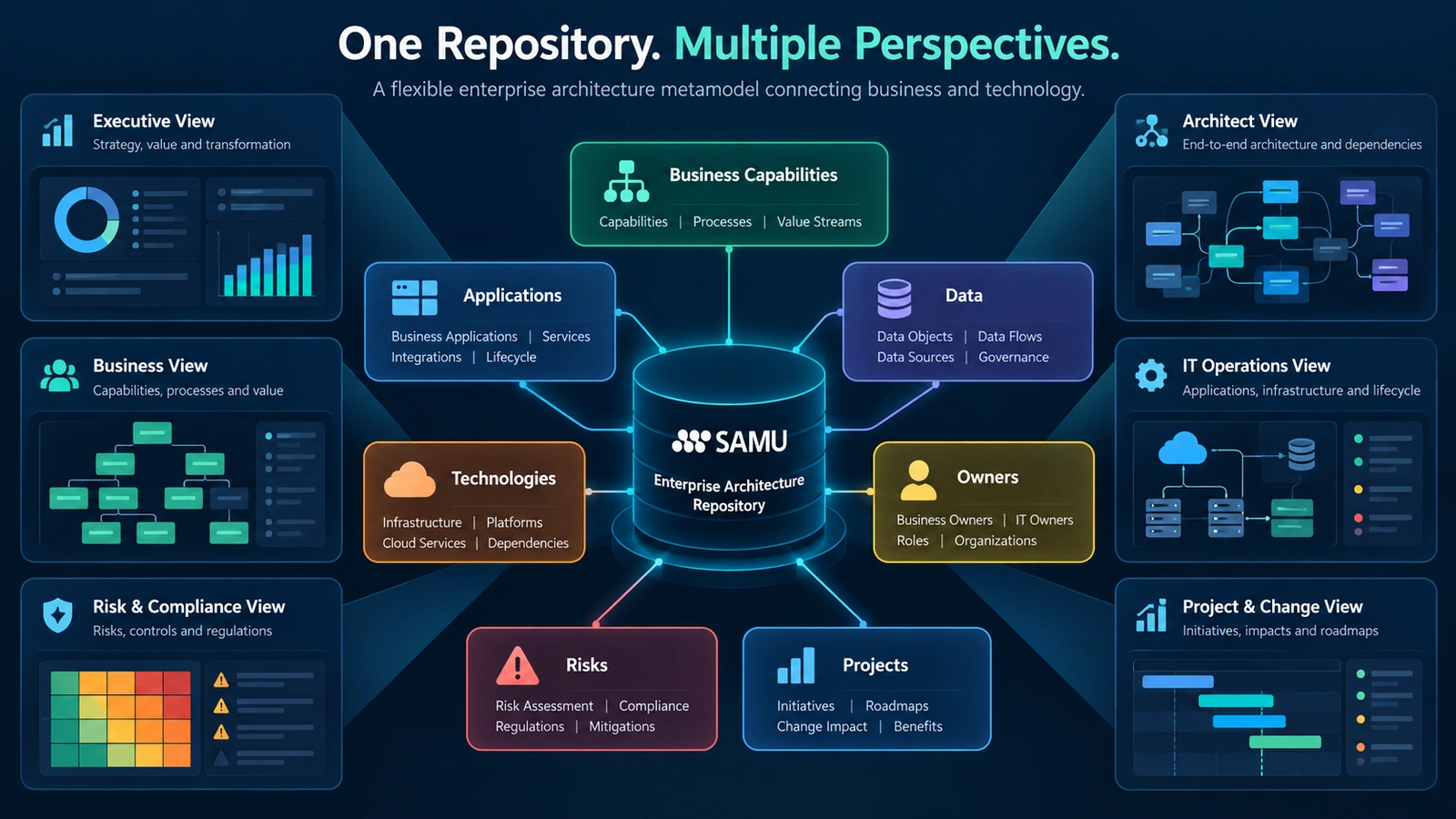
The system combines a live architecture repository, customizable modeling, dynamic visualization, reporting, integration capabilities, and workflow-based data maintenance.
A Fully Configurable Metamodel
Different enterprises have different approaches to architecture management.
A bank may need detailed compliance classifications and risk attributes.
A manufacturer may focus on production systems, operational dependencies, and technological lifecycle risks.
A multinational enterprise may require different ownership models, business domains, and reporting structures.
SAMU allows organizations to configure architecture object types, relationships, attributes, reports, and other settings through its web-based interface.
This makes it possible to align the architecture model with the organization’s actual terminology and management requirements.
A Best Practice Framework That Can Be Adapted
SAMU provides a Best Practice Framework based on more than 20 years of enterprise architecture project experience.
It offers a starting point for organizations that do not want to design their entire architecture structure from scratch.
However, the framework can be modified to reflect customer-specific needs.
This combination is useful because organizations frequently need both a proven initial structure and the freedom to change it.
A Live, Shared Architecture Repository
SAMU stores architecture objects and their relationships in a structured central repository.
Applications can be associated with business processes, capabilities, technologies, integration points, ownership information, risks, and transformation initiatives.
Dynamic architecture diagrams and reports are generated from this information.
As repository data evolves, the corresponding views can reflect the updated information.
This reduces dependence on manually maintaining disconnected diagrams.
Workflow-Based Governance
SAMU’s workflow module supports controlled architecture data maintenance.
Tasks can be organized into processes with responsibilities, approval steps, and transaction history.
This helps connect architecture management to normal operational activities rather than relying on occasional manual updates.
For example, an organization can establish a procedure for reviewing proposed application changes or updating ownership and lifecycle information.
Combined with rule-based permissions, these capabilities can help create a more accountable EA operating model.
Explore the SAMU Enterprise Architecture Tool to learn more about its repository, metamodel, visualization, and governance capabilities.
Metamodel Flexibility: How Easily Can the Platform Adapt?
Metamodel flexibility is one of the most important considerations in enterprise architecture software selection.
It would be inaccurate, however, to describe SAMU as flexible and Ardoq as rigid.
Both platforms offer substantial metamodel customization.
Ardoq supports configurable components, references, fields, and architecture structures.
SAMU also offers extensive configuration through its web interface, including metamodel changes and customer-specific reporting.
The important distinction is therefore not whether customization exists, but how customization works in practice.
The Real Questions Behind Metamodel Flexibility
An organization evaluating these platforms should examine several practical scenarios.
Suppose a new regulatory requirement means that every critical application must be connected to a defined business service, data classification, risk owner, and recovery priority.
The EA team may need to introduce new attributes and relationships, update existing reports, and establish a review process.
The evaluation should determine:
How easily can the required objects and attributes be configured?
Can existing information be retained without extensive restructuring?
Will changes affect dashboards or integrations?
Can the organization maintain customized reports?
What expertise is required for ongoing administration?
How much external support is needed when requirements evolve?
Ardoq’s prepared solutions and flexible metamodel can provide a strong combination of predefined practices and customization.
SAMU’s configuration-driven approach is particularly relevant for organizations that need to adapt their architecture structure and reporting to established internal processes.
The decisive factor is not theoretical configurability, but the total effort required to maintain a useful model over time.
Integrations and Data Quality: Creating a Reliable Architecture Repository
Even the most sophisticated architecture platform cannot create reliable insights from inaccurate or incomplete information.
Enterprise architecture data often exists across several systems.
Application inventories may reside in ServiceNow or another CMDB. Technology information can come from cloud environments. Business ownership data may reside in organizational directories. Transformation initiatives may be maintained in project portfolio systems.
The enterprise architecture platform must bring these sources together.
Ardoq Integrations
Ardoq offers integrations with major enterprise systems alongside configurable integration mechanisms.
The platform supports API-based data exchange and provides an Import Builder for establishing connections to additional sources.
Its AI Import Builder extends these capabilities by helping configure data imports using third-party documentation.
The official Ardoq Integrations Help Center provides details about available integration options and configuration methods.
This integration ecosystem can be particularly useful when an enterprise already uses supported systems and wants to automate the collection of architecture information.
SAMU Integrations
SAMU provides a Sync module designed to exchange information with existing systems.
Its documented integration methods include JDBC, LDAP, REST, SOAP, and CSV.
The platform also provides API capabilities for creating, reading, updating, and deleting repository information.
These capabilities allow architecture data to be connected to existing inventories, operational systems, project portfolio tools, and other data sources.
Because SAMU’s metamodel is configurable, imported information can be organized according to the customer’s own architecture structure.
A Practical Integration Scenario
Imagine an organization that has three authoritative sources:
A CMDB containing applications and infrastructure components.
An organizational directory containing ownership information.
A project management platform containing modernization initiatives.
The goal is to build one architecture repository that connects these records and keeps them up to date.
Both SAMU and Ardoq can support this kind of architecture integration.
The meaningful evaluation criteria include data mapping, synchronization, duplicate handling, error reporting, access permissions, and maintenance requirements.
A successful EA integration does not simply import data. It turns distributed information into reliable, connected knowledge.
Architecture Visualization and Impact Analysis
Enterprise architecture is fundamentally about understanding relationships.
An isolated application record provides limited value. The real insight comes from knowing what depends on that application and what might be affected by changing it.
Both SAMU and Ardoq offer dynamic architecture visualization.
Ardoq Visualization
Ardoq uses its graph-based model to generate architecture views and analytical perspectives.
Users can explore applications, business capabilities, dependencies, and other connected components through its visual tools.
Dashboards and stakeholder-focused views help communicate architecture information to different audiences.
SAMU Visualization
SAMU generates data-driven diagrams directly from the central repository.
Users can navigate relationships, filter architecture information, examine lifecycle states, and create reports aligned with their requirements.
The platform supports custom dashboards and visualizations that can incorporate customer-specific attributes and assessment criteria.
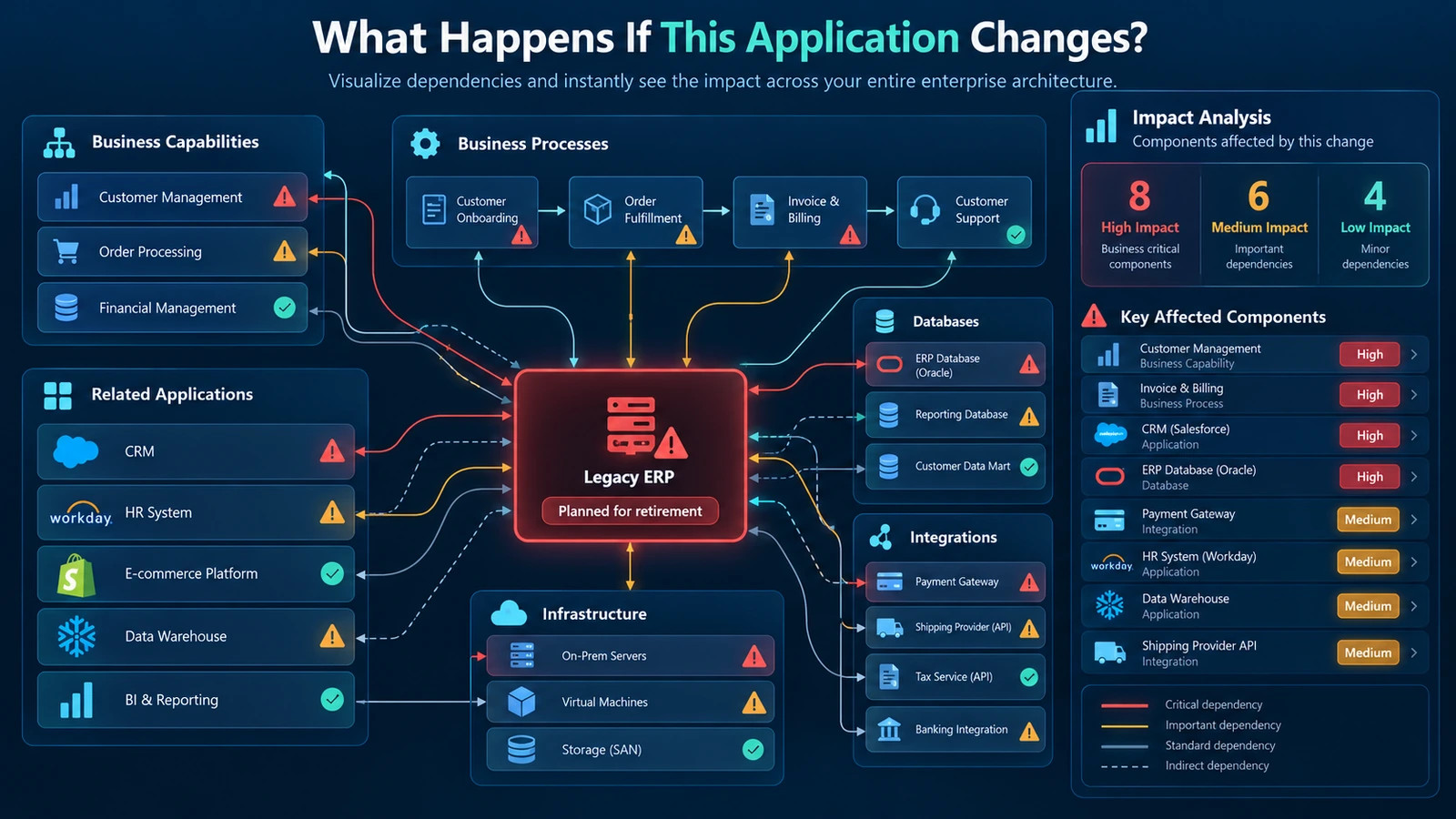
Practical Scenario: Replacing a Legacy Application
Consider a company preparing to retire a legacy financial application.
The architecture team must determine:
Which business capabilities depend on the application?
What other systems exchange data with it?
Which integrations are critical?
Who owns the affected components?
What risks exist during migration?
Which planned projects may be influenced?
Both platforms can support this analysis when the necessary relationships have been captured.
The important question is how quickly and reliably the organization can move from identifying a component to understanding its business impact.
That is what transforms enterprise architecture visualization from technical documentation into decision support.
Application Portfolio Management and Rationalization
Application Portfolio Management (APM) is a central enterprise architecture use case.
Large organizations frequently operate hundreds or thousands of applications, often with overlapping functionality, outdated technology, unclear ownership, and growing support costs.
An effective APM practice helps establish a consistent view of the application portfolio.
It also enables more structured application rationalization and modernization decisions.
Ardoq Application Portfolio Management
Ardoq offers application portfolio management and rationalization capabilities supported by its graph-based repository and predefined solution assets.
Applications can be connected to business capabilities, organizational structures, technical information, and other relevant relationships.
This helps enterprises identify redundant functionality, analyze portfolio complexity, and prioritize improvements.
SAMU Application Portfolio Management
SAMU supports centralized application inventories, dependency analysis, technology lifecycle information, and portfolio assessments.
The platform’s configurable architecture model allows organizations to define assessment criteria according to their own needs.
Applications can be evaluated using attributes such as business criticality, technology risk, strategic importance, cost, and planned lifecycle state.
For a detailed explanation, explore SAMU’s Application Portfolio Management Tool.
Practical Scenario: Rationalizing 800 Applications
Suppose an enterprise operates 800 applications and wants to identify the 50 highest-priority rationalization candidates.
A simple comparison of annual license costs would be insufficient.
An inexpensive application may introduce substantial operational risk. An expensive application may support a critical business capability that cannot easily be replaced.
A meaningful assessment should consider:
Business value and strategic relevance.
Technical condition and vendor support.
Functional overlap with other applications.
Operational and licensing costs.
Integration dependencies.
Security and compliance requirements.
Migration complexity.
Both SAMU and Ardoq can provide the architecture information needed for this process.
The final decision depends on how well the software supports the organization’s assessment methodology and decision-making procedures.
SAMU’s Application Rationalization Tool guide explains how structured portfolio analysis can support decisions to retain, replace, consolidate, modernize, or retire applications.
Governance and Collaboration: Keeping Architecture Information Accurate
One of the most common reasons enterprise architecture initiatives lose value is that repository information gradually becomes outdated.
Application owners change roles. Projects introduce new systems. Integrations are modified. Technologies reach the end of their supported lifecycle.
If architecture information is not maintained systematically, its usefulness decreases.
Both Ardoq and SAMU provide mechanisms to address this problem.
SAMU: Controlled Data Maintenance and Approvals
SAMU’s workflow module allows architecture-related tasks to follow defined processes.
Organizations can assign responsibilities, introduce approval steps, and record changes in a traceable manner.
Its permission model also supports controlled access to architecture data.
This can be particularly important in environments where changes must follow formal review or approval procedures.
Ardoq: Surveys, Broadcasts, and Workflow Automation
Ardoq supports collaborative data collection through Surveys and Broadcasts.
These features allow the architecture team to collect updates from application owners and communicate changes to relevant stakeholders.
Ardoq also supports end-to-end workflow processes based on coordinated Broadcasts and data collection activities.
Its Broadcast workflow documentation describes how multiple steps can be combined into a structured process.
Which Governance Approach Is Better?
Neither platform should be treated as the only one capable of workflow automation.
The important consideration is whether its available mechanisms match the organization’s governance requirements.
For example, a company may need application owners to review specific information quarterly.
Another company may need architecture changes to pass through formal approval before they are accepted into the authoritative model.
A third may prioritize automatically collecting information from hundreds of contributors.
The evaluation should examine which processes can be implemented using standard functionality and how much additional configuration is required.
A living architecture repository needs more than data. It needs clear responsibilities, repeatable processes, and stakeholder participation.
Transformation Planning: From Current Architecture to Future State
Enterprise architecture becomes strategically valuable when it helps organizations understand the consequences of future changes.
This includes application modernization, technology consolidation, cloud migration, organizational restructuring, and large transformation programs.
Ardoq Strategic Planning
Ardoq provides capabilities for future-state architecture modeling and strategic planning.
Its Scenarios functionality allows teams to explore potential changes without immediately modifying the live architecture model.
Architects can use scenarios to compare possible future states and communicate their implications to stakeholders.
The official Ardoq Scenarios documentation explains this approach.
Some advanced planning capabilities may require additional licensing.
SAMU Transformation Planning
SAMU supports transformation planning through its repository-based architecture model.
Organizations can represent current and planned architecture components, model changes, analyze dependencies, and connect architecture information to project activities.
Its configurable data structure and visualization capabilities enable the platform to reflect the enterprise’s own transformation planning methodology.
SAMU’s approach to Enterprise Architecture Lifecycle Management provides additional context for managing architecture across its lifecycle.
Practical Scenario: Enterprise-Wide ERP Modernization
A multinational company plans to replace several legacy ERP systems with a consolidated platform.
The architecture team must understand existing dependencies, affected business capabilities, data flows, migration priorities, and operational risks.
It must also communicate the proposed future architecture and support planning decisions.
Both Ardoq and SAMU offer relevant capabilities.
The better fit depends on the organization’s requirements for scenario modeling, governance, architecture configuration, and project integration.
AI and Automation: How Do SAMU and Ardoq Compare?
Artificial intelligence has become an important differentiator in enterprise architecture software.
However, buyers should distinguish between available capabilities, capabilities in development, and AI features that genuinely improve their architecture practice.
Ardoq AI Capabilities in 2026
On May 28, 2026, Ardoq announced a significant expansion of its AI-first platform strategy.
According to its official AI-first announcement, the generally available capabilities announced included:
AI Assistant: Conversational interaction with architecture information.
AI Import Builder: AI-assisted configuration of third-party data imports.
Foundation Insights Agent: Identification of data quality issues and architecture gaps.
AI Query Builder: Creation of architecture queries using natural language.
AI Semantic Search: More intuitive discovery of architecture information.
Ardoq also announced additional features in open beta or technical preview, including custom agents, data ingestion agents, and AI capabilities for prepared solutions.
These should not be treated as equally mature or universally available without confirmation.
The platform’s AI strategy is built around its architecture graph, helping connect AI-generated answers to relevant enterprise data.
For organizations planning to use conversational AI and agent-based automation extensively, Ardoq presents a compelling proposition.
SAMU AI Capabilities
SAMU has introduced AI-assisted visual recognition for converting existing architecture drawings into structured repository data.
The functionality is designed to analyze visual elements such as boxes, connections, and text in diagrams.
It can then compare recognized elements with existing repository information, helping users identify relevant components and relationships.
SAMU describes this capability in its article Revolutionize Enterprise Architecture with AI: Turning Drawings into Data.
This addresses a practical problem found in many organizations: valuable architecture knowledge exists in drawings, presentations, and whiteboards but has not been transferred into the central repository.
AI-assisted recognition can reduce manual effort when converting such information into structured architecture data.
In addition, SAMU provides integration and workflow mechanisms for automating architecture maintenance activities.
Is Ardoq Ahead in AI?
Based on publicly documented capabilities in October 2026, Ardoq has a broader portfolio of named AI assistants, semantic search, AI-supported imports, and agent-related functions.
This is a genuine area of differentiation.
SAMU’s publicly documented AI functionality has a more specific focus on visual recognition and architecture data capture.
However, AI capabilities should be evaluated against the organization’s actual requirements.
A conversational assistant may be valuable for an enterprise with a mature architecture repository and many stakeholders.
An organization that needs to convert existing architecture documentation into structured information may have different priorities.
In both cases, reliable underlying data remains essential.
The business value of AI in enterprise architecture ultimately depends on the quality of the information it uses and the decisions it helps improve.
Deployment, Security, and Data Sovereignty
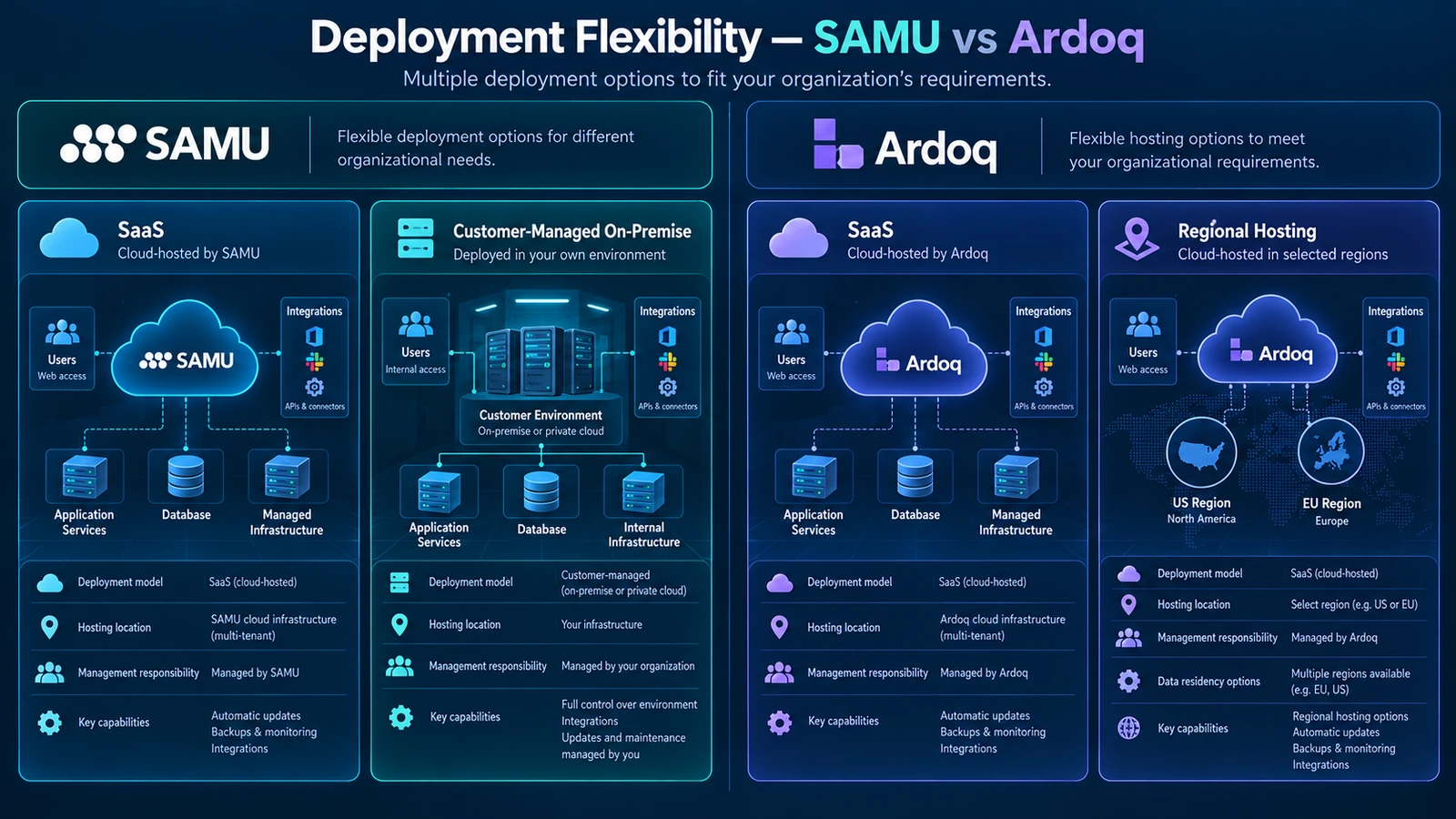
Deployment is one of the most clearly identifiable differences between SAMU and Ardoq.
Ardoq: Cloud-Native SaaS
Ardoq is positioned as a SaaS-based enterprise architecture platform.
This approach offers advantages such as centralized platform management, continuous development, and reduced responsibility for operating application infrastructure.
Ardoq also documents significant information security controls.
According to its Information Security documentation, the company’s information security management system is ISO 27001 certified, and it undergoes annual SOC 2 Type II audits.
Ardoq already supports EU data residency.
On October 7, 2026, the company also announced an EU sovereign-cloud offering, planned for early November 2026.
This offering is intended to provide hosting through an EU-owned and EU-operated cloud provider.
As of this comparison’s research date, it was an announced upcoming option, not an already completed general launch.
SAMU: SaaS and On-Premise Deployment
SAMU offers both SaaS and on-premise deployment options.
This gives organizations an additional choice when deciding how their enterprise architecture repository should be operated.
Some organizations prefer SaaS for ease of maintenance and reduced infrastructure responsibilities.
Others may have internal policies, technical constraints, or integration requirements that favor deployment within their own environment.
For an enterprise that explicitly requires an on-premise EA repository, SAMU’s deployment flexibility can therefore be a significant advantage.
This does not mean that on-premise software is automatically more secure than SaaS.
Security depends on configuration, access controls, patching, infrastructure management, monitoring, and operational responsibilities.
The important distinction is the ability to select an appropriate deployment model.
Ardoq provides a cloud-native SaaS approach with regional hosting choices. SAMU offers the additional option of an on-premise deployment.
For some organizations, that difference alone may influence the purchasing decision.
Pricing and Total Cost of Ownership: SAMU vs Ardoq
Pricing matters, but evaluating an enterprise architecture platform solely by its subscription fee can lead to misleading conclusions.
The real financial question is the total cost of implementing, operating, and maintaining the platform over several years.
Ardoq Pricing
According to the official Ardoq Plans & Pricing page, the platform uses application-based pricing with unlimited users.
This can be attractive for enterprises that want many stakeholders to participate without paying separately for each user.
However, final pricing depends on portfolio size, selected solutions, optional capabilities, implementation needs, and contract terms.
The website does not provide a universal public price that can be applied reliably to every organization.
SAMU Pricing
SAMU offers a customer-specific commercial approach and positions itself as a competitively priced enterprise architecture solution.
Its configurable architecture model and deployment options may be economically attractive for organizations with specific requirements.
However, a credible comparison should not claim that SAMU is always cheaper than Ardoq without comparable commercial offers.
The financial advantage depends on the customer’s requirements and implementation scope.
What Should Be Included in a Three-Year TCO Comparison?
| Cost Category | What Buyers Should Evaluate |
|---|---|
| Platform licensing | Subscriptions, licenses, contract terms, and applicable add-ons |
| Implementation | Configuration, initial data migration, and architecture setup |
| Integrations | Standard connectors, custom development, and synchronization |
| Training | Administrators, architects, application owners, and stakeholders |
| Governance | Workflow setup, permissions, and ongoing data maintenance |
| Infrastructure | Hosting and operational responsibilities, where applicable |
| Support | Vendor support, technical services, and service commitments |
| Future changes | New integrations, model modifications, additional reports |
| Optional functionality | AI, advanced scenario planning, or other paid capabilities |
A platform with a lower initial license fee may still be more expensive if customization and administration require substantial effort.
Conversely, a more expensive subscription may provide good value if it reduces operational complexity or replaces additional tools.
Where SAMU May Offer Financial Advantages
SAMU may offer an attractive total cost of ownership when customers benefit from:
An adaptable Best Practice Framework.
Customer-specific metamodel and reporting configuration.
Workflow-based governance.
Repository-driven visualization.
Flexible deployment.
A practical implementation approach that matches existing processes.
These factors may reduce certain implementation or maintenance costs, but the actual savings must be demonstrated.
The strongest commercial argument is therefore not simply that SAMU costs less.
It is that SAMU may deliver a favorable balance of functionality, implementation flexibility, and total cost of ownership for organizations with specific EA requirements.
Implementation and User Adoption
Enterprise architecture projects rarely succeed through software functionality alone.
They require reliable information, clear ownership, practical governance, and active participation from stakeholders.
A platform may offer sophisticated features while still failing to deliver value if employees find it difficult to maintain information or understand the available reports.
Ardoq Implementation
Ardoq provides prepared Solutions, training resources, implementation services, and a partner ecosystem.
This can help organizations establish architecture practices based on predefined models and common use cases.
Its Surveys and collaboration capabilities can also support participation from stakeholders who are not enterprise architecture specialists.
SAMU Implementation
SAMU provides a Best Practice Framework that can serve as an initial architecture structure.
The framework is configurable, allowing organizations to adapt it as their requirements become clearer.
SAMU also offers a free trial or a Proof of Concept that can be configured using customer data.
This allows buyers to evaluate relevant application inventories, architecture dependencies, and visualizations before committing to wider adoption.
What Makes an EA Implementation Successful?
The key considerations are:
Can the organization create a useful initial architecture repository?
Can stakeholders understand and maintain their information?
Are business-relevant reports available?
Can data be synchronized from existing systems?
Can the platform adapt when requirements change?
Can the architecture team demonstrate value early?
A successful implementation should establish a useful architecture management process rather than simply populate a repository.
Customer Experiences: What Do Real-World Examples Show?
Customer stories help illustrate how architecture management platforms can deliver practical business outcomes.
The examples below come from published vendor case studies. They are not standardized head-to-head product evaluations.
SAMU at Wizz Air: Improving Technology Landscape Transparency
Wizz Air operates in a technology environment involving many applications, integration points, services, and infrastructure components.
Maintaining visibility across this landscape supports more effective architecture decisions, planning, and risk management.
In the Wizz Air customer interview, the company’s Digital Engineering and Architecture leadership explains how SAMU supports architecture transparency and the understanding of relationships across the technology landscape.
The platform helps connect architecture information and make it accessible for decision-making.
The case demonstrates the value of a shared architecture repository in a fast-changing enterprise environment.
SAMU at Provident: Rapid Repository Implementation
Provident needed an architecture repository that could represent complex relationships between systems while remaining adaptable to its requirements.
According to the Provident customer story, SAMU was introduced with a ready-made Best Practice configuration that could be modified as necessary.
The initial repository was implemented rapidly, enabling architects to begin recording architecture information and generating relationship-based diagrams.
The case illustrates the value of combining a prepared starting model with customer-specific flexibility.
Ardoq at Cabinetworks: Application Rationalization
Cabinetworks needed better visibility across a complex application landscape shaped by business growth and acquisitions.
Working with Slalom Consulting, the company used Ardoq to connect applications, business capabilities, and other architecture information.
According to the Cabinetworks customer case study, the organization rationalized 30 applications and achieved more than $800,000 in annual savings.
This is a strong example of how reliable application portfolio information can support concrete financial outcomes.
Ardoq at Jack in the Box: Supporting Acquisition Integration
Jack in the Box used enterprise architecture to understand relationships between business capabilities and applications following its acquisition of Del Taco.
With Ardoq and support from Slalom Consulting, the team improved architecture visibility and identified opportunities for rationalization.
The published Jack in the Box case study reports approximately $600,000 in identified savings potential.
Importantly, identified savings opportunities should not be confused with savings already realized.
What Can Buyers Learn?
These cases show that both platforms can support meaningful business outcomes.
SAMU’s examples highlight flexible implementation, connected architecture information, and practical visibility.
Ardoq’s examples demonstrate application rationalization, stakeholder collaboration, and transformation analysis.
Successful outcomes depend not only on the platform but also on the organization’s data, processes, and commitment to maintaining its architecture practice.
When SAMU May Be the Better Choice
SAMU is particularly relevant when the organization needs an enterprise architecture platform that can adapt closely to its own requirements.
Consider SAMU if:
Deployment choice is essential. The organization needs SaaS and on-premise options rather than relying exclusively on a SaaS delivery model.
Architecture modeling must reflect local requirements. The organization has specialized object types, relationships, governance structures, or reporting expectations.
A configurable workflow model is important. Architecture maintenance and approvals need to reflect defined internal processes.
The organization wants to start with a Best Practice Framework. An initial model should be usable immediately but remain open to adaptation.
Architecture data must be connected to existing systems. The organization wants to integrate repository information with its current technology environment.
A customer-specific Proof of Concept is valuable. The team wants to evaluate architecture modeling, visualizations, and analysis using its own data.
Total cost of ownership is a major selection criterion. The organization wants to compare deployment, implementation, configuration, maintenance, and support costs rather than focusing only on license fees.
SAMU can be a compelling Ardoq alternative for organizations where these requirements strongly influence the purchasing decision.
When Ardoq May Be the Better Choice
Ardoq may be particularly suitable for enterprises that prioritize a cloud-native platform, extensive collaboration, and advanced AI functionality.
Consider Ardoq if:
SaaS deployment aligns with company policy. The organization prefers a vendor-managed cloud platform.
AI-assisted enterprise architecture is a strategic priority. Conversational architecture insights, semantic search, and AI-powered automation are important requirements.
Large-scale stakeholder engagement is essential. Surveys, Broadcasts, and collaborative data ownership are central to the EA operating model.
Preconfigured Solutions provide a strong fit. The organization wants to use prepared architecture assets and established practices.
Existing systems match the integration ecosystem. Available integrations can accelerate data collection and maintenance.
Unlimited users are commercially attractive. The application-based licensing model fits the organization’s expected user population.
Advanced future-state scenarios are important. The team needs structured what-if modeling and strategic planning capabilities.
Ardoq is a strong platform, and its documented strengths should not be underestimated.
Decision Checklist: How to Choose Between SAMU and Ardoq
Before selecting either platform, organizations should evaluate a consistent set of requirements.
| Question | Why It Matters |
|---|---|
| Is on-premise deployment mandatory? | Can determine whether a solution is eligible |
| How many applications must be managed? | Influences scope and licensing |
| How customized is the architecture metamodel? | Determines configuration needs |
| Which integrations are essential? | Affects implementation complexity and data quality |
| How will application owners maintain information? | Influences governance and collaboration |
| Which approval processes are required? | Determines workflow needs |
| Which AI capabilities will create measurable value? | Helps evaluate AI functionality realistically |
| Is scenario modeling a priority? | Influences transformation planning and add-on requirements |
| What is the expected three-year TCO? | Provides a realistic commercial comparison |
| Can the vendor demonstrate value with our data? | Reduces selection and implementation risk |
A Practical Proof of Concept
Rather than relying exclusively on demonstrations, buyers should consider testing both platforms using the same business scenario.
For example, ask both vendors to:
Import a representative set of applications and relationships.
Connect the applications to business capabilities.
Integrate data from an existing enterprise system.
Configure a customer-specific metamodel change.
Create an application dependency visualization.
Identify application rationalization candidates.
Establish a data update and approval process.
Create a management dashboard.
Model a proposed architecture change.
Explain the implementation effort and ongoing administration requirements.
This produces a more meaningful evaluation than counting available features.
The best enterprise architecture platform is the one that enables the organization to maintain reliable information and use it consistently for better decisions.
Frequently Asked Questions
What Is the Main Difference Between SAMU and Ardoq?
Both are data-driven enterprise architecture platforms with flexible modeling, visualization, and application portfolio management capabilities. Ardoq emphasizes cloud-native delivery, broad collaboration, and AI-powered architecture insights. SAMU emphasizes configurable architecture management, workflow-based governance, and deployment flexibility, including an on-premise option.
Is SAMU a Good Alternative to Ardoq?
Yes. SAMU is a relevant Ardoq alternative for organizations seeking a flexible EA repository, configurable modeling, application portfolio management, dependency analysis, workflows, and deployment choice. The best fit should be assessed using real requirements and customer data.
Does Ardoq Offer On-Premise Deployment?
Ardoq publicly positions its platform as SaaS, with regional hosting options. In October 2026, it announced an additional EU sovereign-cloud option planned for November. SAMU offers both SaaS and on-premise deployment options.
How Does Ardoq Pricing Work?
Ardoq advertises application-based pricing with unlimited users. The final price depends on the application portfolio, selected solutions, optional capabilities, and contractual arrangements.
Is SAMU Cheaper Than Ardoq?
There is no reliable universal price comparison available from public information. SAMU positions itself as competitively priced, but organizations should obtain comparable quotations and evaluate implementation, integrations, support, and total cost over several years.
Which Platform Offers More Advanced AI Functionality?
Ardoq currently documents a broader set of AI capabilities, including AI Assistant, semantic search, AI-assisted import, AI Query Builder, and agent-related functions. SAMU documents AI-supported visual recognition for transforming architecture diagrams into structured repository information. Buyers should confirm current availability and licensing.
Can Both Platforms Support Application Rationalization?
Yes. SAMU and Ardoq can help enterprises maintain application inventories, analyze dependencies, connect applications to business capabilities, and identify modernization or rationalization opportunities. Actual results depend on reliable portfolio data and a consistent assessment methodology.
Which Platform Is Better for a Customized Enterprise Architecture Practice?
Both provide extensive modeling flexibility. SAMU places particular emphasis on adapting its metamodel, reporting, and workflows to customer requirements. Ardoq also supports customized models and architecture practices. A practical Proof of Concept is the most reliable way to compare the effort involved.
Conclusion: Ardoq Is AI-First; SAMU Offers Flexibility and Deployment Choice
SAMU and Ardoq are both serious enterprise architecture platforms.
Both can help organizations gain visibility into their IT landscape, maintain application portfolios, understand dependencies, support transformation planning, and improve architecture-related decision-making.
However, they are optimized around somewhat different priorities.
Ardoq is particularly attractive for organizations that want an AI-focused, cloud-native EA platform with strong collaboration, a graph-based repository, extensive integrations, and prepared enterprise architecture solutions.
Its AI strategy and customer examples demonstrate meaningful strengths in architecture automation, application rationalization, and transformation.
SAMU is particularly attractive for organizations that need a flexible architecture repository, configurable governance, data-driven visualizations, customer-specific implementation, and SaaS or on-premise deployment choices.
Its adaptable Best Practice Framework, workflow capabilities, and architecture modeling approach make it a strong candidate for enterprises that want their EA platform to reflect their operating model.
The right decision should be based on strategic fit, not simply the number of product features.
For organizations evaluating Ardoq competitors, SAMU is a credible alternative worth considering.
And for enterprises that prioritize deployment choice, customer-specific modeling, and practical architecture governance, SAMU may be the better fit.
What Could Better Enterprise Architecture Be Worth to Your Organization?
Choosing the right enterprise architecture platform is an important decision, but the broader objective is to create measurable business value.
Improved architecture visibility can support application rationalization, technology risk reduction, more effective transformation planning, and better IT investment decisions.
The SAMU Enterprise Architecture Value Assessment can help organizations explore the potential business value of improving their architecture management practices.
Calculate Your Enterprise Architecture Value →
Ready to Evaluate SAMU?
Discover how a flexible architecture repository, configurable modeling, workflow-based governance, and dynamic visualization can support your organization.
Explore SAMU using your own architecture requirements and application data.
Comparing Other Enterprise Architecture Platforms?
Read our previous in-depth comparison:
SAMU vs SAP LeanIX: Which Enterprise Architecture Tool Fits Your Organization Better?
Research reviewed: October 13, 2026. Product features, licensing, availability, and deployment options may change. This comparison is based on publicly available information and published customer experiences, not a controlled performance benchmark.