
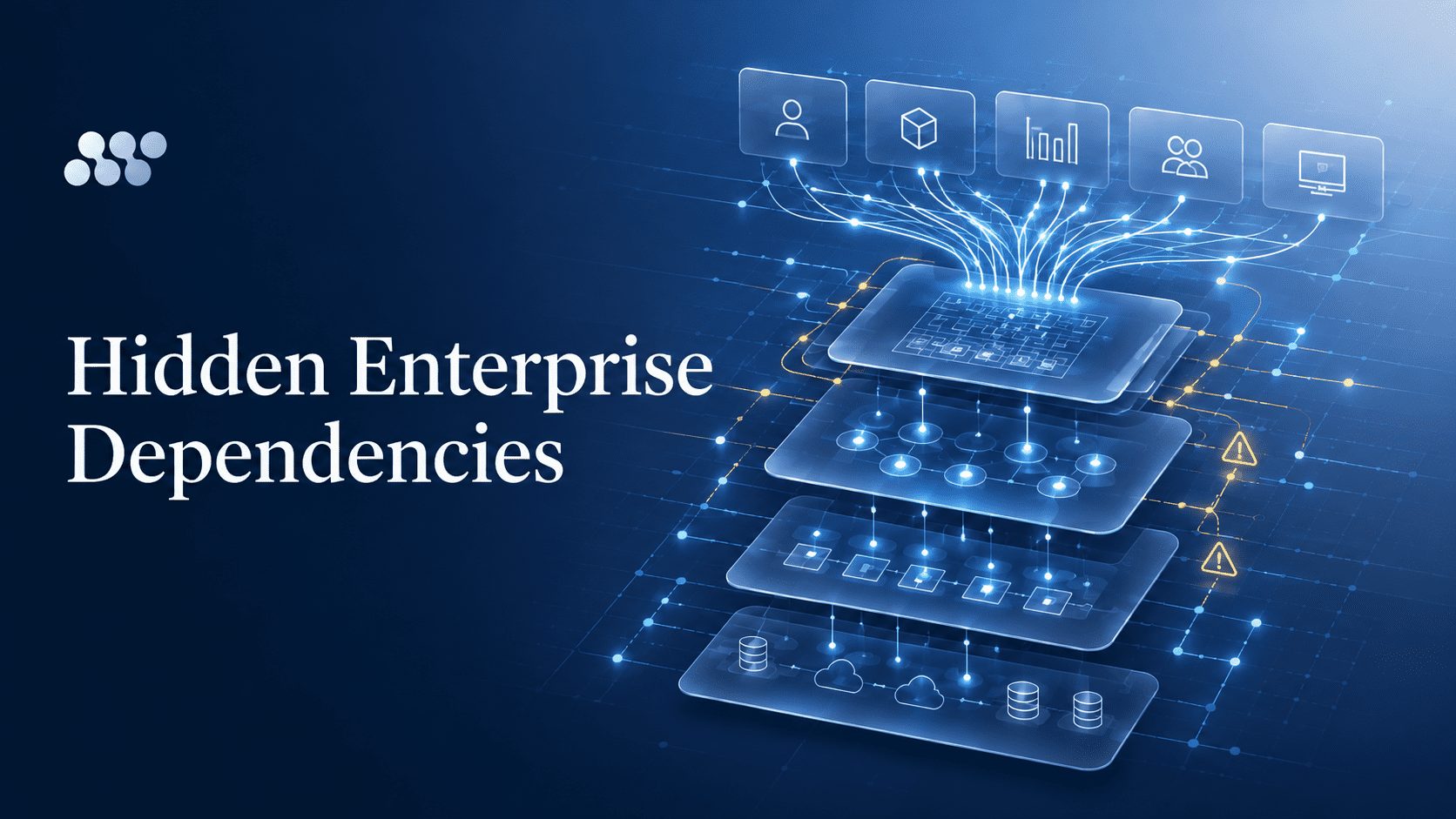
How Independent Digital Initiatives Evolve into Complex Enterprise Dependencies
New digital initiatives are launched continuously across large enterprises.
Sales introduces a new customer management solution. Marketing adopts its own automation platform. Finance develops a reporting tool. HR purchases a new payroll cloud service. Another business unit begins testing an AI-based application. Meanwhile, central IT builds integrations, develops data platforms, modernizes existing systems, and attempts to retire legacy applications and systems.
Considered individually, most of these initiatives are entirely reasonable.
They address specific business needs, promise rapid results, and initially appear to have a clearly defined scope. Enterprise complexity, however, rarely originates within a single development project. It emerges gradually through the relationships created between different initiatives.
A new application begins consuming data from an existing system. Later, another solution is built on the data produced by the new application. A third software development then connects to both. Over time, the same business process may appear in several systems but in slightly different forms. One initiative may modify the data that another process treats as its authoritative source.
Projects that started independently gradually become an interconnected network of systems that build upon and intersect with one another.
The failure of one application may affect much more than its direct users. A change in how data is structured or exchanged can disrupt several interfaces, reports, and automated processes. When the organization attempts to retire a system, it may discover that local workflows, business decisions, and undocumented automations still depend on it.
The challenge is further amplified when successful small-scale developments grow beyond their original purpose.
A temporary application gains an increasing number of users. An experimental report becomes the basis for management decisions. A SaaS tool purchased by one business unit requires implementing new integrations and data connections. An AI prototype gradually becomes embedded in the business’ daily operations.
The solution has actually become something that is business-critical, yet it may still appear in the enterprise application portfolio as a small, local, or experimental development—if it is documented at all.
Decision-Makers Are Not Making Decisions About Isolated Systems
Management and IT decision-makers regularly make decisions about new IT investments, application consolidation, cloud migration, system retirement, and the prioritization of digital initiatives.
These decisions, however, rarely affect only one system.
Behind an application there may be business processes, organizational responsibilities, datasets, integrations, technology components, external providers, and other development initiatives. The true subject of a management decision is therefore not the application itself, but the wider network of relationships in which it operates.
Knowing an application’s name, vendor, or its annual cost, is typically not enough to support a reliable decision.
Organizations must also understand:
- which business capabilities and processes the application supports;
- which data it creates, modifies, or consumes;
- which other applications and initiatives depend on it;
- which external services and technology components it relies on;
- where the same functionality or business logic is implemented in multiple systems;
- which operational, technological, security, or compliance risks it introduces;
- and what the consequences would be if it were modified, unavailable, or retired.
Without this context, an apparently rational decision may create new duplications, hidden dependencies, or unexpected business risks.
Digital Complexity Can Be Observed on a Smaller Scale
This process can also be observed in the development of the Hungarian digital product Poker Academies League, or PAL.
PAL is an online strategy and management game available in five languages. Users build their own poker academies, recruit and develop players, enter competitions, manage resources, and make long-term strategic decisions.
PAL is not a large enterprise, nor is it an enterprise IT system.
During its development, however, the same underlying patterns became visible but on a smaller scale: a sequence of individually logical developments gradually created increasingly complex business and technological dependencies.
A new game feature may involve much more than changing a single screen or a database table. It can affect player availability, a financial settlement, reward mechanisms, scheduled processes, notifications, analytics, and several other parts of the user interface.
The state created by one feature may become an input condition for another process. The same game logic may need to be applied consistently across multiple interfaces. A previous solution may lose its original purpose while part of its data or logic remain connected to newer functionality.
In a smaller digital product, these relationships may still be partly understood through the knowledge of the developers, the source code, or a limited set of documents.
In a large enterprise, however, dozens or hundreds of similar developments may be running simultaneously across different business units, countries, project teams, and external suppliers.
PAL is therefore not presented as an enterprise case study.
It is a small-scale model that makes visible how the same types of problems emerge—problems that can create significant financial, operational, compliance, and strategic risk when multiplied across a large enterprise.
The real management question is therefore not simply how many applications the organization operates.
The more important questions are whether the organization can see:
- how its digital initiatives build upon one another;
- where data flows and business processes intersect;
- which local or experimental solutions have become business-critical;
- where parallel developments are creating unnecessary duplication;
- and how a new investment, modification, or retirement decision would affect the wider enterprise environment.
Small Initiatives Can Create Critical Enterprise Relationships
The relationships between digital initiatives are not always obvious.
A small application may become the source of data used by a management report. That report may influence operational decisions. A separate automation may then use the report’s output to trigger another process.
Each component may appear relatively insignificant when examined in isolation. Together, however, they may form a chain that supports an important business capability.
Critical relationships may exist between:
- applications and business capabilities;
- operational processes and data sources;
- local solutions and central platforms;
- internal systems and external cloud services;
- automated workflows and manually maintained datasets;
- strategic reports and the applications that generate their underlying data;
- current systems and legacy components that have never been fully retired.
These dependencies can also cross organizational boundaries.
A development owned by one business unit may consume data managed by another. A system operated in one country may support processes in several regions. A locally funded tool may gradually become part of an enterprise-wide workflow.
Without a shared architectural view, each team may understand its own part of the environment while no one sees the complete picture.
The Objective Is Not to Prevent Local Innovation
The conclusion should not be that every small development must be stopped or subjected to a lengthy central approval process.
Local initiatives, rapid prototypes, SaaS tools, and AI experiments can all create significant business value. In many cases, their speed and flexibility are precisely what make them successful.
The role of enterprise architecture is not to prevent experimentation.
Its role is to recognize when an experiment begins to evolve into a durable business capability and to make its wider relationships visible before they become unmanageable.
This requires organizations to distinguish between:
- temporary experiments and permanent operational solutions;
- local tools and enterprise dependencies;
- isolated data usage and authoritative data sources;
- replaceable components and business-critical systems;
- intentional architectural decisions and dependencies that emerged accidentally.
The earlier these transitions are recognized, the easier it is to manage security, integration, ownership, lifecycle, cost, and compliance.
From an Application Inventory to Decision-Relevant Architecture Information
An application inventory is a useful starting point, but effective application portfolio management requires significantly more context.
A list can show which applications exist. It may also include their owners, vendors, technologies, or costs.
Management decisions require relationships and context.
The organization must be able to connect applications with:
- business capabilities;
- business processes;
- organizational units;
- data objects and information flows;
- interfaces and integrations;
- infrastructure and technology components;
- lifecycle status;
- strategic initiatives;
- risk assessments;
- and planned transformation activities.
This connected view enables the organization to answer questions that a simple inventory cannot.
For example:
- Which business capabilities depend on an application scheduled for retirement?
- Which systems use a technology that is approaching end of support?
- Where are several applications providing the same business functionality?
- Which local solutions have become critical without receiving appropriate governance?
- Which strategic projects are changing the same processes or data objects?
- Which applications would be affected by a change to a central platform?
- Where could consolidation reduce cost without introducing unacceptable business risk?
These are not documentation questions. They are management questions.
Turning an Assessment into Living Enterprise Knowledge with SAMU
Enterprise architecture information is only valuable if it reflects the environment in which decisions are being made.
New applications are introduced. Projects modify processes and integrations. Contracts expire. Technologies reach the end of their supported lifecycle. Business priorities shift. Systems are modernized, replaced, or retired.
For this reason, architecture information should not remain fragmented across static presentations, spreadsheets, or isolated documents.
SAMU Repository enables organizations to connect business and technology architecture information in a shared and maintainable environment.
It can help make visible:
- the relationship between applications and business capabilities;
- system integrations and data flows;
- technology standards and dependencies;
- application and technology lifecycles;
- organizational ownership and responsibility;
- risks and strategic relevance;
- current-state and target-state architectures;
- and the initiatives responsible for changing the enterprise environment.
- compliance (GDPR, DORA, PCI, etc.)
Enterprise architecture can therefore become more than a periodic documentation exercise.
It becomes a continuously maintained source of knowledge that supports strategic planning, portfolio management, transformation programs, risk management, and operational decision-making.
The Real Question: How Many PAL-Like Initiatives Exist Inside the Enterprise?
PAL is a single digital product.
Inside a large enterprise, dozens or hundreds of comparable initiatives may be developing at the same time.
Some begin as formal programs. Others emerge as local applications, departmental SaaS subscriptions, spreadsheet-based processes, low-code solutions, AI experiments, or custom tools created to solve an immediate operational problem.
Not all of them will become critical.
Those that do, however, should be recognized before the wider organization becomes dependent on them without understanding their ownership, lifecycle, risks, and relationships.
PAL provides a small and easily understandable illustration of how digital complexity develops.
The scale is different in a large enterprise, but the underlying mechanism is similar:
Individually reasonable developments create data, process, application, and technology relationships. Over time, these relationships become a complex enterprise environment that can no longer be managed reliably through fragmented knowledge and isolated documentation.
The challenge is not simply the number of applications.
The challenge is understanding how they support the business, how they depend on one another, which initiatives are becoming critical, and what the consequences of change will be.
SAMU helps organizations make these relationships visible and maintain them as living enterprise knowledge that can support better decisions over time.
Would you like to understand how applications, technologies, data, and business capabilities are connected across your organization? Contact us to learn how SAMU can support a more connected view of your enterprise architecture.

Adam has over 20 years of experience in online marketing and holds a professional qualification in marketing management. Throughout his career, he has worked with well-known digital businesses such as Webshippy, Shoprenter, and Netrisk, building extensive experience in SEO, content marketing, analytics, marketing strategy, and lead generation.
Adam joined Atoll as Online Marketing Manager for SAMU in 2026. His work focuses on strengthening SAMU’s online presence, developing its content and SEO strategy, and turning complex Enterprise Architecture topics into clear, accessible content for an international audience. He also supports SAMU’s long-term marketing strategy with a strong focus on increasing organic visibility and generating new business opportunities.
Outside of work, Adam enjoys spending time with his family, travelling, sports, and poker. He is particularly interested in digital technologies and new ideas, and enjoys combining analytical thinking with creativity and strategy both professionally and in his personal projects.