
We are proud to share an important milestone for SAMU.
SAMU has been included in ERP Management’s 2026 market study covering Enterprise Architecture Management solutions in practice.
For a smaller, independent European software company, being featured in a respected German industry publication is more than a welcome mention. It shows that SAMU is increasingly being recognised as a serious option for organisations looking for a flexible and practical Enterprise Architecture platform.
It also gives us a good reason to pause for a moment, look at how the EAM market is changing, and explain where SAMU fits into that change.
Not just another software directory
There are plenty of online software lists where almost any vendor can appear.
This ERP Management publication is different.
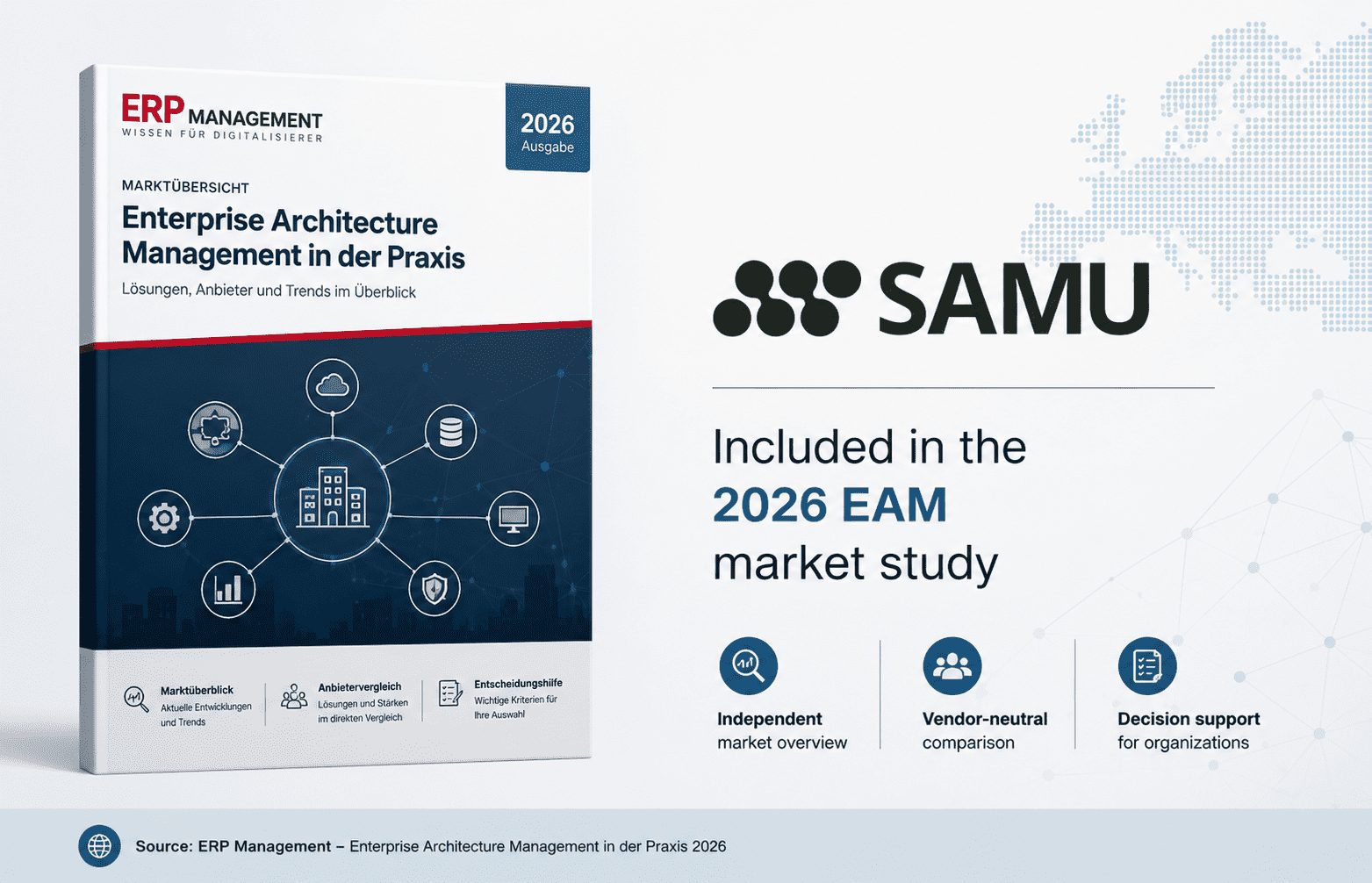
The study is presented as a vendor-independent market overview. It is designed to help companies understand the available EAM solutions, compare their capabilities and create a more informed shortlist.
The providers are evaluated using consistent criteria, and ERP Management clearly states that vendors cannot pay for a better position or a more favourable evaluation.
That is what makes the inclusion meaningful.
It does not mean that SAMU has been declared the best Enterprise Architecture platform for every organisation. No serious market study could make such a universal claim.
Different companies have different requirements. A global corporation may look for a highly standardised suite. Another organisation may need a more adaptable solution, a specific hosting model or a fully configurable data structure.
The value of a good market study is not that it names one winner. Its value is that it makes the differences between the available solutions easier to understand.
Organisations evaluating Enterprise Architecture tools should compare not only functionality, but also flexibility, integration, usability and long-term vendor support.
SAMU is now part of that comparison.
For us, that is something worth celebrating.
Enterprise Architecture is becoming a business priority
The timing of the study is also important.
Enterprise Architecture has changed considerably over the past few years. It is no longer seen only as a specialist discipline focused on technical diagrams, standards and documentation.
Today, companies use Enterprise Architecture Management to support much broader decisions.
They need to understand:
- which business processes depend on critical applications;
- where outdated technologies and unmanaged technology lifecycles create operational risks;
- which systems overlap and generate unnecessary costs;
- how planned projects affect existing applications and interfaces;
- where transformation programmes may conflict with each other;
- how business, technology, data and security decisions are connected.
These are not questions for architects alone.
They affect CIOs, transformation leaders, IT managers, security teams, finance departments and business executives.
Enterprise Architecture is becoming a shared source of information for the entire organisation.
This is especially important as IT environments become more complex. Companies are managing cloud services, legacy systems, SaaS applications, custom developments, external providers and growing numbers of integrations at the same time.
Without a clear overview, even a small change can have unexpected consequences.
Clear visibility into application dependencies helps teams identify these connections before a planned change causes disruption.
A system may look unimportant until someone discovers that five business processes, three interfaces and a regulatory report depend on it.
That is exactly the kind of surprise Enterprise Architecture Management should help prevent.
From static diagrams to living architecture information
The EAM market is also moving away from static modelling.
Traditional Enterprise Architecture projects often started with workshops, spreadsheets and diagrams. The organisation collected a large amount of information, created an impressive repository and produced a set of architecture views.
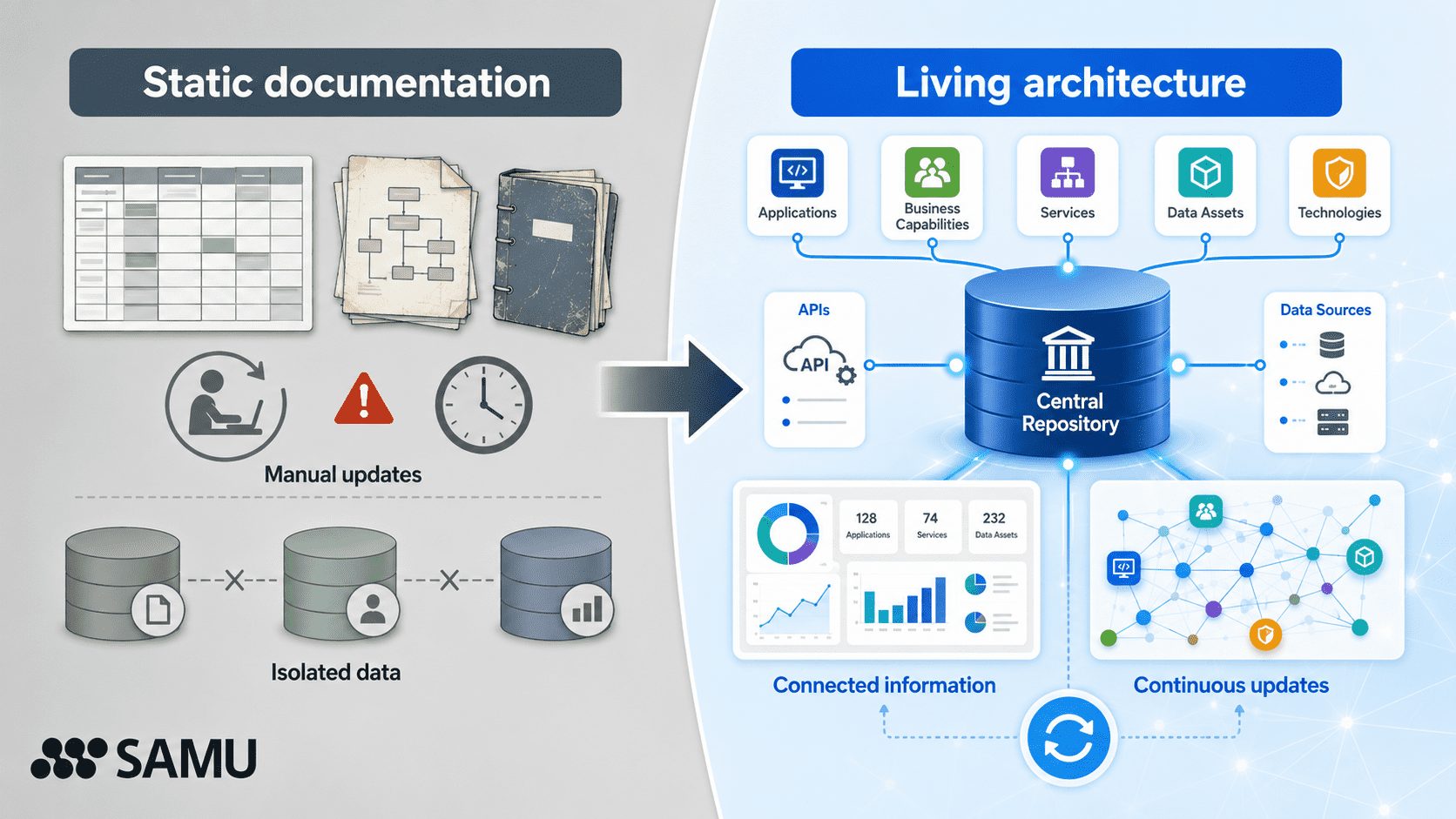
The difficult part came later.
Applications changed. New integrations were introduced. Ownership was transferred. Technologies reached the end of support. Projects created new dependencies.
The architecture documentation quickly started to lose its accuracy.
This is one of the biggest challenges in Enterprise Architecture Management. A repository only creates value when people trust the information stored in it.
An outdated architecture model may look professional, but it cannot support reliable decisions.
Organisations increasingly need to move beyond static documentation and maintain architecture information as a living, shared source of truth.
Modern EAM platforms therefore need to do more than create diagrams. They need to work as living information systems.
That requires:
- structured and connected data;
- flexible data models;
- APIs and integrations;
- automated imports;
- clear ownership;
- practical dashboards and visualisations;
- processes for keeping information up to date.
- data quality maintenance and governance
This shift is strongly reflected in the current market discussion.
Organisations are not simply looking for a place to document their architecture. They are looking for a platform that helps them understand continuous change.
Where SAMU fits into the market
A related Enterprise Architecture tool comparison by the University of Potsdam provides a useful overview of SAMU’s position.
The material highlights several areas that have always been central to our product:
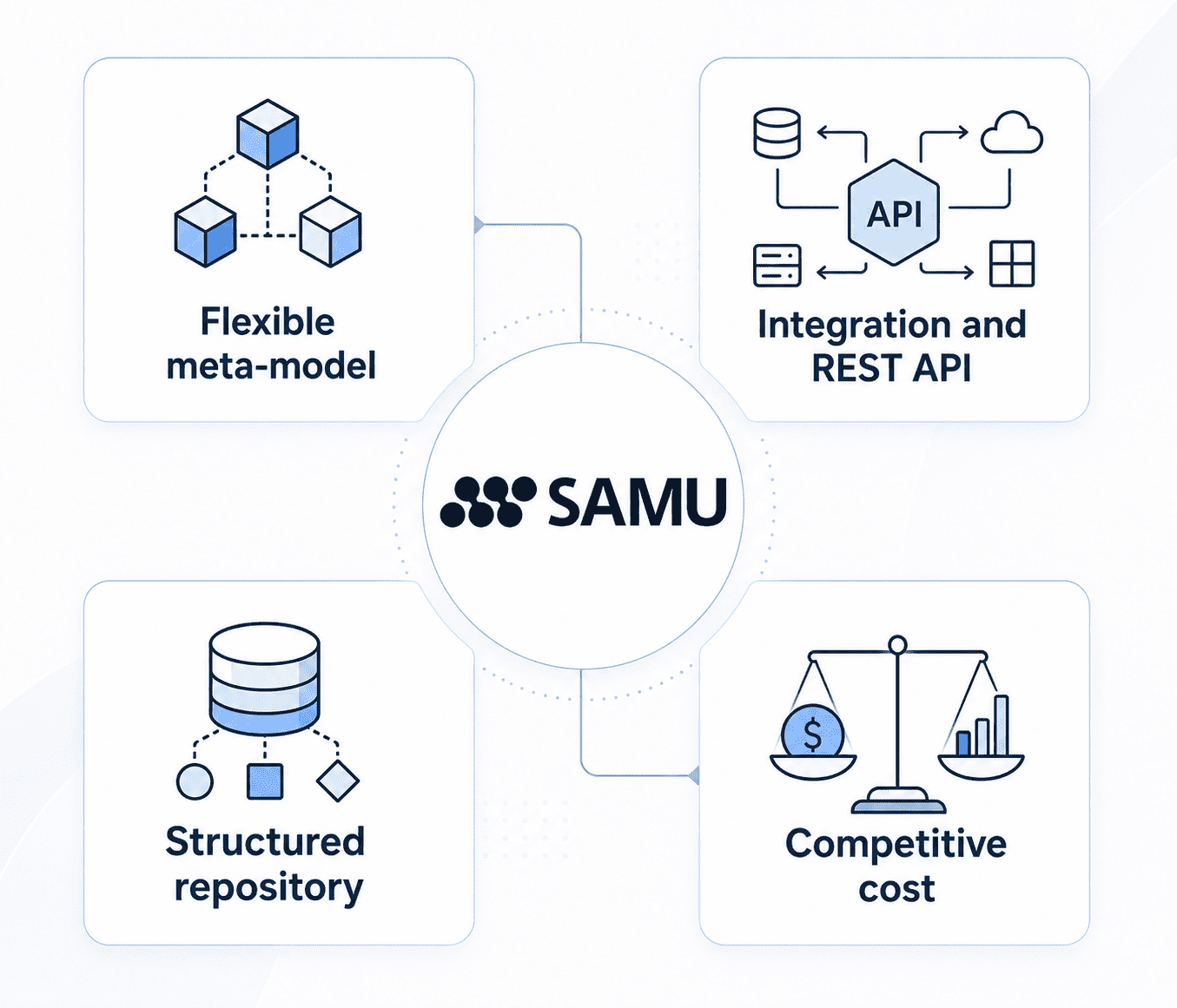
- a strong focus on meta-models and relationships between objects;
- integration with enterprise data platforms;
- a structured architecture repository;
- REST API capabilities;
- a generally more competitive price level than the largest EAM suites.
These points describe the role SAMU is designed to play.
It is a flexible Enterprise Architecture platform for organisations that want structure without being forced into a rigid, predefined model.
A flexible meta-model
Every organisation describes its architecture differently.
Some companies organise their information around business capabilities. Others focus on applications, services, processes, technologies, projects, data objects or organisational units.
Even companies in the same industry may use different terminology and decision-making structures.
This is why flexibility matters.
A rigid EAM model may be easy to demonstrate, but it can become a problem when the organisation needs to represent its own way of working.
SAMU allows companies to configure the meta-model according to their own needs.
They can define the objects, attributes and relationships that are relevant to their architecture.
This does not mean that everything has to be created from scratch. SAMU can provide structure and proven starting points. But the organisation is not locked into a fixed interpretation of Enterprise Architecture.
The platform adapts to the company, rather than forcing the company to adapt to the platform.
Integration is essential
Architecture information rarely exists in one system.
Application data may come from a CMDB. Ownership information may be stored in an identity system. Project data may come from a project management platform. Technology information may be available in cloud services, security tools or asset-management systems.
And, of course, some information may still live in spreadsheets.
An EAM platform needs to connect these sources.
A well-managed integration architecture makes it easier to understand how applications, interfaces, APIs and data sources work together.
Without integrations, architecture teams spend too much time asking people for updates, importing files and manually correcting data.
This is why SAMU includes REST API capabilities for data import, export, queries and standard data operations.
Integrations help reduce manual maintenance and improve the quality of the repository.
They also make it possible to build a continuously accurate Enterprise Architecture repository instead of performing a major manual update only once or twice a year.
The repository should support decisions
Enterprise Architecture should not produce documentation for its own sake.
The information needs to help people answer practical questions.
For example:
- Which applications support a specific business capability?
- What would be affected if a system were replaced?
- Where are several applications providing the same functionality? These insights provide the foundation for structured application rationalization and portfolio optimisation.
- Which technologies are approaching the end of their supported lifecycle?
- Which projects are changing the same part of the architecture?
- Where are operational or compliance risks concentrated?
SAMU uses structured data and relationships to answer these questions.
Visualisations are generated from the underlying repository information. This means that different users can see the same architecture from different perspectives.
An enterprise architect may need a detailed dependency map.
A CIO may prefer a summary of technology risk.
A business leader may want to see which applications support a critical capability.
The information is the same, but the view should match the decision.
This is one of the main principles behind SAMU.
The goal is not to create more diagrams.
The goal is to make complexity easier to understand.
Enterprise capability without unnecessary complexity
Another important point in the independent comparison is the price positioning of SAMU.
Large EAM suites can offer broad functionality, but they may also bring considerable licensing costs, implementation effort and organisational complexity.
For some companies, that level of investment is justified.
For others, it can make the business case for Enterprise Architecture unnecessarily difficult.
SAMU aims to provide enterprise-level architecture capabilities without requiring the largest possible budget or the longest possible implementation project.
A platform should create value by helping an organisation manage complexity. It should not become another source of complexity itself.
This does not mean that EAM can be implemented without effort. Architecture information still needs ownership, governance and clear business objectives.
But the technology should support that work instead of slowing it down.
Recognition, not a victory claim
We are genuinely pleased to be included in the ERP Management market study.
At the same time, we want to communicate this milestone accurately.
We are not claiming that ERP Management selected SAMU as the single best EAM platform. We are not claiming that one tool is suitable for every organisation.
What we can proudly say is that SAMU has been included in an independent German market study alongside other recognised Enterprise Architecture Management providers.
That matters.
It shows that SAMU is part of the professional EAM landscape and deserves to be considered by organisations evaluating their options.
It also confirms that the areas we have focused on—flexibility, integration, structured architecture information and practical decision support—are becoming increasingly important across the market.
Part of a longer professional journey
The latest ERP Management appearance is not an isolated milestone. SAMU has been part of the international Enterprise Architecture conversation for more than fifteen years.
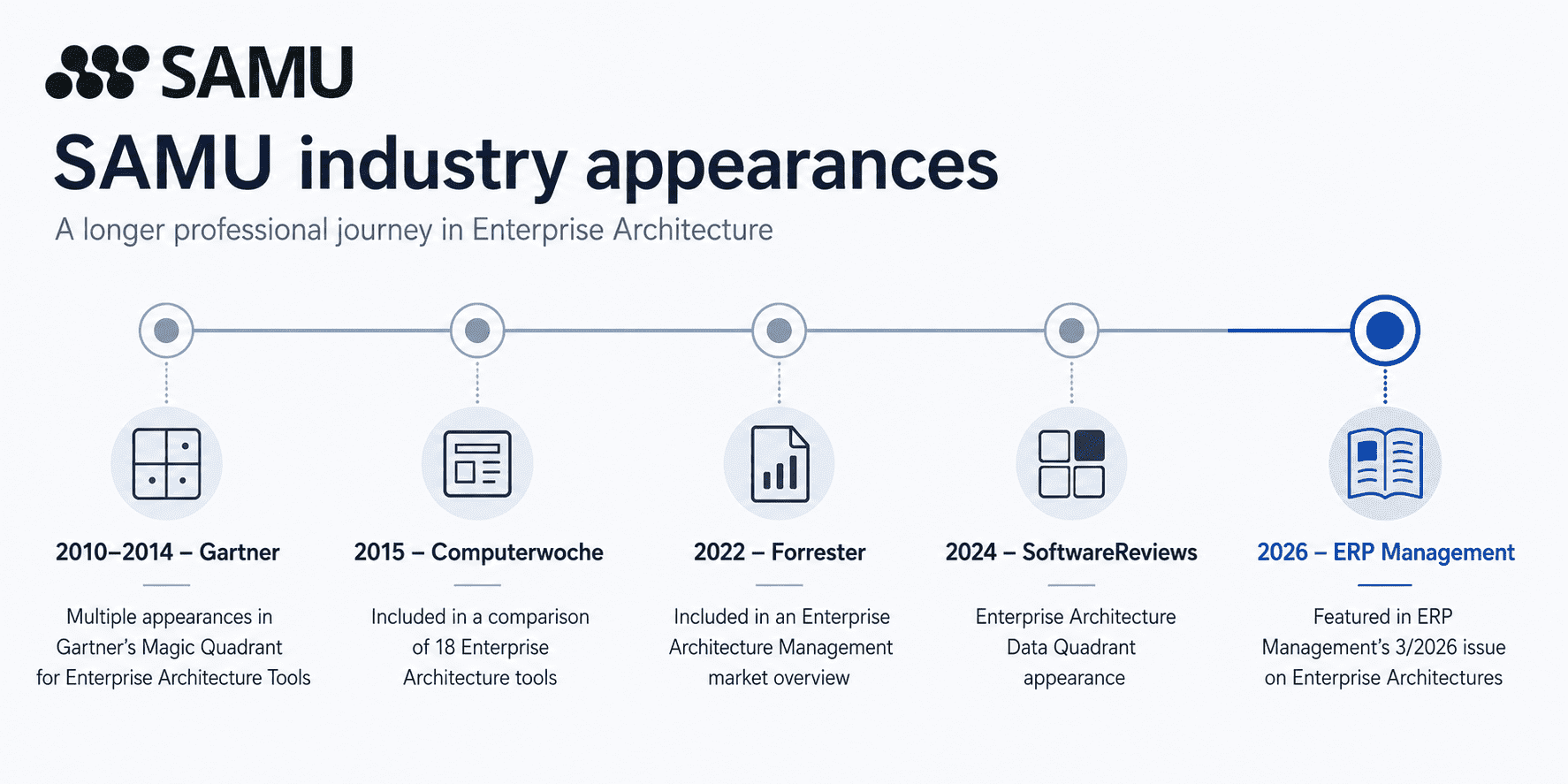
Atoll and SAMU first appeared in Gartner’s Magic Quadrant for Enterprise Architecture Tools in 2010. Atoll’s company archive records a second inclusion in 2011, another appearance in the 2012 analysis, and describes the company’s 2014 inclusion as its fourth.
SAMU was later included in a Computerwoche comparison of 18 Enterprise Architecture tools in 2015, the Forrester overview of Enterprise Architecture Management Suites in 2022, and the SoftwareReviews Enterprise Architecture Data Quadrant in 2024.
Today, this longer analyst history is complemented by direct customer feedback. As of July 2026, SAMU has a rating of 4.9 out of 5 based on 35 ratings on Gartner Peer Insights.
These appearances cover different periods, evaluation methods and perspectives. Together, however, they show something important: SAMU has remained part of the professional EAM landscape while both the product and the market have continued to evolve.
The latest inclusion in ERP Management’s 3/2026 issue adds a new chapter to that story.
A proud moment for SAMU
Enterprise Architecture is rarely the loudest part of the software industry.
It usually works in the background, helping organisations avoid expensive mistakes, understand dependencies and make better decisions.
That is exactly why this recognition means so much to us.
SAMU has been included in ERP Management’s 2026 Enterprise Architecture Management market study.
We are proud to see our platform represented in this professional overview, and we are pleased that the wider market is placing greater emphasis on the same principles that have always guided SAMU:
flexibility, connected information, integration and practical decision support.
We will take a moment to celebrate this milestone.
Then we will continue doing what Enterprise Architecture teams do best: making complex organisations a little easier to understand.
Sources
- ERP Management: Enterprise Architecture Management in der Praxis
- ERP Management 3/2026: Unternehmensarchitekturen
- University of Potsdam: EAM Tools im Vergleich
- Computerwoche: 18 EA-Tools im Vergleich
See how SAMU supports modern Enterprise Architecture Management
Explore how SAMU can help your organisation create a flexible, connected and continuously updated view of its Enterprise Architecture.
Start your free SAMU trial

Oliver holds a degree in Economics from the University of California, Berkeley, and was raised in the United States. With over 25 years of extensive experience in sales, business development, and account management, he has specialized in managing enterprise accounts within the Information and Communications Technology (ICT) sector.
For more than eight years, Oliver has been a key contributor at Atoll, where he has played a pivotal role in expanding SAMU’s customer base. Currently, he is focused on growing SAMU’s international presence, with a strategic emphasis on the North American market.
Outside of his professional life, Oliver is a dedicated family man, proud father to a son and daughter. He is passionate about sports, avidly following all major US sports leagues, and actively competes in golf and basketball. His competitive spirit and team-oriented mindset extend beyond the office, reflecting his dynamic approach both professionally and personally.